
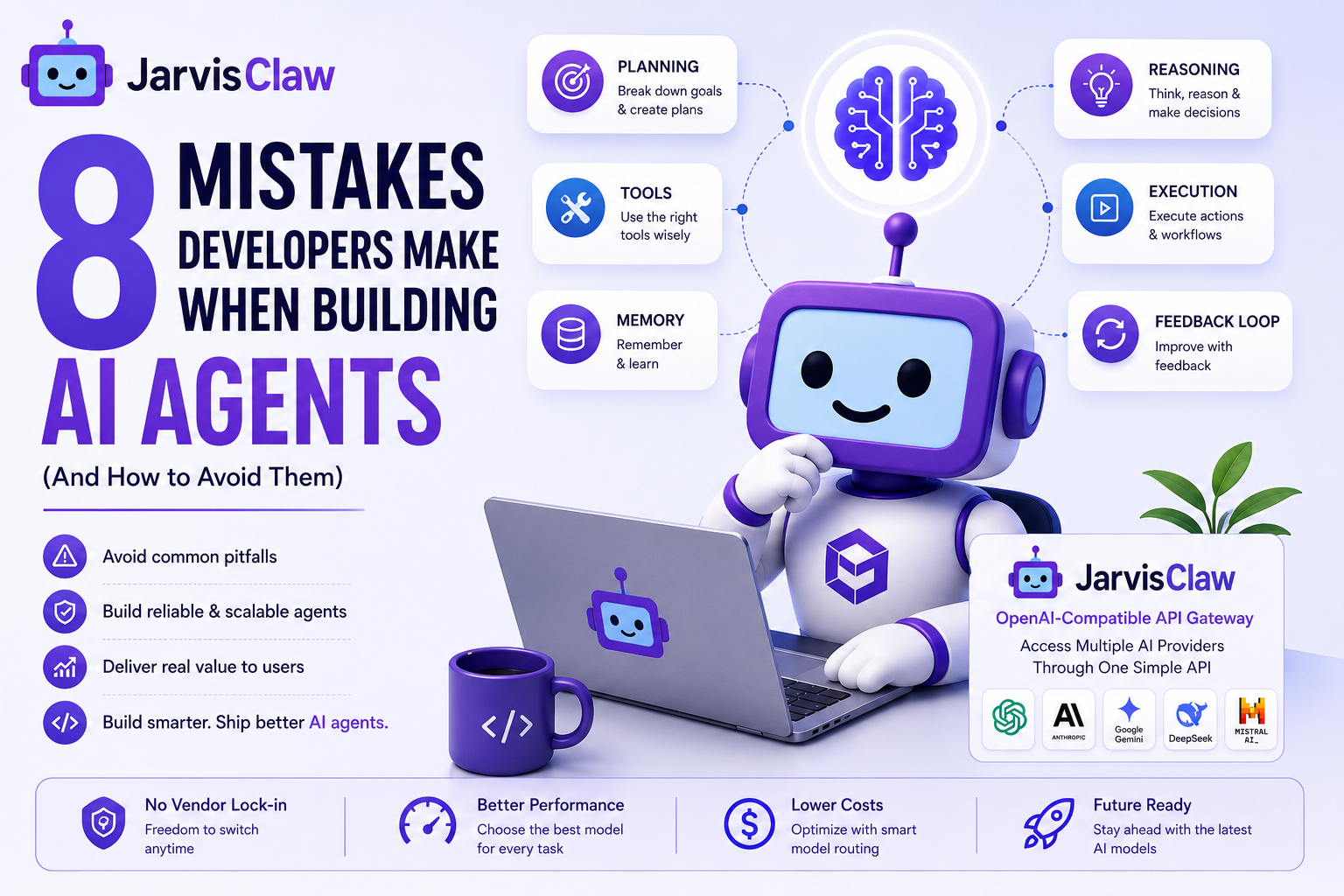
Artificial intelligence has evolved far beyond simple chatbots. Today’s AI agents can reason through problems, use external tools, retrieve information, write code, automate workflows, and make decisions with minimal human intervention. From customer support assistants and coding copilots to autonomous business automation systems, AI agents are becoming a core part of modern software development.However, building an effective AI agent isn’t as simple as connecting a large language model (LLM) to a chat interface. Many promising projects fail because developers overlook key architectural decisions that impact reliability, scalability, security, and long-term maintainability.The good news? Most of these pitfalls are avoidable.In this article, we’ll explore ten of the most common mistakes developers make when building AI agents and share practical strategies to help you build more reliable, intelligent, and production-ready AI applications.

1. Treating an AI Agent Like a Simple Chatbot
One of the most common mistakes is assuming an AI agent is simply a chatbot with better prompts.A chatbot typically waits for user input and generates a response. An AI agent goes much further. It can break down tasks, create plans, decide which tools to use, remember previous interactions, retrieve knowledge from external systems, and execute multi-step workflows to accomplish a goal.
Instead, think of your AI agent as a system made up of multiple components:
- Reasoning
- planning
- memory
- Tool execution
- Feedback loops

Designing these layers separately makes your application easier to maintain and significantly improves performance over time
2. Locking Yourself to a Single AI Provider
Not every AI model is good at every task.Some models excel at coding, others perform better at reasoning, document analysis, or multilingual conversations.
Pricing, speed, availability, and context window sizes also vary between providers.Building your application around a single provider creates unnecessary vendor lock-in. If pricing changes, outages occur, or a better model becomes available, migrating your application can become a costly engineering project.
Many development teams now prefer an OpenAI-compatible architecture, allowing them to switch providers without rewriting their application.This is where JarvisClaw adds real value.
Instead of integrating multiple AI providers individually, JarvisClaw provides a single OpenAI-compatible API that connects your application to multiple leading AI models through one endpoint. Developers gain the flexibility to experiment with different models, improve uptime, and optimize costs—all without changing their application’s core logic.Building with flexibility from day one prepares your AI agent for the rapidly evolving AI ecosystem.
3. Ignoring Prompt Version Control
Many developers spend hours refining prompts but store them directly inside application code.Over time, prompts are modified repeatedly without documentation, making it impossible to identify which version performs best.Treat prompts like software.Use version control, document changes, test prompt performance, and monitor improvements over time. Prompt engineering should follow the same development practices as the rest of your codebase.A well-managed prompt library makes debugging significantly easier as your AI application grows.
4. Forgetting Memory Management
Without memory, every conversation starts from scratch.Users become frustrated when an AI agent repeatedly asks for information it already received or forgets preferences halfway through a workflow.
Different applications require different types of memory:
- short term conversation memory
- session memory
- long term user preference
- External Databases
Choosing the appropriate memory architecture dramatically improves user experience and makes AI agents feel significantly more intelligent.
5. Giving the Agent Too Many Tools
It may seem logical to equip an AI agent with dozens of tools, but more isn’t always better.Every additional tool increases the complexity of the agent’s decision-making process.
Too many options can lead to incorrect tool selection, slower execution, higher costs, and more hallucinations.Instead, provide only the tools necessary for each workflow.
Smaller, specialized toolsets generally produce more reliable and predictable AI agents.
6. Ignoring Error Handling
Unlike traditional software, AI systems fail in unpredictable ways.Common failures include:

- Hallucinated function calls
- Invalid JSON output
- API timeouts
- Network interruptions
- Context window limits
- Rate limiting
- Unexpected reasoning errors
7. Building Without Observability
If you can’t measure your AI system, you can’t improve it
Monitor metrics such as:
- Token usage
- Cost per request
- Latency
- Model selection
- Tool success rate
- Error frequency
- User satisfaction
These insights help identify performance bottlenecks before they become major production issues.
Observability should be built into your AI architecture from the beginning—not added later.
8. Neglecting Security
AI agents often have access to APIs, internal documents, databases, and sensitive business data.
Without proper safeguards, they may expose confidential information or perform unintended actions.
Essential security practices include:
Permission-based tool access
API authentication
Input validation
Output filtering
Audit logs
Rate limiting
Role-based permissions
Security is not an optional feature—it’s a fundamental part of production AI systems.
Building Better AI Agents with JarvisClaw
Building a successful AI agent requires more than choosing the latest language model.
It demands thoughtful architecture, effective memory management, reliable tool execution, observability, strong security, and the flexibility to adapt as AI technology evolves.As new models are released at an unprecedented pace, maintaining separate integrations for every AI provider can quickly become complex and time-consuming.
JarvisClaw simplifies this challenge by providing an OpenAI-compatible gateway that connects your application to multiple leading AI providers through a single API. Instead of rewriting your backend whenever you want to try a new model, you can switch providers with minimal changes to your existing code.Whether you’re building AI assistants, coding agents, research tools, enterprise automation systems, or customer support platforms, JarvisClaw gives developers the flexibility to optimize for performance, cost, and reliability without vendor lock-in.
By handling the complexity of multi-provider AI integrations, JarvisClaw allows development teams to spend less time managing infrastructure and more time building intelligent AI experiences that users love.Start building with JarvisClaw today.