
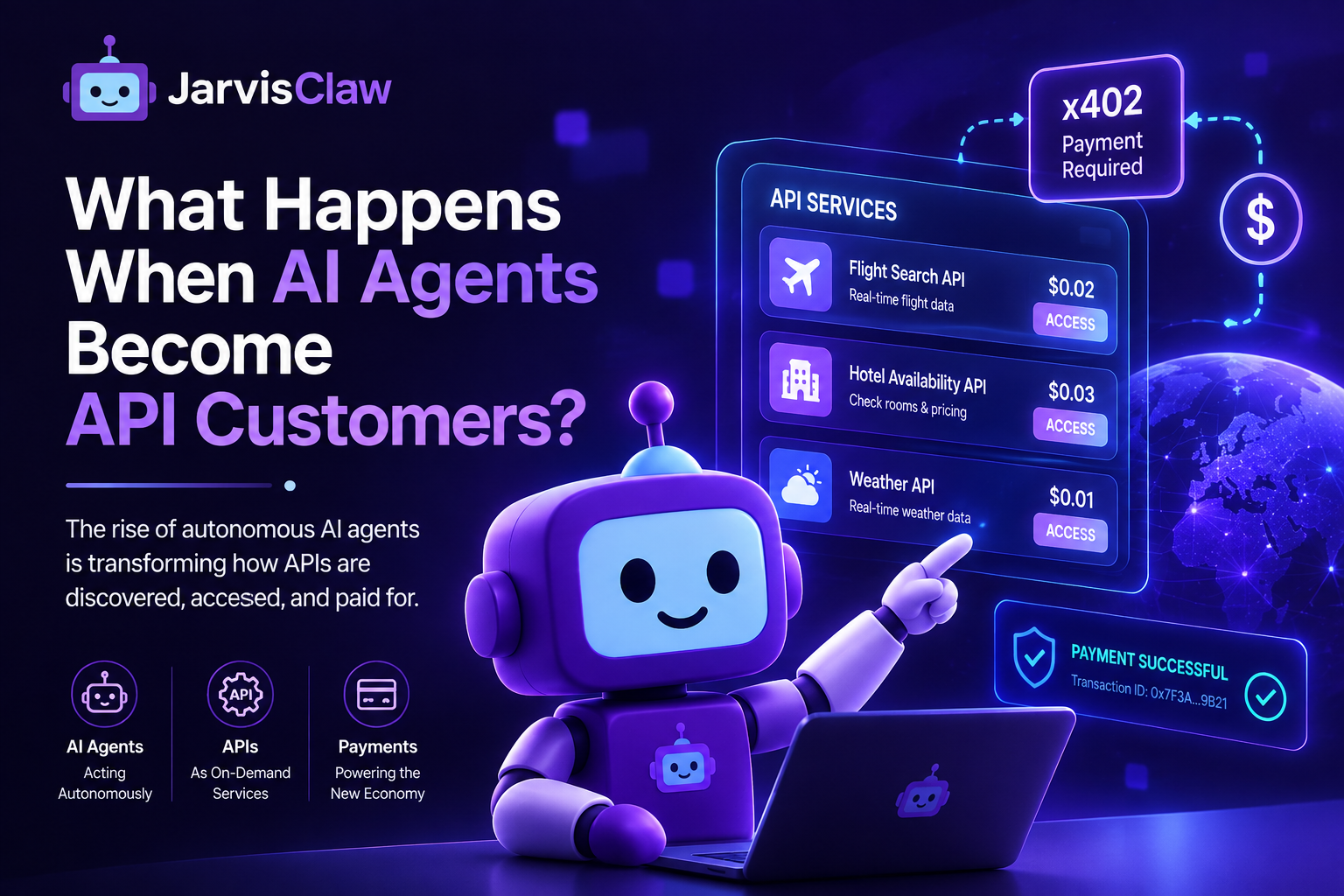
For years, APIs were designed around a simple assumption: a human developer would use them to build software for other humans.
A developer reads documentation, creates an account, generates an API key, chooses a pricing plan, writes code, and sends requests to an endpoint.But the internet is entering a different phase.
AI Agents are becoming active software consumers.
Instead of simply answering questions, AI agents can plan tasks, call tools, interact with APIs, retrieve information, make decisions, and increasingly complete multi-step workflows with limited human intervention.
OpenAI describes this shift as a move from short chatbot interactions toward delegated, long-horizon tasks where agents orchestrate tool calls and work toward goals.
That raises an important question:
What happens when AI agents become API customers?
The answer could reshape the API economy, AI infrastructure, and the way software services are bought and consumed.
AI Agents Are Different From Traditional API Consumers

A traditional API customer is usually a developer or application.An AI agent is different.An agent may decide dynamically which API it needs, how many times to call it, which provider offers the best result, and whether the information is worth paying for.For example, imagine an AI travel agent helping someone plan a trip.
It might need to:
- Search flight data.
- Check hotel availability.
- Compare prices.
- Retrieve weather information.
- Calculate transportation costs.
- Make a booking.
Instead of having every capability hard-coded into one application, the agent can interact with multiple APIs as tools.This creates a new category of software consumer:the autonomous API customer.Industry discussions are increasingly describing this as a transformation of the API economy because traditional APIs were largely designed around developers intentionally constructing requests and workflows.
Instead of having every capability hard-coded into one application, the agent can interact with multiple APIs as tools.
This creates a new category of software consumer:
the autonomous API customer.Industry discussions are increasingly describing this as a transformation of the API economy because traditional APIs were largely designed around developers intentionally constructing requests and workflows.
The API Key Problem
There is an obvious problem.Most APIs were not designed for autonomous software.
A human can visit a website, create an account, enter billing information, accept terms, generate an API key, and configure an application.An AI agent cannot easily perform that entire process safely every time it discovers a new service.
This creates friction.
An agent may discover the perfect API for a task but still need:
- An account
- An API key
- A subscription
- A payment method
- Authentication credentials
- Manual approval
The intelligence may be autonomous, but the transaction layer is still human-dependent.
That is one reason machine-to-machine payments are becoming increasingly important.
From API Calls to API Transactions
The next evolution isn’t simply about AI agents making more API calls.It is about agents being able to discover, evaluate, purchase, and use digital services programmatically.
This is where protocols such as x402 become interesting.x402 uses the HTTP 402 Payment Required status code to allow an API or digital service to request payment directly through an HTTP interaction.
The protocol is designed to support machine-to-machine payments, including AI agents accessing paid APIs without traditional account and credential workflows.
A simplified flow looks like this:Agent → API request → 402 Payment Required → Payment → API access → Result.
The agent doesn’t necessarily need to create an account or negotiate a subscription first.Instead, payment can become part of the request itself.
That changes the relationship between an AI agent and an API provider.The API isn’t simply a tool anymore.
It becomes a service the agent can purchase when it needs it.
Why This Matters for AI Agent Development
Consider an AI research agent.
The agent may need access to a premium search API for one particular question.
Under a traditional model, the developer might need to maintain an account, API credentials, subscription, and billing relationship.With programmatic payments, the agent could potentially discover the service, determine the price, evaluate whether the service is useful, authorize a payment, and retrieve the result.This creates a more flexible agentic workflow.
The agent can make decisions based not only on technical capabilities but also on:
- Price
- Latency
- Quality
- Availability
- Reliability
- Usage limits
In other words, APIs can become dynamic resources inside an agent’s decision-making process.
The Rise of the Agentic API Economy
This could create an entirely new API economy.
Today, API monetization often revolves around subscriptions, API keys, usage tiers, and monthly plans.
The agentic economy introduces another possibility:pay-per-use services consumed directly by software.
An AI agent could pay a few cents for a specialized data request, use a particular model for a difficult task, pay for image processing, purchase a location lookup, or access premium information only when required.x402 explicitly supports pay-per-request API services and autonomous AI agents, making this model increasingly practical.
The x402 ecosystem itself reports substantial recent transaction activity, showing that machine-oriented payment infrastructure is moving beyond a purely theoretical concept.
What AI Infrastructure Needs to Change
If AI agents become major API customers, simply adding more APIs won’t be enough.Developers will need infrastructure capable of handling agentic API consumption.That means solving problems such as:
API discovery
How does an agent find the right service for a particular task?
Intelligent routing
How does it choose between multiple models or API providers?
Cost management
How does an agent determine whether an API call is worth the price?
Reliability
What happens when an API fails, times out, or returns a poor result?
Authentication and payments
How can an autonomous system access paid services without exposing sensitive credentials?
Observability
How can developers understand what their agents are doing and how much each task costs?
These challenges are becoming increasingly important as AI agents move from prototypes into real-world workflows.
Google Cloud’s 2026 AI Agent Trends report similarly highlights the growing role of agents in automating complex workflows and business processes.
Where JarvisClaw Fits
This is the problem space JarvisClaw is built around.
The future of AI isn’t just about having access to a powerful LLM.
Agents need infrastructure.
They need a way to interact with models and APIs efficiently, choose the right capabilities, manage costs, and eventually participate in machine-to-machine transactions.
JarvisClaw can serve as part of that infrastructure layer by giving developers a simpler way to build applications that interact with multiple AI capabilities through an API-driven architecture.
The bigger opportunity is not simply making another AI API.It is helping developers build systems where AI agents can actually operate in an API economy.
The Future: Agents as Digital Customers
The most important shift may be philosophical.We traditionally think of customers as people.But autonomous AI agents can increasingly act on behalf of people and organizations.
They can search, compare, decide, execute, and potentially pay.That means the next generation of APIs may need to be designed not just for developers, but for machines making decisions.
The question will no longer be:”How does a developer call my API?”It may become:”
How does an AI agent discover, evaluate, pay for, and use my service?”That is a much bigger opportunity.
The transition from human-to-API to agent-to-API could become one of the defining changes in the software economy.
And as AI agents become more autonomous, the APIs that serve them will need to become more intelligent, programmable, discoverable, reliable, and payment-aware.
The API customer of the future may not be a developer sitting behind a keyboard.It may be an AI agent acting on their behalf.
Start Building with JarvisClaw today!