
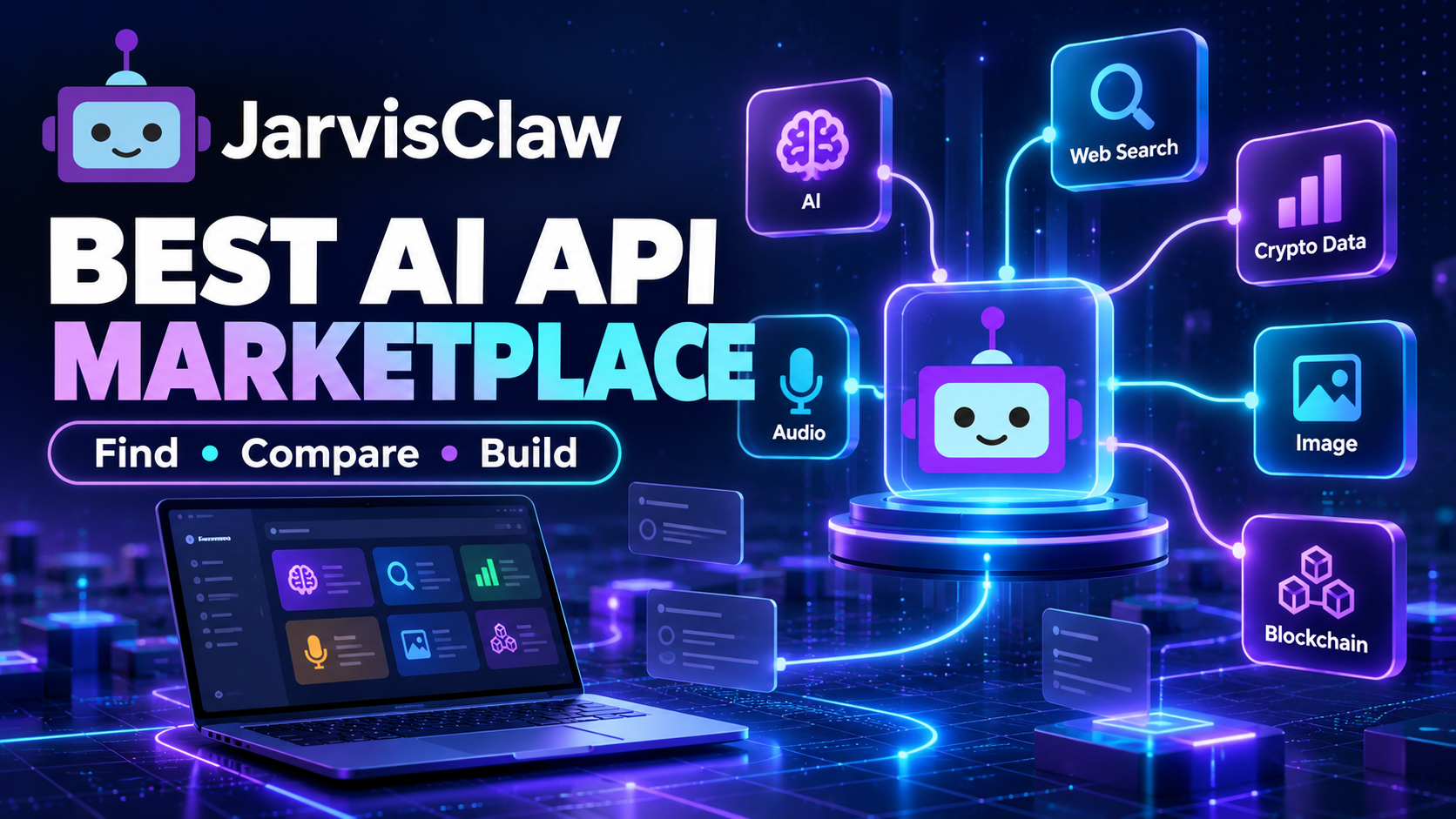
Building an AI product rarely stops at choosing a language model.
A useful application may also need web search, speech transcription, image generation, blockchain data, market prices, code execution, document processing, or real-time prediction-market data. Each new capability normally introduces another provider, account, API key, billing system, SDK, and response format.
The real bottleneck is no longer finding an API. It is deciding which API fits the task, understanding what it will cost, and integrating it without turning the product into a collection of fragile connectors.
An AI API marketplace solves that problem by bringing discoverable, priced, and callable services into one developer workflow.
JarvisClaw gives developers and AI agents access to thousands of marketplace APIs across AI creation, data, blockchain, search, media, finance, and automation. Instead of integrating each provider independently, teams can find an endpoint by capability, review its price and method, and call it through a consistent platform.
What Makes an AI API Marketplace Useful?
A long directory of links is not an API marketplace.
A useful marketplace must help a developer answer five questions before writing production code:
- Does this API perform the exact task I need?
- What method and parameters does it require?
- How much does one request cost?
- Can I test it without buying a monthly subscription?
- Can my application or AI agent call it programmatically?
JarvisClaw organizes APIs around capabilities rather than forcing users to begin with a provider name. A developer can search for an outcome such as “transcribe audio,” “retrieve token prices,” “generate video,” or “search prediction markets.”
Marketplace entries expose concrete endpoints and pricing where available. This matters because an AI agent should be able to compare services before it spends money—not discover the cost after completing the request.
Find the API by Task, Not by Brand
The fastest way to choose an API is to start with the job that must be completed.
For example, suppose you are building a crypto research agent. The workflow may require:
- Retrieving current token and market data.
- Checking wallets, projects, or on-chain activity.
- Searching news and public sources.
- Comparing prediction-market prices.
- Summarizing the findings with an AI model.
A traditional implementation may require four or five external vendors. With an API marketplace, the developer can search for each required capability inside one catalogue.
JarvisClaw includes services for areas such as:
- AI image, audio, music, and video generation
- Speech synthesis, transcription, and translation
- Web and knowledge search
- Crypto and DeFi intelligence
- Prediction-market data
- DEX routing and blockchain RPC
- Market prices and financial data
- Secure code execution
- Phone and conversational voice workflows
This task-first approach prevents a common mistake: selecting a popular provider before confirming that its endpoint, geographic coverage, response fields, and update frequency actually match the product.
Compare More Than the Headline Price
The cheapest request is not always the cheapest integration.
An API priced slightly lower per call may become more expensive if it returns incomplete data, has inconsistent schemas, requires additional enrichment, or fails often enough to trigger repeated requests.
Before choosing an API, compare:
- Required input: Does it accept the identifiers and formats already used by your application?
- Response structure: Can the result be consumed without extensive transformation?
- Data freshness: Is the information suitable for real-time workflows or only historical analysis?
- Coverage: Does it support the assets, countries, networks, languages, or platforms you need?
- Price per successful workflow: Include retries and secondary enrichment calls.
- Latency: A low-cost endpoint may still be unsuitable for an interactive product.
- Failure behavior: Check error formats, rate limits, and timeout handling.
- Payment model: Decide whether prepaid platform access or pay-per-call execution fits the workload.
The hidden cost of an API is usually not its listed price. It is the engineering time spent normalizing results, rotating credentials, investigating billing, and replacing the provider later.
A Practical Find-to-Build Workflow
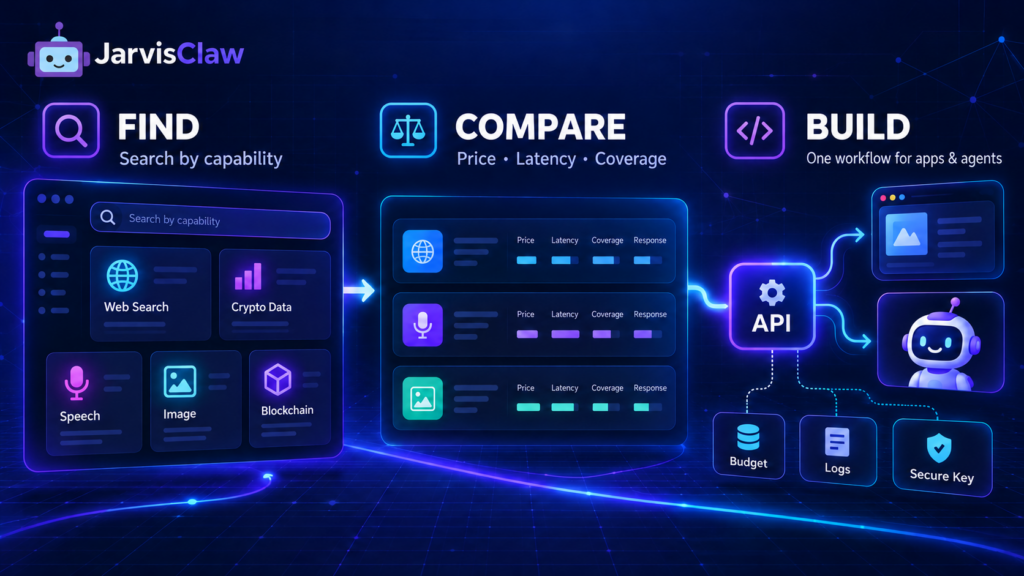
A marketplace becomes valuable when discovery leads directly to implementation.
Use the following workflow when evaluating a JarvisClaw API.
1. Define the Output First
Write down the exact result your product needs.
“Crypto data” is too broad. A better requirement is:
Return the current USD price, 24-hour volume, market capitalization, and timestamp for a supplied token identifier.
This makes it easier to reject endpoints that do not return the required fields.
2. Search by Capability
Visit the JarvisClaw API Marketplace and search using the task, object, or output format.
Useful searches may include:
- wallet activity
- token price
- audio transcription
- image editing
- prediction-market odds
- web search with citations
- document classification
- code execution
Do not search only for provider names. Capability-based searches can surface services that are less familiar but better suited to the use case.
3. Inspect the Endpoint Before Calling It
Review the method, endpoint path, description, expected inputs, price, and example request.
Confirm that the API produces structured data your application can validate. If the response depends heavily on unstructured text, define a schema or validation layer before sending it deeper into an automated workflow.
4. Test With a Realistic Input
A simple “hello world” request proves connectivity but not product fit.
Use a representative input from your actual workload. For an audio API, test realistic duration, noise, and language. For a market-data API, test both common and low-liquidity assets. For document processing, include a file with the formatting problems your users normally upload.
Store the raw response during evaluation. It becomes useful when comparing alternatives or debugging a later schema change.
5. Add Limits Before Automation
If an AI agent will select and call APIs automatically, apply controls before running it unattended.
Set:
- A maximum price per call
- A maximum task budget
- An allowlist of approved capabilities
- Request timeouts
- Retry limits with exponential backoff
- Logging for the selected API, parameters, cost, and status
A natural-language prompt such as “keep the cost low” is not a billing control. Budget enforcement should exist in application logic or the execution layer.
6. Keep the Provider Replaceable
Avoid coupling the entire application to one marketplace endpoint.
Create an internal interface for each capability:
search_web(query)
get_market_price(asset)
transcribe_audio(file)
generate_image(prompt)
Map the selected marketplace API behind that interface. If pricing, reliability, or output quality changes, you can replace the provider without rewriting the business workflow.
This is one of the most valuable but overlooked benefits of an API marketplace: it makes provider comparison useful after launch, not only during initial development.
Example: Building a Market Intelligence Agent
Consider an agent that produces a daily digital-asset report.
The agent needs to collect crypto prices, inspect selected wallets, search current news, compare prediction-market signals, and generate a concise summary.
Without a shared marketplace, the development team may need separate accounts and SDKs for every data source.
With JarvisClaw, the team can:
- Search the marketplace for each required capability.
- Compare available endpoints and per-call costs.
- Test shortlisted APIs with real assets and questions.
- Set a maximum total cost for each daily report.
- Execute the selected calls.
- Pass normalized results to the preferred AI model.
- Log sources, timestamps, costs, and failures.
The agent gains access to multiple services, but the engineering team keeps one clear workflow for discovery and execution.
Common API Marketplace Mistakes
Choosing by Price Alone
Low cost is valuable only when the result is usable. Compare response quality, coverage, freshness, and retry rates.
Allowing Discovery to Trigger Execution
Searching for an API and calling it should be separate actions. Let the agent present the proposed endpoint and price before executing paid requests.
Skipping Response Validation
Never assume that a successful HTTP response contains complete or current information. Validate required fields and timestamps.
Hard-Coding an Experimental Endpoint
Use an internal adapter so that endpoints can be replaced without changing the rest of the application.
Exposing Credentials in Client-Side Code
Marketplace credentials, wallet keys, and payment authorization must remain on the server or in an approved secret manager.
Ignoring Observability
Log the endpoint, request ID, response status, latency, and cost. Without these fields, comparing providers later becomes guesswork.
Why JarvisClaw Fits AI Agent Workflows
Traditional API platforms are usually designed around a human developer who selects a provider in advance.
AI agents need a more dynamic process. They must be able to discover a capability, inspect the endpoint, understand the price, follow a spending policy, execute the request, and return a traceable result.
JarvisClaw connects API discovery with agent-ready infrastructure. Marketplace services can be used alongside AI models, MCP connections, and intent-based execution.
Developers can still select exact endpoints for predictable production workflows. Agents can use discovery and routing for long-tail tasks where the best service may depend on the request.
The result is not simply access to more APIs. It is a practical way to build applications that can gain new capabilities without accumulating a separate integration for every provider.
Build the Workflow, Not the Integration Collection
The best AI API marketplace should reduce decisions after helping you make better ones.
It should let you search by outcome, compare concrete prices and capabilities, test a realistic request, and move into production with clear security and budget controls.
JarvisClaw brings thousands of APIs into one searchable environment, covering everything from AI media generation and web search to blockchain infrastructure, crypto intelligence, prediction markets, and compute.
Start with one task. Define the required output. Compare a small number of suitable endpoints. Test them with real input. Then place the chosen API behind a stable internal interface.
That approach is faster to build, easier to maintain, and safer to automate.
Explore the JarvisClaw API Marketplace and find the next capability for your application or AI agent.
FAQ
What is an AI API marketplace?
An AI API marketplace is a searchable catalogue of AI models, data services, and software capabilities that developers can inspect and call programmatically. A useful marketplace also exposes endpoint details and pricing.
What can developers find on JarvisClaw?
Developers can explore APIs for AI content creation, speech, video, web search, crypto data, prediction markets, blockchain RPC, DeFi, market prices, code execution, voice, and other automation tasks.
Do I need a separate account for every provider?
JarvisClaw is designed to provide marketplace access through a shared developer workflow, reducing the need to manage a separate integration and credential set for every service.
How should I compare two APIs?
Compare the required inputs, response schema, coverage, data freshness, latency, reliability, price per successful workflow, and error behavior. Do not choose only by the advertised per-call price.
Are marketplace APIs suitable for AI agents?
Yes. Structured discovery, visible pricing, MCP access, and budget-aware execution make marketplace APIs particularly useful for agents that need to select tools dynamically.
What does pay per call mean?
Pay per call means paying for individual API requests rather than committing to a monthly subscription. It is useful for variable workloads, prototypes, agents, and specialized APIs that are used occasionally.
How can I prevent an AI agent from overspending?
Set enforceable limits for each request and task. Use allowlists, restricted balances, retry limits, execution logs, and human approval for calls above a defined threshold.
Should I call marketplace APIs directly from a frontend?
No. API credentials and payment authorization should normally be kept in server-side code or a secure execution environment.
Where can I browse JarvisClaw APIs?
Visit the JarvisClaw API Marketplace or start from the JarvisClaw homepage.
Related JarvisClaw Resources
- JarvisClaw API Marketplace
- JarvisClaw Developer Documentation
- API Discovery Protocol
- JarvisClaw Homepage