
Blockchain applications increasingly need to know who or what they are interacting with.
A cryptocurrency wallet address may look like a random string, but it can have a complex history across blockchain networks.
For developers building crypto applications, payment systems, compliance workflows, and AI agents, screening an address before interaction can be an important step.
That is where an Address Screen API becomes useful.
An Address Screen API allows software to check a cryptocurrency wallet address against a defined screening dataset.
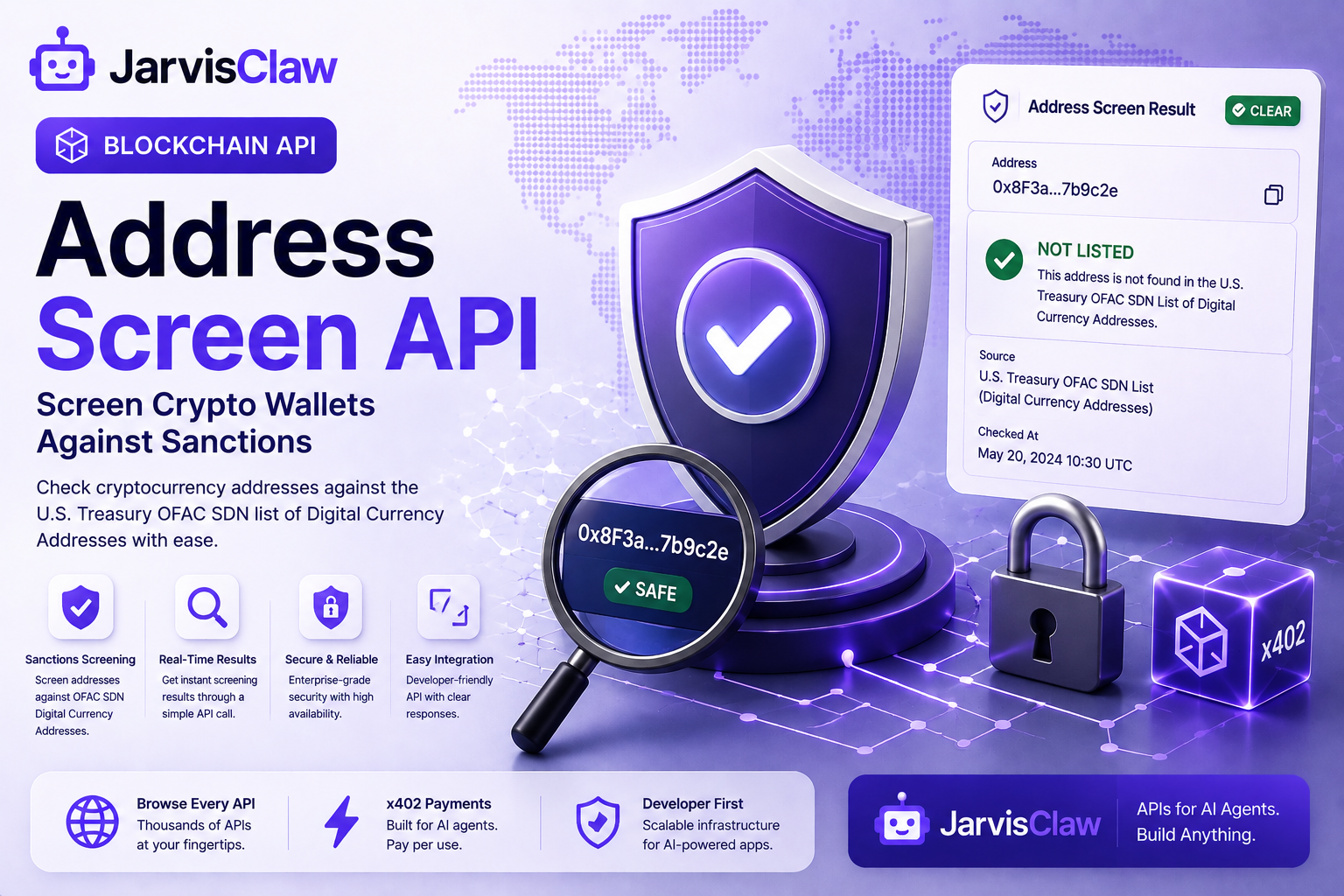
JarvisClaw’s Address Screen endpoint is designed to check a crypto wallet address against the U.S. Treasury OFAC SDN list’s published Digital Currency Addresses.
This gives developers a programmable way to incorporate sanctions screening into blockchain workflows.
What Is an Address Screen API?
An Address Screen API is a blockchain screening service that lets an application submit a cryptocurrency address and receive information about whether that address matches a relevant screening source.
The basic workflow is:Wallet address → Address Screen API → Screening result → Application or AI agentInstead of manually checking addresses, developers can integrate screening directly into their applications.
This becomes particularly useful when software processes many addresses or when an AI agent needs information before recommending or performing a blockchain action.
Why Do AI Agents Need Address Screening?

AI agents are moving beyond simple conversations.
Modern agents can search for information, call APIs, coordinate workflows, and potentially interact with blockchain services.
That creates a new requirement: agents need specialized tools that provide information before they take action.
Imagine a user tells an AI agent, “Send funds to this wallet.”Before continuing, the agent could call an Address Screen API and check the destination address against a relevant screening source.
The workflow could become:User request → AI agent → Address Screen API → Screening result → Agent reasoning → Action or review
Address Screen API Use Cases
Crypto Payments
Payment applications can screen destination addresses before processing blockchain transfers.
A screening step can provide additional information before a transaction moves forward.
Crypto Wallets
Wallet applications can integrate screening into send workflows. When a user enters a destination address, the application can request screening information and display the result before the user proceeds.
AI-Powered Crypto Assistants
An AI assistant can use address screening as a specialized tool.
The agent can receive an address, call the endpoint, interpret the response, and explain the result in plain language.
How Does an Address Screening API Work?
The process is straightforward.
First, an application identifies the cryptocurrency address that needs to be screened.
Second, it sends the address to the screening endpoint.
The application can then use that result in its workflow.
A simplified architecture is:Address → API request → Screening source → Match result → Application
For an AI agent, another layer can be added:Address → Screen API → Result → LLM reasoning → User explanation
This separation allows the screening service to retrieve specialized information while the AI model handles interpretation and communication.
Address Screening and Agentic AI
Address screening becomes particularly important when AI agents operate with greater autonomy.
An agent that only answers questions may not need to screen a wallet.
An agent that can initiate payments, manage digital assets, or coordinate blockchain workflows has a stronger reason to gather relevant information before taking action.
For example, an autonomous payment agent could receive a payment request, identify the destination address, call an Address Screen API, evaluate the returned result, and then continue the workflow or request human review.
The broader architecture could be:Payment request → Address screening → Additional analysis → Agent decision → Blockchain actionThis is an example of tool-augmented AI, where external APIs give an intelligent system access to specialized information.
JarvisClaw’s API marketplace brings together thousands of endpoints across categories including Blockchain, Audio, Search, LLM, Image, Video, Web, and more.
The Address Screen endpoint can become one tool inside a larger blockchain workflow.
Developers can combine address screening with other APIs for token transfers, historical balances, address risk, and additional blockchain intelligence.
This approach lets developers assemble specialized capabilities instead of building every blockchain service internally.
JarvisClaw also focuses on infrastructure for AI agents, including API access, smart routing, and x402 payment capabilities.
As AI agents increasingly interact with paid digital services, programmable API infrastructure can connect specialized capabilities to automated workflows
Final Thoughts
An Address Screen API gives developers a practical way to programmatically screen cryptocurrency addresses against relevant datasets.
From crypto wallets and payment applications to blockchain compliance workflows and AI agents, address screening can support applications that need additional information before interacting with a wallet.
Through JarvisClaws API marketplace, developers can combine Address Screen with other blockchain capabilities to create more intelligent, tool-powered workflows.
As agentic AI evolves, the ability to retrieve specialized information before taking action will become increasingly important.
APIs such as Address Screen can provide one building block for AI agents that interact with blockchain services more thoughtfully.
For developers building the next generation of crypto and AI applications, combining intelligent models with specialized APIs can turn automated systems into more capable and context-aware digital agents.
You can now download, install, and test our developer tools for free.📦 JarvisClaw MCP on NPM(https://www.npmjs.com/package/jarvisclaw-mcp)🐍 Agent Intent Protocol on PyPI(https://pypi.org/project/agent-intent-protocol/)Built for developers working with AI Agents, MCP, AIP, and multi-model AI workflows.