
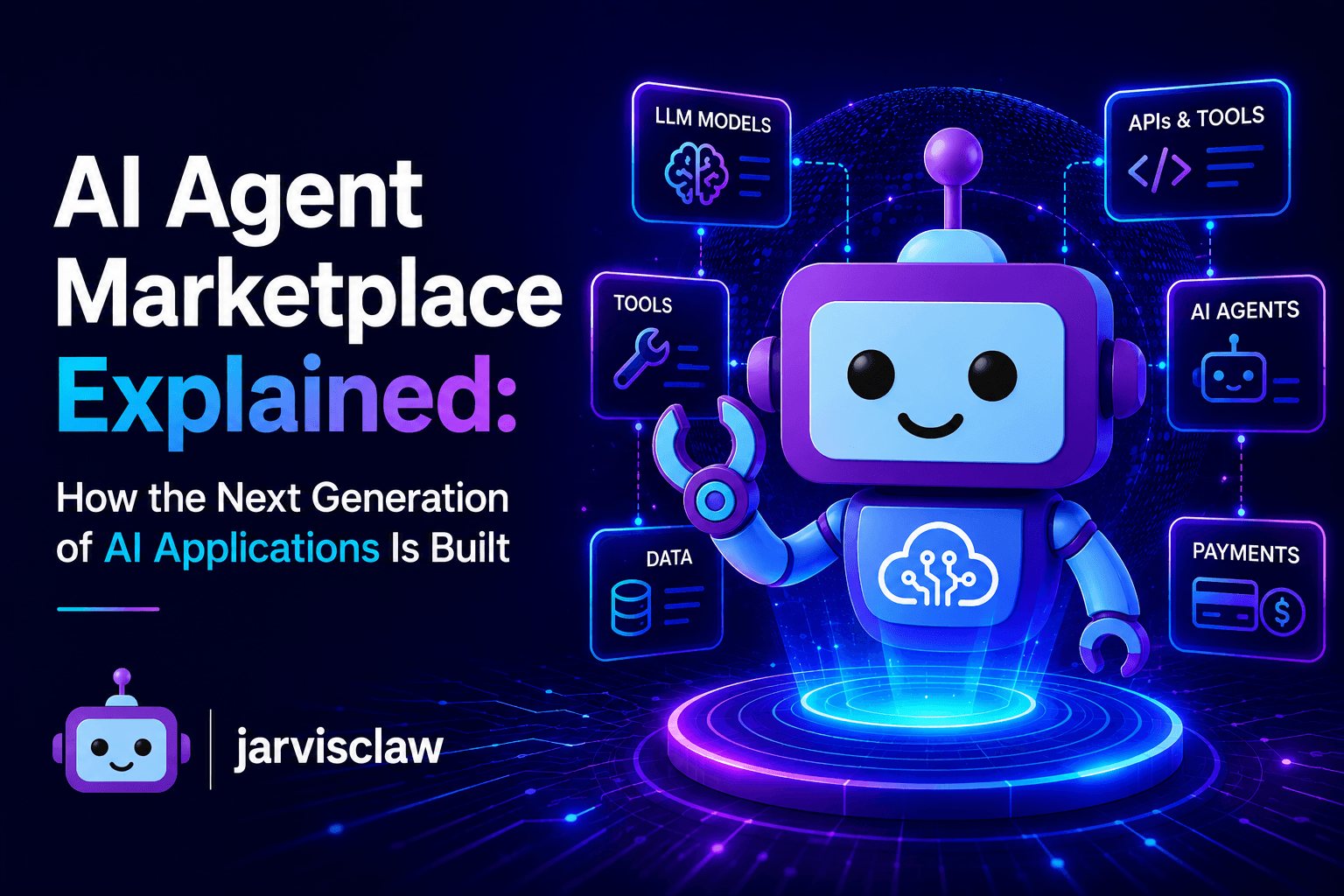
Artificial intelligence is rapidly moving beyond single-model chatbots.
Today’s AI applications are expected to search the web, retrieve enterprise knowledge, call APIs, generate code, analyze images, make decisions, and even pay for services automatically. These capabilities are no longer powered by one model alone—they require an ecosystem of models, tools, APIs, and services working together.
This is why the concept of an AI Agent Marketplace is gaining attention.
Rather than acting as another AI model directory, an AI Agent Marketplace provides the infrastructure that allows AI agents to discover, select, access, and pay for the resources they need to complete real-world tasks.
Platforms like JarvisClaw are helping shape this new infrastructure by combining multi-model AI access, API discovery, agent communication, and programmable payments into one developer-friendly platform.
In this article, we’ll explain what an AI Agent Marketplace is, why it matters, and how it is changing the way AI applications are built.
1. What Is an AI Agent Marketplace?
An AI Agent Marketplace is a platform where developers and autonomous AI agents can discover, connect to, and use AI capabilities through standardized interfaces.
Unlike traditional AI marketplaces that only list models, an AI Agent Marketplace can provide access to:
- Large Language Models (LLMs)
- Image and video generation models
- AI APIs
- Search services
- Enterprise tools
- Prediction market APIs
- MCP servers
- Third-party AI agents
- Payment-enabled digital services
Think of it as an operating system for AI agents rather than simply an app store.

Instead of manually integrating dozens of services, developers can access everything through one programmable marketplace.
2. Why AI Applications Need More Than One Model
One of the biggest misconceptions in AI development is believing that a single model can solve every problem.
In reality, different models excel at different tasks.
For example:
- GPT models are excellent at reasoning and writing.
- Claude performs well on long-document analysis.
- Gemini offers strong multimodal capabilities.
- DeepSeek is highly competitive for coding tasks.
- Qwen delivers excellent multilingual performance.
A modern AI application often combines several models within a single workflow.
For example:
- Detect user intent.
- Select the best model.
- Retrieve external information.
- Generate structured output.
- Execute API calls.
- Return results.
Without a marketplace, developers must manually connect every provider.
An AI Agent Marketplace removes this complexity.
3. The Hidden Infrastructure Behind AI Agents
When people talk about AI agents, they usually focus on reasoning ability.
However, production AI agents spend most of their time performing infrastructure tasks.
These include:
- Finding available models
- Comparing costs
- Checking API availability
- Calling external tools
- Managing authentication
- Handling failures
- Switching providers
- Paying for services
None of these tasks involve reasoning.
They are infrastructure problems.
An AI Agent Marketplace provides the missing layer between AI models and production applications.
4. How JarvisClaw Fits Into the AI Agent Economy
JarvisClaw is designed as an AI API Gateway and AI Agent Marketplace for developers, AI startups, SaaS platforms, and Web3 applications.
Instead of maintaining separate integrations for every AI provider, developers can connect through one OpenAI-compatible API.
The platform currently provides access to more than 80 AI models from multiple providers.
This allows applications to switch models without rewriting business logic.
For developers already using OpenAI-compatible SDKs, migration is straightforward because request formats remain familiar.

4.1 One API Instead of Dozens
Traditional AI development often looks like this:
- OpenAI API
- Anthropic API
- Google Gemini API
- DeepSeek API
- Qwen API
- Mistral API
Every provider has different:
- Authentication
- SDKs
- Rate limits
- Error handling
- Pricing
- Documentation
As applications grow, maintaining multiple integrations becomes expensive.
JarvisClaw solves this through a unified API layer.
Instead of maintaining dozens of integrations, developers manage one.
4.2 Smart Routing Makes AI Applications More Efficient
Not every request needs the most expensive model.
For example:
Customer support questions can use a lightweight model.
Complex reasoning tasks can use GPT.
Code generation might use DeepSeek.
Image understanding could use Gemini.
This approach reduces cost while maintaining quality.
JarvisClaw’s Smart Routing helps developers build applications that automatically select appropriate models for different workloads.
Instead of optimizing prompts for one model, developers optimize workflows.

5. Why MCP Is Becoming an Industry Standard
As AI agents become more capable, they also need access to external tools.
This is where the Model Context Protocol (MCP) comes in.
MCP provides a standardized way for AI models to communicate with tools and APIs.
Instead of creating custom integrations for every application, developers expose capabilities through MCP.
JarvisClaw supports MCP-compatible tools, making it easier for developers to build agent workflows that interact with external systems.
This greatly improves interoperability between AI applications.
6. x402 Payments: Enabling Autonomous Commerce
Traditional APIs assume humans are paying.
Developers create accounts.
Add credit cards.
Purchase credits.
Monitor balances.
AI agents cannot easily follow this process.
The emerging x402 payment standard changes this.
Instead of requiring manual subscriptions, services can charge per API call.
An AI agent can:
- Discover a service
- Read the price
- Pay automatically
- Retry the request
- Receive the response
This creates an entirely new economic model where software can purchase digital services autonomously.
JarvisClaw supports x402-compatible payments alongside USDC and fiat top-ups, making it easier for AI agents to access paid services without traditional subscription workflows.
7. Real-World AI Agent Marketplace Use Cases
7.1 AI Coding Assistants
A coding assistant can:
- Search documentation
- Generate code
- Run tests
- Fix errors
- Deploy applications
Each task may use a different model.
7.2 AI Customer Service
A customer support agent can:
- Understand user intent
- Search knowledge bases
- Retrieve CRM information
- Generate responses
- Translate into multiple languages
Different APIs and models work together seamlessly.
7.3 Enterprise Knowledge Agents
An enterprise agent can:
- Search internal documents
- Analyze contracts
- Generate reports
- Call internal APIs
- Schedule workflows
Without a marketplace, every integration would need to be built separately.
7.4 Web3 AI Applications
Web3 projects increasingly combine:
- Wallets
- Smart contracts
- Prediction markets
- On-chain payments
- AI models
JarvisClaw enables these services to operate through one infrastructure layer.
8. Choosing the Right AI Agent Marketplace
Before selecting a platform, developers should evaluate:
Model Coverage
Can it access multiple leading AI providers?
API Compatibility
Does it support OpenAI-compatible APIs?
Routing
Can requests automatically switch models?
Payment Infrastructure
Does it support programmable payments like x402?
Developer Experience
Are SDKs and documentation easy to use?
Scalability
Can the platform support production workloads?
The marketplace should simplify development—not introduce additional complexity.
9. The Future of AI Applications
The next generation of AI applications will not depend on one “best” model.
Instead, they will orchestrate many models, APIs, tools, and services dynamically.
AI agents will become consumers of digital services.
They will purchase APIs, retrieve live data, coordinate specialized agents, and complete tasks with minimal human intervention.
An AI Agent Marketplace provides the infrastructure required for this future.
Rather than building isolated AI applications, developers will build interconnected AI ecosystems.
Platforms like JarvisClaw are helping accelerate this transition by providing unified model access, standardized APIs, intelligent routing, programmable payments, and developer-friendly infrastructure.
As AI moves toward autonomous workflows, the most valuable platforms won’t simply offer more models—they’ll make it easier for developers and AI agents to connect everything together.
Conclusion
AI development is entering a new phase.
Success will depend less on choosing one powerful model and more on building flexible systems that can combine models, APIs, tools, and payment infrastructure.
An AI Agent Marketplace makes this possible.
By providing unified access to models, intelligent routing, MCP integration, and x402 payments, JarvisClaw helps developers build AI applications that are more scalable, maintainable, and ready for the agent economy.
The future isn’t about one model.
It’s about giving AI agents the ability to discover, connect, collaborate, and transact across an open ecosystem.
FAQ
1. What is an AI Agent Marketplace?
An AI Agent Marketplace is a platform where AI agents and developers can discover, access, and use AI models, APIs, tools, and services through standardized interfaces, enabling autonomous and multi-service workflows.
2. How is an AI Agent Marketplace different from an AI model marketplace?
An AI model marketplace focuses on AI models only. An AI Agent Marketplace also includes APIs, tools, MCP services, payment infrastructure, and agent-to-agent collaboration capabilities.
3. Why do AI agents need multiple models?
Different models are optimized for different tasks such as reasoning, coding, multimodal understanding, translation, or structured output. Combining multiple models improves both performance and cost efficiency.
4. What is Smart Routing?
Smart Routing automatically selects the most suitable AI model for each request based on factors such as task type, latency, cost, or availability, improving both reliability and efficiency.
5. What is MCP?
Model Context Protocol (MCP) is an open standard that enables AI models to securely interact with external tools, APIs, and data sources using a consistent interface.
6. What is x402 payment?
x402 is an emerging open standard for machine-to-machine payments that allows AI agents to pay for APIs and digital services on a per-call basis without relying on traditional subscription workflows.
7. Why use JarvisClaw instead of integrating multiple AI providers separately?
JarvisClaw offers one OpenAI-compatible API to access 80+ AI models, reducing integration complexity while providing Smart Routing, MCP support, x402 payments, and AI Agent Marketplace capabilities through a unified developer platform.
8. Who should use an AI Agent Marketplace?
AI developers, SaaS companies, AI startups, enterprise engineering teams, and Web3 builders can all benefit from an AI Agent Marketplace by simplifying multi-model integration, reducing development costs, and enabling scalable agent-based applications.
Build the Future of AI with JarvisClaw
AI is moving beyond individual models toward a connected ecosystem of models, APIs, agents, and intelligent services.
JarvisClaw provides the infrastructure developers need to build this future — combining 80+ AI models, OpenAI-compatible APIs, Smart Routing, MCP support, x402 payments, and AI Agent-ready capabilities in one platform.
Whether you are building AI SaaS products, autonomous agents, automation workflows, or next-generation applications, JarvisClaw helps you integrate faster, optimize costs, and scale with confidence.
One API. Multiple Models. Agent-Ready AI Infrastructure.
Start building with JarvisClaw today.