
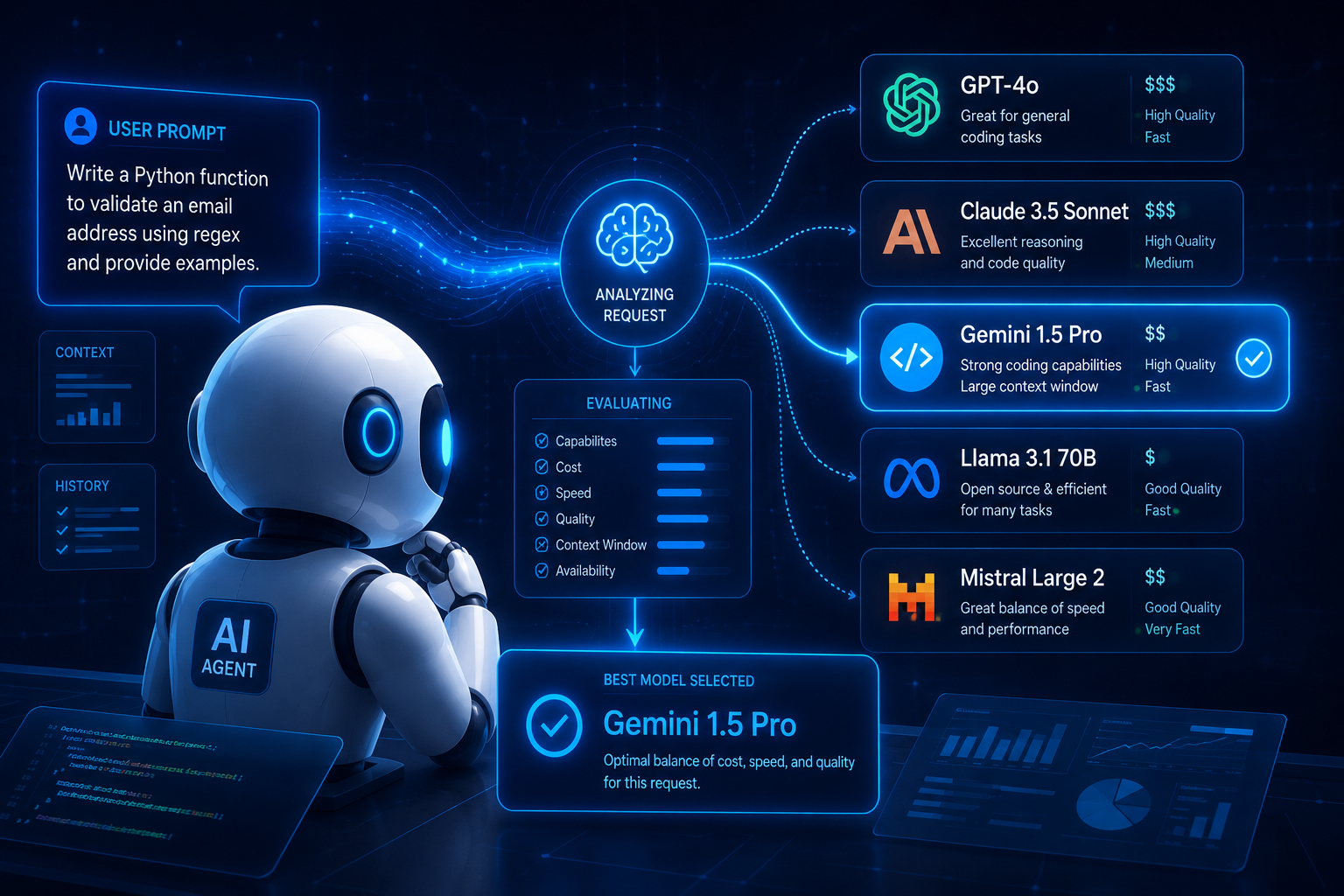
Most people think AI agents simply send every prompt to a single LLM like GPT5.6 or Claude. In reality, that’s one of the fastest ways to waste money and increase latency.Modern AI agents make decisions before every API request. They evaluate the task, estimate the cost, consider the required capabilities, and select the most suitable model automatically. This process is known as smart routing.

In this guide, we’ll explore how smart routing works, why it matters, and how platforms like JarvisClaw make it possible to build faster, cheaper, and more reliable AI applications.
What Is Smart Routing?
Smart routing is the process of selecting the most appropriate AI model for a specific request instead of always using the same one.Think of it as having a team of specialists rather than asking the same person to do every job.For example:A simple grammar correction doesn’t need an expensive reasoning model.Image analysis requires a multimodal model.Long research tasks benefit from models with large context windows.Coding tasks often perform better on specialized coding models.Instead of hardcoding one provider, a smart router evaluates the request and forwards it to the best available option.
Why Smart Routing Matters
Using a single AI model for every request creates several problems:
Higher API costs
Slower responses
Lower availability when one provider experiences downtime
Poor task specialization
Limited scalability
Smart routing solves these problems by matching each request with the model that offers the best balance of quality, speed, and cost.
How Smart Routing Works
A typical request follows this workflow:

Instead of blindly calling one endpoint, the routing engine makes an informed decision based on predefined rules or intelligent policies.
Factors Used to Select a Model

A smart routing engine usually considers several variables before making a decision.
1. Cost
Large reasoning models deliver excellent results but cost significantly more.If a lightweight model can answer correctly, there’s no reason to spend extra tokens.
Example:
Summarization → Smaller model
Simple chatbot → Smaller model
Complex reasoning → Larger model
2. Speed
Not every application needs the most advanced reasoning.Customer support bots often prioritize low latency over maximum intelligence.For these tasks, the router chooses the fastest available model.
3.Availability
Cloud providers occasionally experience outages or rate limits.If one provider becomes unavailable, the router can automatically redirect traffic to another compatible model without interrupting the user experience.This improves reliability while reducing downtime.
Example Smart Routing Logic
Imagine a user submits different prompts throughout the day.

Implementing Smart Routing
A basic routing engine usually performs four steps:
Receive the prompt.
Classify the task.
Evaluate available models.
Forward the request to the selected provider.
More advanced implementations also consider:
-Token pricing
-Context window size
-Historical performance
-User preferences
-Rate limits
-Geographic latency
-Provider health
This enables dynamic routing decisions that adapt in real time.

Why This Matters for Autonomous AI Agents
Autonomous agents operate independently, often making hundreds or thousands of API calls.
Without smart routing, they may:
-Overspend on simple tasks
-Fail when a provider is unavailable
-Experience unnecessary delays
Smart routing allows agents to optimize each request automatically, making them more efficient, resilient, and cost-effective.When combined with standards like x402, agents can not only choose the best model but also pay for premium APIs autonomously, enabling fully automated workflows.
Final Thought
As AI applications grow more sophisticated, selecting the right model becomes just as important as writing the right prompt.
Smart routing transforms AI systems from static integrations into adaptive platforms capable of balancing performance, cost, and reliability in real time.
Whether you’re building chatbots, coding assistants, research tools, or autonomous agents, implementing smart routing is one of the most effective ways to improve both user experience and operational efficiency.
Build the Future of AI with JarvisClaw
AI is moving beyond individual models toward a connected ecosystem of models, APIs, agents, and intelligent services.
JarvisClaw provides the infrastructure developers need to build this future — combining 80+ AI models, OpenAI-compatible APIs, Smart Routing, MCP support, x402 payments, and AI Agent-ready capabilities in one platform.
Whether you are building AI SaaS products, autonomous agents, automation workflows, or next-generation applications, JarvisClaw helps you integrate faster, optimize costs, and scale with confidence.
One API. Multiple Models. Agent-Ready AI Infrastructure.
Start building with JarvisClaw today.