
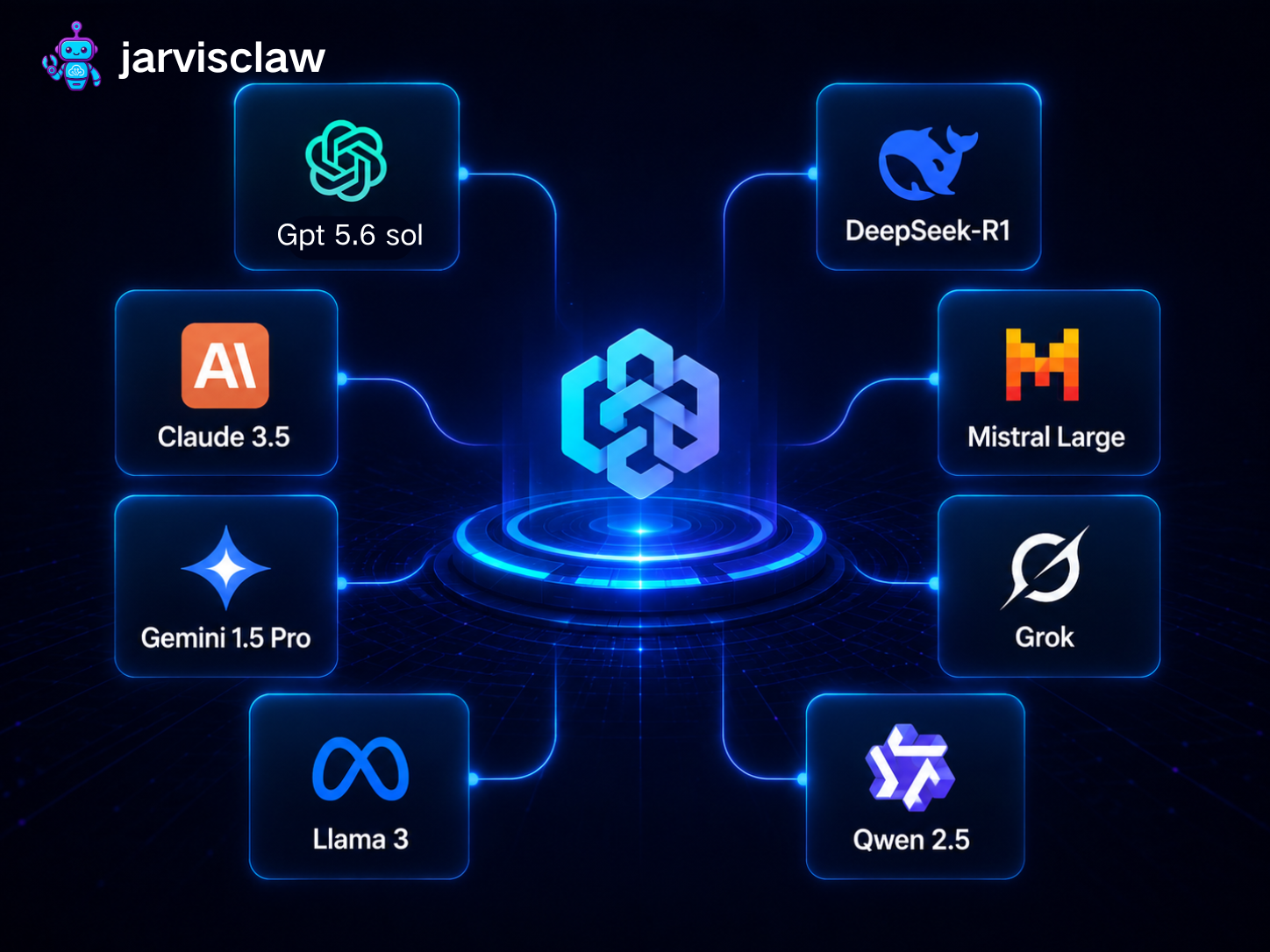
As generative AI moves from experimentation into real-world production, developers are discovering that the biggest challenge is no longer simply finding a capable model.
The real difficulty lies in connecting multiple models reliably, managing different APIs, controlling usage costs, handling provider failures, and enabling AI agents to access paid services and external data independently.
When a project needs models from OpenAI, Anthropic, Google, Meta, and other providers, development teams usually have to create separate accounts, maintain multiple API keys, adapt different request formats, and manage different pricing, rate limits, and error responses.
The more models a project connects, the more complex the infrastructure becomes.
JarvisClaw is designed to simplify this process. It is an AI API Gateway and API Marketplace built for developers, AI agents, SaaS teams, and Web3 users. Through one OpenAI-compatible API, teams can access more than 80 AI models while also integrating payment and prediction market data capabilities.

1. Access 80+ AI Models Through One API
Traditional multi-model integration may appear flexible, but it often creates a large amount of repetitive development work.
Every time a team adds a new model provider, developers may need to handle a different endpoint, authentication method, parameter structure, error format, and billing system. When the provider updates its models or API rules, the existing integration may also require additional maintenance.
JarvisClaw provides a unified OpenAI-compatible API.
For projects that already use the OpenAI SDK or a compatible request format, developers can connect to different models with fewer changes to their existing codebase.
Instead of building a separate integration for every provider, teams can use one API entry point to test, switch, and manage multiple models.
This approach is especially useful for:
- AI SaaS products
- Customer service chatbots
- Content generation platforms
- Coding assistants
- Enterprise automation tools
- Autonomous AI agents
By reducing integration and maintenance work, developers can spend more time improving the actual product.
2. The Real Value of Multi-Model AI Is Not the Number of Models

Many AI platforms promote the size of their model catalog as a major selling point.
However, developers should not focus only on how many models are available. The more important question is whether those models can support different tasks, budgets, and performance requirements.
For example:
- Advanced reasoning and coding tasks may require a more capable model.
- Content creation and everyday conversations may work better with a balanced model.
- Classification, summarization, and information extraction may be assigned to faster and more affordable models.
- When one provider becomes unavailable, the application may need to switch to another model.
There is also a hidden cost that many teams overlook:
A cheaper model does not always result in a lower total cost.
If a low-cost model needs three attempts to complete a task, regularly produces invalid formats, or fails during tool calls, its real operating cost may be higher than a more capable model that succeeds on the first request.
The real benefit of a multi-model platform is therefore not simply having more options. It is the ability to choose the right model based on task complexity, speed, reliability, and cost.
3. Why x402 Payments Matter for AI Agent Developers
In traditional web applications, payments are usually initiated and confirmed by a human user.
In the agent economy, however, AI agents may need to call APIs, purchase data, use external tools, or pay for digital services without manual intervention.
This creates a new infrastructure problem:
How can an AI agent make small, usage-based payments automatically?
JarvisClaw supports x402 on-chain micropayments, providing a payment method designed for machine-to-machine API usage. It also supports USDC payments and fiat top-ups, giving developers and businesses more flexibility.
For traditional SaaS teams, fiat top-ups may fit more naturally into existing accounting and purchasing processes.
For Web3 developers and autonomous agents, x402 and USDC can reduce friction in cross-border settlement and automated payments.
The important point is not simply that JarvisClaw supports cryptocurrency payments.
The deeper change is that payment is becoming part of AI infrastructure.
Future AI agents may not only answer questions. They may independently select models, purchase data, call paid APIs, complete transactions, and execute multi-step workflows.
Platforms that connect APIs, billing, and programmable payments will be better positioned to support these next-generation applications.
4. What Can Developers Build with Prediction Market APIs?
In addition to multi-model access and agent-native payments, JarvisClaw provides Prediction Market API capabilities covering data scenarios such as Polymarket, Kalshi, sports, and Binance.
These APIs can support several practical product categories.
1. AI-Powered Market Research Tools
Developers can combine large language models with market data to generate event analysis, explain probability changes, summarize market sentiment, and identify relevant signals.
2. Prediction Market Dashboards
Applications can aggregate data from platforms such as Polymarket and Kalshi to display trending markets, probability movements, trading activity, and event momentum.
3. Sports Data Applications
Sports data can be combined with AI models to produce pre-game summaries, event updates, structured reports, and data visualizations.
4. Web3 and Market Intelligence Tools
By connecting AI models with Binance-related and other market data, developers can build price monitoring tools, unusual-movement alerts, news correlation systems, and automated research workflows.
Prediction Market APIs are best used for data aggregation, research, monitoring, and analytical support.
Developers should still consider data latency, source differences, regulatory requirements, and clear risk disclosures. AI-generated analysis should not automatically be treated as financial advice.
5. Who Should Use JarvisClaw?
JarvisClaw is not limited to large enterprises.
Several types of users can benefit from its infrastructure.
AI startups can use one API to test different models and shorten product validation cycles.
SaaS developers can reduce the maintenance burden created by multiple model providers.
AI agent projects can use x402 and USDC to build automated payment workflows.
Web3 developers can combine model access with on-chain payments.
Prediction market and data product teams can connect multiple data sources to build monitoring, analytics, and information services.
Individual developers can also reduce the inconvenience of creating accounts across multiple providers, managing several API keys, maintaining different SDKs, and tracking balances on separate platforms.
6. A Product Opportunity Many Developers Are Missing
Many AI applications still follow a simple workflow:
A user submits a prompt, and the model generates a response.
The next generation of AI products will operate more like complete automated systems:
- The user provides a goal.
- An AI agent breaks the goal into smaller tasks.
- The system selects the most suitable model.
- The agent calls external tools and data sources.
- It pays for required API services.
- It processes and validates the results.
- It produces the final deliverable.
In this workflow, the model is only one part of the system.
API routing, payments, billing, data access, monitoring, and failover all determine whether the application can operate reliably in production.
This is the core positioning of JarvisClaw:
One API, connected to multi-model AI.
One payment system, built for the agent economy.
JarvisClaw is not simply another model access platform. Its goal is to bring multi-model AI, agent-native payments, and external data capabilities into one developer-focused infrastructure layer.
Conclusion
When choosing AI infrastructure, developers should not look only at the number of supported models or the listed token price.
More important questions include:
- Is the API compatible with the existing project?
- Can models be switched easily?
- Are payment options flexible?
- Can the platform provide useful external data?
- Is the infrastructure suitable for autonomous agent workflows?
- Can the system handle provider failures and changing requirements?
JarvisClaw connects more than 80 AI models through one OpenAI-compatible API while supporting x402 on-chain micropayments, USDC payments, fiat top-ups, and Prediction Market APIs.
This helps developers reduce repetitive integrations and spend more time building products, improving user experiences, and solving real business problems.
As AI moves from chat-based tools toward autonomous agents, unified APIs and programmable payments may become essential components of the next generation of AI applications.
FAQ
1. What is JarvisClaw?
JarvisClaw is an AI API Gateway and API Marketplace built for developers, AI agents, SaaS teams, and Web3 users. It provides multi-model AI access, programmable payments, and prediction market data capabilities.
2. How many AI models does JarvisClaw support?
Developers can access more than 80 AI models through one OpenAI-compatible API. Actual model availability, identifiers, and pricing are listed in the JarvisClaw Model List.
3. Do developers need to rewrite their entire application to use JarvisClaw?
Projects already using the OpenAI SDK or a compatible API format will generally only need to update the API endpoint, API key, and model identifier. They do not need to create a completely separate integration for every provider.
4. What are x402 on-chain micropayments?
x402 is a payment mechanism designed for APIs, digital services, and autonomous agents. It allows software and AI agents to make small usage-based payments without relying entirely on traditional subscriptions or manual checkout processes.
5. Which payment methods does JarvisClaw support?
JarvisClaw supports x402 on-chain micropayments, USDC payments, and fiat top-ups, covering the needs of individual developers, business teams, AI agents, and Web3 projects.
6. What can Prediction Market APIs be used for?
Prediction Market APIs can support market dashboards, sentiment analysis, sports data applications, Web3 research tools, event monitoring, market alerts, and automated data products.
7. Is JarvisClaw suitable for individual developers?
Yes. Individual developers can use one API to test different models and reduce the burden of managing multiple provider accounts, API keys, SDKs, and account balances.