
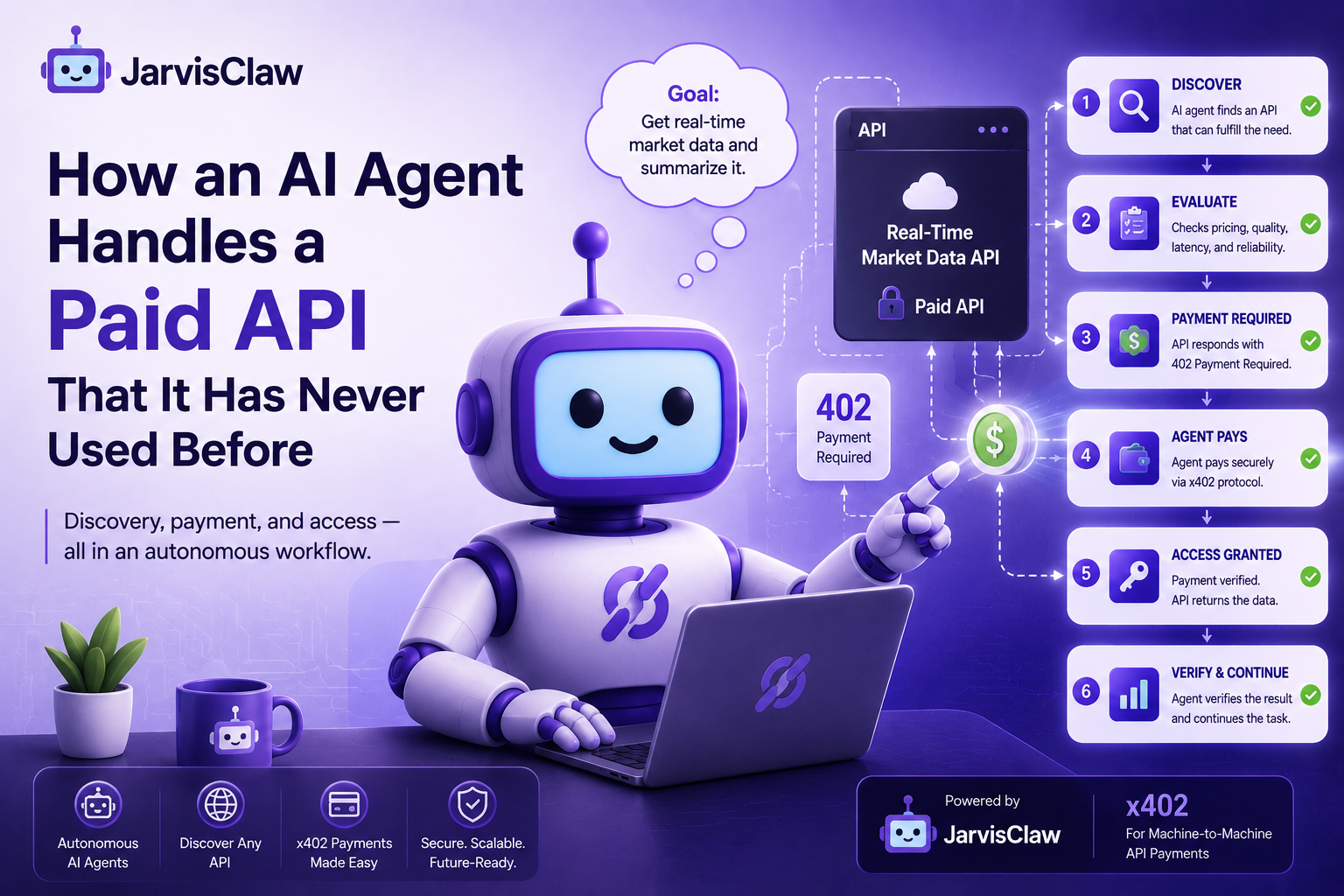
Imagine an AI agent is working on a task and suddenly needs information from an API it has never used before.
The API has no account registered for the agent. There is no API key stored in its configuration, and the service requires payment before returning data.What happens next?This is becoming an important question around AI agents, autonomous AI, AI APIs, and agentic commerce. Traditional software expects developers to discover an API, create an account, obtain credentials, and configure the application.
Autonomous AI agents need a different model—one where software can discover a service, understand its requirements, pay for access, and continue its task with minimal human intervention.
Protocols such as x402 support this model by enabling pay-per-request interactions between agents and APIs. This creates a practical foundation for autonomous API access, agentic payments, and secure machine-to-machine digital commerce.
Why Would an AI Agent Need an API It Has Never Used?

AI agents are increasingly designed to complete multi-step tasks rather than simply generate text.An agent might research a company, compare financial data, find current market information, check real-time weather, search a database, or complete a transaction.
The agent may know what information it needs without knowing which API provides it.
This creates a new problem: how can an autonomous AI agent access a useful API when it has never used that API before?
Step 1: The Agent Identifies the Required Capability
The process begins with the agent’s goal.
Suppose a user asks an AI agent to find the latest market data and summarize the results.
The agent understands that its existing knowledge may not be sufficient because real-time information changes quickly.
It therefore needs an external data source.An agentic system can identify available services for the required capability instead of relying only on a preconfigured tool.
Step 2: The Agent Evaluates the API
Finding an API is not enough.
The agent needs to determine whether the service is suitable. It can evaluate what the API does, price per request, response quality, latency, availability, usage limits, and supported parameters.If several APIs provide similar information, an AI agent could select the service offering the best combination of cost, reliability, speed, and quality.
Step 3: The API Returns a Payment Requirement
Now suppose the API requires payment.
With a traditional API, the agent might encounter an authentication error and stop.
With an x402-enabled API, the server can respond with HTTP 402 Payment Required and provide the payment requirements needed to continue.
The basic interaction becomes:Agent → API request → HTTP 402 → Payment requirements → Agent pays → Request is retried → API returns data.
Step 4: The Agent Pays for the Request
Once the agent understands the payment requirement, it needs access to a payment mechanism.
This could involve a wallet or agent payment infrastructure capable of authorizing the transaction.
JarvisClaw supports x402-enabled API access where an agent can use a wallet to pay directly, without requiring a traditional account for the service.Instead of purchasing a monthly subscription, an agent could pay for the exact API request it needs.
Step 5: The Agent Completes the API Request
After payment, the agent sends the request again with the required payment proof.The API verifies the payment.
If everything is valid, it processes the request and returns the requested information.
Step 6: The Agent Verifies the Result
Getting a response does not necessarily mean the task is complete.A reliable AI agent should evaluate the result.Did the API return the expected information? Is the data recent enough? Does it satisfy the original request?If the answer is no, the agent may try another provider or adjust its request.
This creates a feedback loop:Goal → Discover → Evaluate → Pay → Call API → Verify → Continue.
What This Means for API Developers
The rise of AI agents changes what it means to build an API.
APIs increasingly need to be discoverable, machine-readable, reliable, payment-aware, and agent-friendly.
AI agents are becoming potential customers of digital services, creating new opportunities for the agentic economy.
Where JarvisClaw Fits
JarvisClaw is designed around this changing AI infrastructure landscape.Its API gateway combines AI model access, smart routing, OpenAI-compatible APIs, MCP connectivity, and x402 direct payments.
For developers building autonomous AI agents, this means infrastructure can move beyond simply asking an LLM for an answer.
An agent can access the capabilities it needs, choose appropriate services, and participate in payment-enabled API workflows.
Tomorrow’s agent could discover specialized services and purchase exactly what it needs to complete a task.
The Future of AI Agents Is Pay-Per-Action
The bigger change is that AI agents can potentially become economic participants—discovering services, evaluating prices, paying for digital resources, and using those resources to accomplish goals.
As autonomous AI becomes more capable, the question will shift from:“Which APIs did the developer give the agent?”to:“Which services can the agent discover, evaluate, pay for, and use?”
That is the foundation of an emerging agentic API economy—and infrastructure such as JarvisClaw and X402 is helping developers build toward it.