
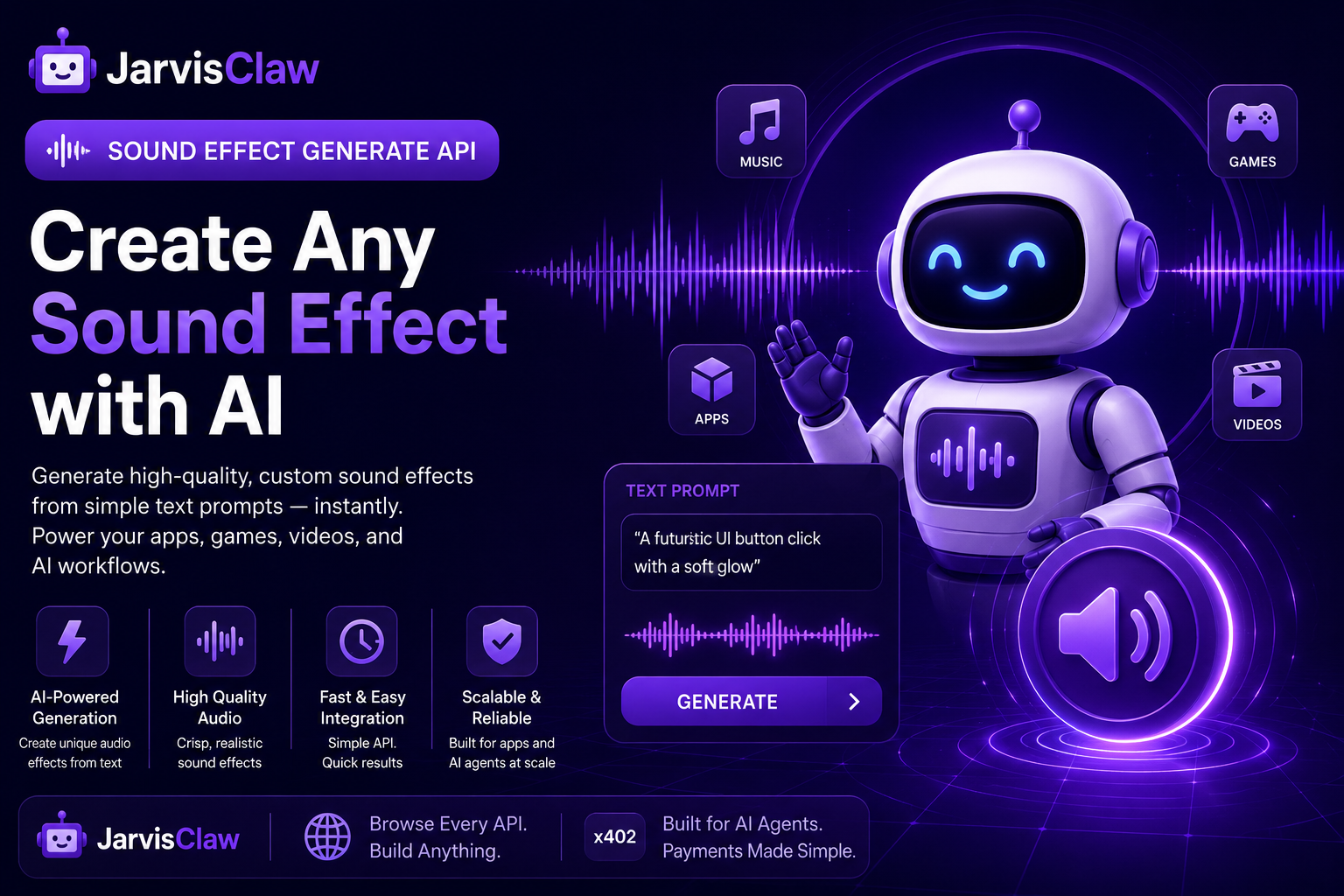
Sound plays an important role in digital experiences. From mobile applications and video content to games, advertisements, virtual environments, and AI-generated media, the right sound effect can make an experience feel more realistic and engaging.
Traditionally, creating custom sound effects required recording equipment, audio libraries, or professional sound designers.
Generative AI is changing that process.
A Sound Effect Generate API allows developers to create sound effects programmatically from text prompts.
Instead of manually searching through audio libraries, an application or AI agent can describe the sound it needs and request a generated audio result.
JarvisClaw includes a Sound Effect Generate endpoint in its API marketplace, giving developers access to AI-powered audio generation alongside other specialized APIs.
What Is a Sound Effect Generate API?
A Sound Effect Generate API is an API that creates audio effects based on a text description.
For example, an application might need the sound of a door opening, a futuristic machine activating, footsteps, an explosion, environmental ambience, or another custom effect.
The basic workflow is:
Text prompt → Sound Effect Generate API → Generated audio → Application or AI agent
This approach gives software the ability to create audio dynamically instead of depending entirely on pre-recorded sound libraries.
The Sound Effect Generate endpoint available through JarvisClaw uses a text prompt to generate sound effects and supports generated audio with durations ranging from short clips to longer effects.
Why Do AI Agents Need Sound Effect Generation?
AI agents are becoming capable of handling complete creative workflows.An agent might be asked to create a video, design a game scene, build an interactive application, or produce promotional content.
These tasks can require custom audio.
Without a sound-generation tool, an agent may need to search an external library or rely on a human to provide the audio.
A Sound Effect Generate API gives the agent another option.
The workflow could look like this:User request → AI agent → Sound Effect Generate API → Audio effect → Creative application → Final outputThe agent can decide what sound is needed, generate it, and incorporate the result into a larger workflow.
Sound Effect Generation API Use Cases
Video and Content Creation
Video creators often need sound effects for transitions, actions, environments, and visual events.
An AI content agent could analyze a video concept and generate effects that match specific scenes.
For example, a technology video could require futuristic interface sounds, machine activation effects, or digital transitions.
Game Development
Games depend heavily on sound.
Developers may need effects for footsteps, weapons, vehicles, menus, environments, character actions, and interactive events.
A generative sound effects API can help developers experiment with custom audio rather than relying only on fixed sound libraries.
AI-Powered Creative Tools
An AI creative assistant could allow users to describe the sound they want using natural language.
A request such as “create a short futuristic computer startup sound” can become an API call that generates the requested effect.
This makes sound design more accessible to people without professional audio-production skills.
Interactive Applications
Applications can use generated audio for notifications, interactive experiences, simulations, virtual environments, and other digital products.
Because the sound-generation process is API-based, developers can incorporate it directly into automated workflows.
How Does a Sound Effect API Work?
The process begins with a text description.The application or AI agent sends the prompt to the Sound Effect Generate endpoint.
The generation system processes the description and produces an audio effect.
The application can then use the generated audio in another part of the workflow.
For an AI agent, the process could look like:User instruction → AI agent → Audio prompt → Sound Effect API → Generated sound → Final applicationThis modular structure allows sound generation to become one tool among many.
An AI agent could combine it with image generation, video generation, text generation, search, storage, or other APIs.
Why Use an API for AI Sound Generation?
Building an AI sound-generation system internally can require specialized models, computing resources, audio processing infrastructure, and ongoing maintenance.
A sound effects API provides developers with a simpler way to add this capability.
Instead of developing the underlying generation system, developers can focus on their application’s user experience and use an API when custom audio is required.
This is especially useful for startups, independent developers, creative platforms, and teams building AI-powered products.
Sound Effects and Agentic AI

The real opportunity becomes clearer when sound generation is connected to agentic AI.
Imagine an AI video-production agent receiving a brief for a short promotional video.
The agent could generate the script, create visual assets, produce narration, generate background music, and create individual sound effects for important scenes.
The workflow could become:Creative brief → AI agent → Script → Visuals → Voice → Music → Sound effects → Final video
The Sound Effect Generate API handles one specialized part of that workflow.
This demonstrates how AI agents can coordinate multiple APIs instead of attempting to perform every task themselves.
Why Use Sound Effect Generate Through JarvisClaw?
JarvisClaw’s API marketplace provides access to thousands of API endpoints across categories such as Audio, Search, LLM, Blockchain, Image, Video, Web, and more.
The Sound Effect Generate endpoint can become part of a broader AI application where developers combine specialized capabilities.
For example, an AI agent could use an LLM to understand a creative request, call a sound-generation API for audio effects, and combine the result with other generated media.
JarvisClaw also focuses on AI-agent infrastructure, including API access, smart routing, and x402 payment capabilities.
As AI agents become more autonomous, these capabilities can help agents interact with specialized digital services as part of automated workflows.
The Future of AI-Generated Sound
Generative audio is becoming an important part of the broader AI ecosystem.
Instead of selecting from a fixed collection of sounds, developers can create effects tailored to specific applications and situations.
AI agents could eventually generate sound dynamically based on context.
A game agent could create environmental effects based on a changing scene, while a content-production agent could generate audio that matches a video’s visual events.
This makes sound generation more than a creative feature.
It becomes an API capability that can be connected to intelligent software.
Start building with JarvisClaw today!!