
Blockchain data is constantly changing.
Token balances move when users transfer assets, trade cryptocurrencies, receive payments, or interact with decentralized applications.
For developers building blockchain applications and AI agents, understanding how holdings changed over time can be especially valuable.
That is where an Address Historical Token Balances API becomes useful.An Address Historical Token Balances API allows applications to retrieve historical token balance information for a specified blockchain address.
Instead of building blockchain indexing infrastructure from scratch, developers can request historical asset data through an API and use it in dashboards, analytics systems, financial applications, or AI-agent workflows.
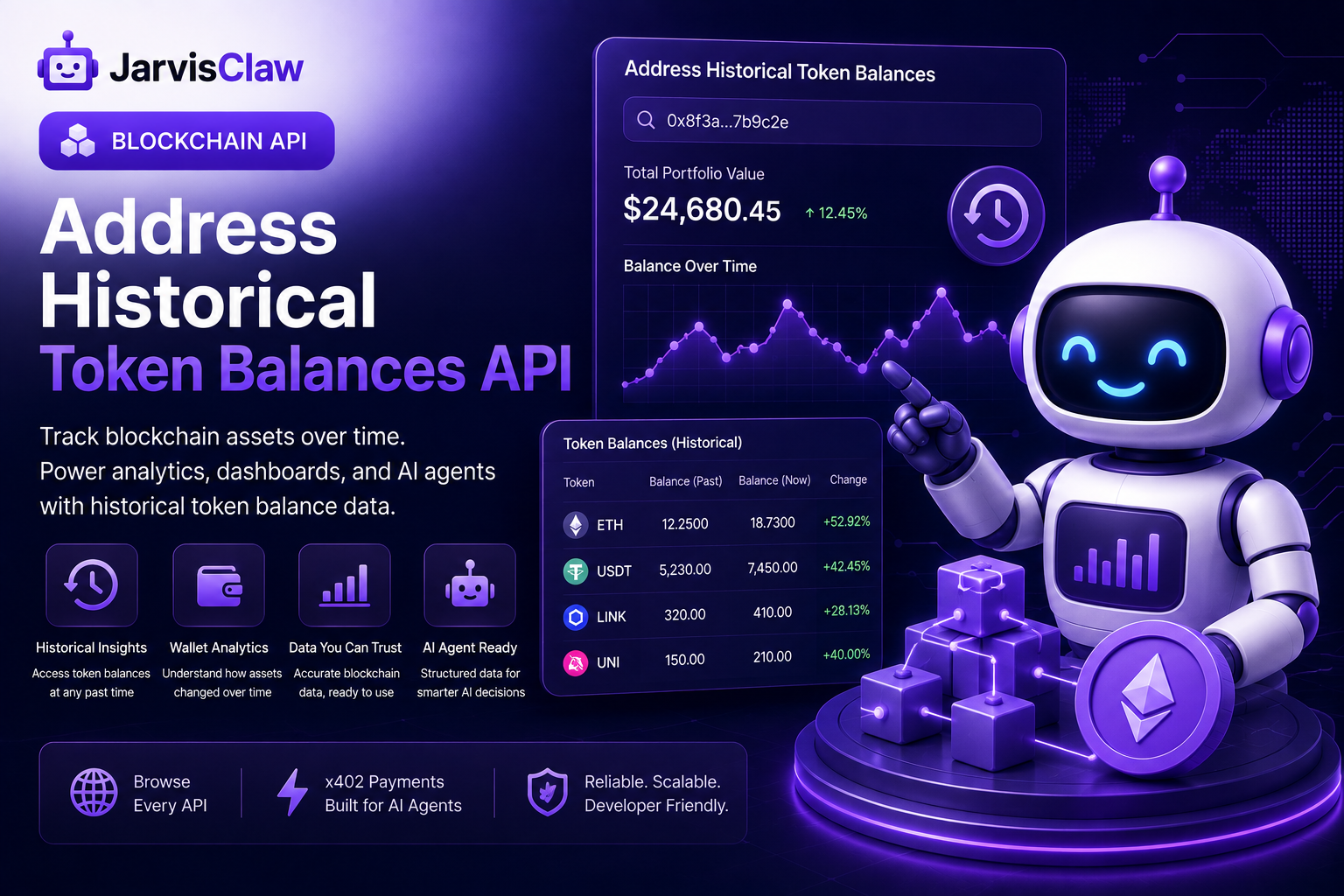
JarvisClaw includes an Address Historical Token Balances endpoint in its API marketplace, giving developers access to specialized blockchain capabilities alongside thousands of other API endpoints.
What Is an Address Historical Token Balances API?
An Address Historical Token Balances API is a blockchain data API designed to retrieve token balance information associated with a wallet address across historical points or periods.
The basic workflow is:Wallet address → API request → Historical token balances → Application or AI agentThe data helps applications understand what assets were associated with an address and how those holdings changed over time. This supports blockchain analytics, portfolio tracking, research, monitoring, and AI-powered crypto applications.
Why Do AI Agents Need Historical Blockchain Data?
AI agents are becoming capable of performing research, analyzing information, monitoring markets, and interacting with blockchain services.
Suppose a user asks an AI agent:“Analyze this wallet and explain how its token holdings have changed.”The agent needs more than a current balance.
It needs historical blockchain data that can reveal changes in the wallet’s assets.A possible workflow is:User → AI agent → Historical Token Balances API → Blockchain data → Agent analysis → Explanation
The API provides structured information while the AI agent interprets it and turns the data into a useful response.
Historical Token Balance API Use Cases
Crypto Portfolio Tracking
A portfolio application can use historical balance data to understand how a wallet’s holdings changed.
An AI portfolio assistant could retrieve historical token balances and explain which assets increased, decreased, appeared, or disappeared during a selected period.
Blockchain Analytics
Researchers and analysts can use historical token balances to study wallet activity and asset distribution.
Instead of examining transactions manually, an application can retrieve structured balance information and include it in an analytics workflow.
AI-Powered Crypto Research
AI agents can combine historical balances with other blockchain APIs to investigate wallet activity.
An agent could retrieve token balances, examine transfers, identify relevant addresses, and summarize findings for a user.

How Does a Historical Token Balance API Work?
The process begins with a blockchain address.
An application sends the address and required parameters to the API.
The endpoint retrieves relevant blockchain data and returns historical token balance information.
The application can then store, visualize, analyze, or pass the data to an AI model.
For an AI agent, the workflow could look like:Wallet address → API request → Historical balances → Data analysis → LLM reasoning → User responseThis separation between data retrieval and reasoning is important for agentic AI.
The AI model does not need to directly index a blockchain. It can call a specialized API whenever blockchain information is required.
Historical Balances and Agentic AI
Historical blockchain information becomes especially powerful when combined with autonomous AI agents.
Imagine an AI research agent monitoring several blockchain addresses.
The agent could periodically retrieve historical token balances, compare changes, identify unusual movements, combine the results with market or transaction data, and generate a report.
The workflow could become:
Scheduled task → AI agent → Historical balances → Blockchain analysis → Other APIs → Report
This illustrates how agentic AI can coordinate specialized tools to complete complex tasks.
Why Use Address Historical Token Balances Through JarvisClaw?
JarvisClaw’s API marketplace provides access to thousands of endpoints across categories such as Blockchain, Audio, Search, LLM, Image, Video, Web, and more.
The Address Historical Token Balances endpoint can be combined with other blockchain services to create complete crypto-data workflows.
For example, a developer could build an AI wallet analyst that retrieves historical balances, investigates transfers, evaluates address risk, and summarizes blockchain activity for users.
JarvisClaw also focuses on AI-agent infrastructure, including API access, smart routing, and x402 payment capabilities.
As autonomous AI agents increasingly use specialized digital services, API infrastructure becomes important for reliable workflows.
Final Thoughts
An Address Historical Token Balances API gives developers a practical way to retrieve historical blockchain asset information for wallet addresses.
From portfolio tracking and blockchain analytics to AI-powered research, historical token data supports modern applications.
Through JarvisClaw’s API marketplace, developers can access Address Historical Token Balances alongside other specialized blockchain and AI capabilities.Agentic AI depends on connecting intelligent models with reliable tools.
Blockchain APIs let developers build applications that retrieve data, analyze activity, and help users understand digital assets.
JarvisClaw provides API infrastructure that helps make these tool-powered AI workflows possible.