
Blockchain applications generate enormous amounts of transaction data every day.
For developers building crypto wallets, analytics platforms, and AI agents, understanding token movements is essential.
That is where an Address Token Transfers API becomes useful.
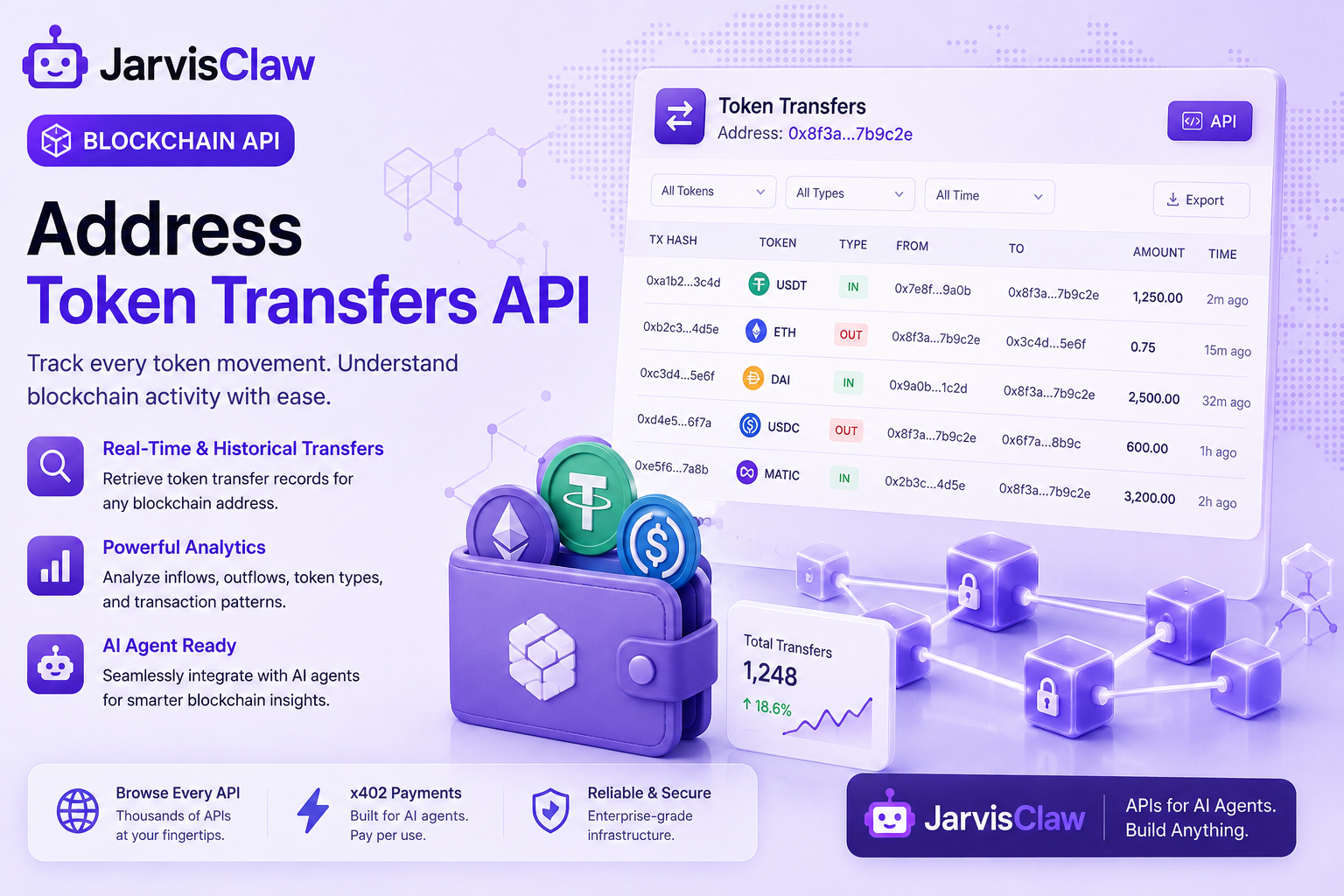
An Address Token Transfers API allows applications to retrieve token transfer information associated with a blockchain address.
Instead of building blockchain indexing infrastructure from scratch, developers can access structured transfer data through an API and use it in applications, dashboards, analytics tools, or AI-agent workflows.
JarvisClaw includes an Address Token Transfers endpoint in its Browse Every API marketplace, giving developers access to blockchain capabilities alongside thousands of other API endpoints.
What Is an Address Token Transfers API?
An Address Token Transfers API is a blockchain data service that retrieves token transfer records associated with a blockchain address.
A token transfer can represent assets moving into or out of a wallet.
By accessing these records programmatically, applications can investigate wallet activity and understand how digital assets move across blockchain networks.
The basic workflow is:Blockchain address → API request → Token transfer data → Application or AI agent For developers, this provides a convenient way to connect blockchain activity with software that needs structured transaction information.

Why Do AI Agents Need Token Transfer Data?
AI agents are increasingly used for research, monitoring, analytics, and financial applications.
However, an AI model cannot independently know every blockchain transaction.It needs external tools and APIs to retrieve specialized information.
Consider a user asking: “Show me the recent token transfers associated with this wallet and explain what changed.”
An AI agent could use an Address Token Transfers API to retrieve relevant records before analyzing them.
The workflow could look like:User → AI agent → Address Token Transfers API → Blockchain data → AI analysis → ResponseThe API provides the data, while the AI agent interprets it and presents information.
Address Token Transfers API Use Cases
Blockchain Research
Researchers can analyze transfer activity associated with specific addresses. This can help them understand asset movements and transaction patterns.An AI research assistant could retrieve transfer records and summarize important changes automatically.
How Does an Address Token Transfers API Work?
The process starts with a blockchain address.
An application sends the address to the API endpoint.
The service retrieves relevant transfer information and returns structured data that the application can process.
The general workflow is:Address → API request → Transfer records → Data processing → User interfaceFor an AI agent, another layer can be added:Address → API → Transfer data → LLM analysis → Natural-language explanation
This separation makes the system easier to build because the blockchain data layer and reasoning layer perform different jobs.
Why Use an API for Blockchain Transfers?
Building blockchain indexing infrastructure internally can be technically demanding.
Developers may need to connect to different networks, process transaction data, maintain indexing systems, and keep infrastructure reliable as activity grows.
A blockchain API can simplify this process.
Instead of creating every data-access component internally, developers can connect to an existing endpoint and focus on the application they are building.
This is useful for developers that need blockchain data without building indexing infrastructure.
Address Token Transfers and Agentic AI
Token transfer data becomes more useful when connected to autonomous AI agents.
Imagine an AI wallet assistant receiving a request to analyze a blockchain address.
The agent could retrieve token transfers, identify incoming and outgoing assets, compare activity over time, and explain the results.The workflow could become:User request → AI agent → Token transfer lookup → Data analysis → Other APIs → Final explanationThe agent could also combine transfer information with address risk, historical balances, market data, or other blockchain services.
This demonstrates an important principle of agentic AI: an intelligent system becomes more capable when it can call specialized APIs for information it cannot efficiently obtain itself.
Why Use Address Token Transfers Through JarvisClaw?
JarvisClaw API marketplace provides access to thousands of endpoints across categories including Blockchain, Audio, Search, LLM, Image, Video, and Web.
The Address Token Transfers endpoint can become one component of a broader blockchain or AI-agent workflow.
Developers could combine transfer data with historical balances, address risk tools, and an LLM to explain blockchain activity.
JarvisClaw also focuses on AI-agent infrastructure, including API access, smart routing, and x402 payment capabilities, helping agents use digital services.
The Future of Blockchain APIs and AI Agents
As AI agents become more capable, they will need ways to retrieve and interpret blockchain activity.
An Address Token Transfers API can provide one building block for that future.
An agent could monitor a wallet, retrieve new transfers, compare activity with historical data, and communicate the results to a user.
The API handles specialized data retrieval while the AI handles reasoning and communication.
Final Thoughts
An Address Token Transfers API gives developers a way to retrieve token movement information associated with blockchain addresses.
From wallet analytics and portfolio monitoring to blockchain research and autonomous AI agents, token transfer data can support many applications.
Through JarvisClaw’s API marketplace, developers can access Address Token Transfers alongside other blockchain and AI capabilities.
AI is increasingly about connecting intelligent models with reliable tools. When agents can access blockchain data through APIs, they can move beyond generic answers and perform useful, data-driven tasks.
For developers building crypto applications and agentic AI systems, specialized blockchain APIs can turn blockchain data into actionable intelligence.