
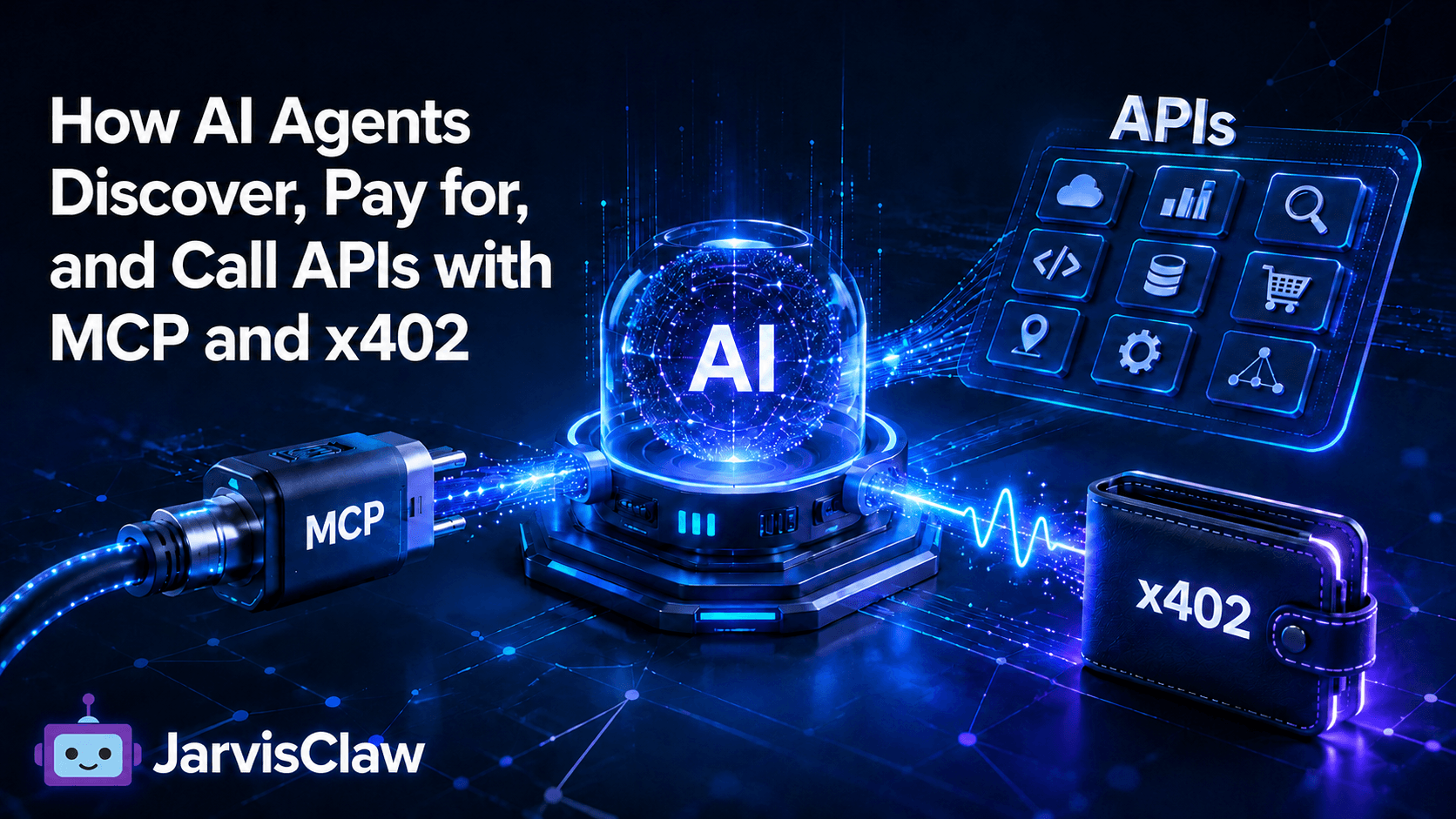
AI agents are becoming increasingly capable of planning workflows, selecting tools, processing documents, searching the web, generating media, and analyzing data. Yet most agents still depend on infrastructure designed for human users.
When an agent needs a new API, a developer usually has to find a provider, register an account, verify an email address, create an API key, configure billing, read the documentation, and add another credential to an environment file.
That process may be acceptable for three integrations. It becomes a serious operational problem when an agent needs dozens—or potentially thousands—of specialized services.
JarvisClaw addresses this problem by combining an MCP server, a multi-model AI gateway, a priced API marketplace, intent-based routing, and x402 payments. The goal is straightforward: allow an AI agent to discover a suitable service, inspect its price, stay within a defined budget, pay for the request, and receive the result without requiring a new manual integration every time.
Why the Traditional API-Key Model Limits AI Agents
API keys are not inherently unsuitable. They remain useful when a business relies on a small group of predictable providers.
The problem appears when agents operate dynamically.
Imagine an unattended research agent that suddenly needs OCR for a scanned report, geocoding for a location, token pricing for a market analysis, and text-to-speech for its final output. Under the traditional model, every service must be prepared in advance.
This creates several practical problems:
- Credentials accumulate across multiple providers.
- Different billing systems must be monitored separately.
- Developers must maintain custom integration logic.
- Agents cannot easily use a service that was not preconfigured.
- Monthly subscriptions may be purchased for APIs used only occasionally.
- Removing or replacing a provider creates additional development work.
An agent that must wait for a person to provision every new service is not fully autonomous. It is still operating inside a manually prepared toolset.
Read this article: “One Line of MCP Config: Connect Claude and Cursor to Thousands of APIs” to learn more.
One MCP Connection Instead of Multiple Integrations

Model Context Protocol, or MCP, gives AI applications a standardized way to connect with external tools. JarvisClaw exposes its catalogue through a remote MCP server.
For supported clients such as Claude Desktop or Cursor, the basic configuration is:
{
  "mcpServers": {
    "jarvisclaw": {
      "type": "url",
      "url": "https://api.jarvisclaw.ai/mcp"
    }
  }
}
This single connection gives the client a consistent interface for discovering available models and API endpoints. Instead of manually teaching the agent how every provider structures its authentication, URLs, parameters, and billing, the MCP server acts as a shared access layer.
Clients that require the standard input/output transport can use the npm package:
npx jarvisclaw-mcpThe direct URL is generally the simpler option when the MCP client supports remote URL transport.
Discover Services and Prices Before Spending
One of the most important differences between a useful agent marketplace and a basic API directory is price visibility.
According to the supplied JarvisClaw platform data, the MCP service provides free discovery tools for browsing supported AI models, searching thousands of individually priced endpoints, reviewing supported task intents, and estimating costs.
This means an agent can ask questions such as:
- Which weather APIs are currently available?
- Which endpoint supports OCR?
- What does each request cost?
- Which providers can perform image generation?
- Can this task be completed below $0.01?
Searching does not need to trigger a paid API request. The agent can first compare the available options and then decide whether to proceed.
This distinction matters because autonomous software should not discover the real price only after completing a request. A reliable agent workflow needs pricing information before execution.
Two Ways for an Agent to Choose an API
JarvisClaw supports two practical selection methods.
The first method is direct marketplace selection. The agent searches the catalogue, reviews the endpoint method and price, and chooses a specific service. This is appropriate when the developer needs predictable provider behavior or exact control over the endpoint being used.
The second method is intent-based routing. Instead of naming an endpoint, the agent describes the task—for example, web search, translation, document processing, image generation, video generation, code execution, or text-to-speech. The routing layer then identifies a suitable provider.
Direct selection offers more control. Intent routing reduces integration work. A well-designed agent can use both: fixed endpoints for sensitive or repeatable workflows, and intent-based routing for flexible tasks where the outcome matters more than the provider.
How x402 Pay-Per-Call Payments Work

x402 is an open payment standard built around the HTTP 402 Payment Required status code. It allows a server to return a machine-readable payment request when a client attempts to access a paid resource.
The basic workflow is:
- The agent requests an API resource.
- The server responds with an HTTP 402 payment requirement.
- The agent’s wallet authorizes the quoted payment.
- The client retries the request with payment authorization.
- The service executes and returns the result.
With the Agent Intent Protocol Python package, much of this process can be handled inside the SDK:
from agent_intent_protocol import AIPClient, Wallet

wallet = Wallet(private_key="0x...")
client = AIPClient(wallet=wallet)

result = client.call_api(
    "city-weather",
    {"city": "Singapore"}
)
The agent does not need to manage a separate subscription or API key for every marketplace provider. It pays for the specific call it needs.
JarvisClaw’s supplied documentation describes support for USDC settlement on Base and Solana, allowing developers to choose a supported network based on where the agent’s wallet already holds funds.
For teams that prefer conventional account billing, authenticated prepaid access can still be used. Wallet payments are therefore an additional machine-native option rather than a requirement for every implementation.
How to Prevent an Autonomous Agent from Overspending
Giving software access to a wallet naturally creates a security and budget question: what stops an agent from making too many expensive requests?
The answer should not depend only on monitoring the bill later. The spending limit needs to be applied before execution.
A task can be submitted with a maximum permitted price:
result = client.execute(
    "web_search",
    {"query": "latest x402 protocol adoption"},
    constraints={"max_price_usd": 0.01}
)
If the available service exceeds the defined limit, the task should not run. This creates a practical control layer for unattended agents.
Developers should also consider:
- Per-request price limits
- Daily wallet allowances
- Approved task categories
- Provider allowlists
- Logging for every paid request
- Separate wallets for development and production
- Human approval for unusually expensive tasks
A wallet does not eliminate governance. It makes payment programmable, which allows governance rules to be enforced directly in the workflow.
Verifiable Receipts Improve Agent Accountability
Autonomous payments need more than a transaction record. Teams must be able to verify what was requested, what result was returned, and whether the receipt was genuinely signed.
JarvisClaw’s Agent Intent Protocol can return signed AIR/1 receipts for paid responses. These receipts are designed to support independent verification of request and result hashes, the signing identity, and the associated on-chain transaction.
This is especially valuable for agent platforms, enterprise automation, financial workflows, and marketplaces where one agent may purchase services from another system. Instead of trusting a dashboard alone, developers can build verifiable payment records into their own audit process.
A Practical Architecture for Agent-Ready Applications
A production implementation can use JarvisClaw in several layers:
- Connect Claude or Cursor through MCP for interactive tool use.
- Use the Python SDK for autonomous background agents.
- Search the API marketplace before selecting a service.
- Use intent-based routing when provider selection can be automated.
- Apply a hard price limit before each task.
- Pay per call through an agent wallet or use prepaid authentication.
- Store signed receipts and transaction references for auditing.
- Configure fallback providers for important workflows.
This architecture separates the agent’s goal from the provider-specific integration. Developers can spend more time designing the workflow and less time maintaining a growing collection of API keys.
From AI Assistants to Economically Autonomous Agents
The next stage of AI infrastructure is not only about giving agents access to more powerful models. Agents also need a standardized method to discover tools, understand prices, control spending, pay for services, and verify the result.
MCP solves much of the tool-connection problem. Intent-based routing helps select the right service. x402 provides a machine-readable payment flow. Agent wallets enable pay-per-call execution, while spending limits and signed receipts create necessary controls.
JarvisClaw brings these components together through one agent-ready infrastructure layer. Developers can connect supported AI clients through MCP or build Python agents that search, select, and purchase API calls programmatically.
For teams building autonomous research agents, developer tools, data workflows, multimodal applications, or agent marketplaces, this model provides a practical alternative to maintaining separate accounts, credentials, billing systems, and integration code for every service.
Explore the available models, APIs, pricing, and agent infrastructure at JarvisClaw.
FAQ
What is an AI agent API marketplace?
It is a searchable catalogue of services that agents can discover and call programmatically. A priced marketplace also shows the cost, method and technical requirements of each endpoint.
How does MCP help AI agents use external APIs?
MCP provides a standardized connection between an AI client and external tools. It reduces the need to build a separate custom integration for every service.
What is x402?
x402 is an open payment standard that uses the HTTP 402 Payment Required response to let software receive a price quote and authorize payment for a digital resource.
Can an AI agent pay for an API without an API key?
Yes. If the service supports x402, an agent with a compatible wallet can authorize a pay-per-call transaction without maintaining a separate provider API key.
How can developers control an AI agent’s spending?
Developers can set a maximum price before task execution, restrict available tools, establish wallet allowances, maintain provider allowlists and log every paid request.
What is the difference between API selection and intent-based routing?
Direct selection allows the agent or developer to choose an exact endpoint. Intent-based routing starts with the desired task and lets the platform select a suitable provider.
Does JarvisClaw only support wallet payments?
No. The supplied platform documentation also describes authenticated prepaid access for teams that prefer a conventional account-based billing method.
Build the Future of AI with JarvisClaw
AI is moving beyond individual models toward a connected ecosystem of models, APIs, agents, and intelligent services.
JarvisClaw provides the infrastructure developers need to build this future — combining 80+ AI models, OpenAI-compatible APIs, Smart Routing, MCP support, x402 payments, and AI Agent-ready capabilities in one platform.
Whether you are building AI SaaS products, autonomous agents, automation workflows, or next-generation applications, JarvisClaw helps you integrate faster, optimize costs, and scale with confidence.
One API. Multiple Models. Agent-Ready AI Infrastructure.