
Blockchain technology has made it possible to move digital assets without traditional financial intermediaries.
But with this openness comes a major challenge: how can developers and AI agents evaluate the risk associated with a cryptocurrency address?
A wallet address may interact with many contracts, tokens, and other addresses. Understanding whether an address presents potential risks can require analyzing large amounts of blockchain information.
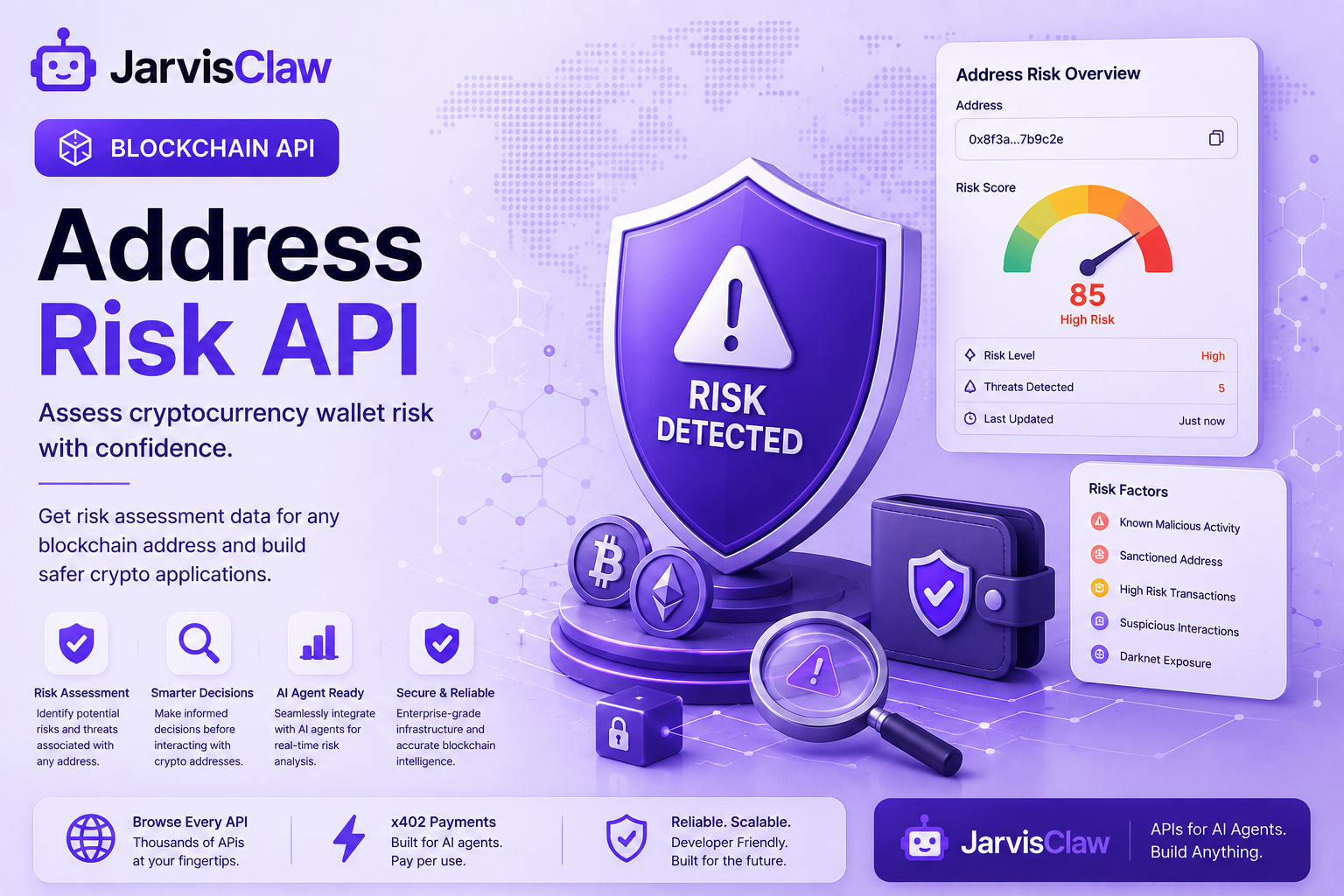
That is where an Address Risk API becomes useful.An Address Risk API provides applications with risk assessment information for a specific cryptocurrency address.
Instead of building blockchain risk-analysis infrastructure from scratch, developers can connect to an API and retrieve structured risk information that can be used in wallets, compliance workflows, analytics platforms, monitoring systems, and AI-agent applications.
JarvisClaw includes an Address Risk endpoint in its AI API Marketplace, giving developers access to specialized blockchain capabilities alongside thousands of other API endpoints.
What Is an Address Risk API?
An Address Risk API is a blockchain intelligence service that provides risk assessment data for a cryptocurrency address.
A typical application can provide a wallet address to the endpoint and receive information that can help determine whether that address presents potential risks based on available blockchain intelligence.
The basic workflow is:Wallet address → Address Risk API → Risk assessment → Application or AI agent
The returned information can then be used to support automated decisions, monitoring, investigation, or further analysis.
For developers building blockchain applications, this can turn complex wallet analysis into a programmatic API call.
Why Do AI Agents Need Blockchain Risk Data?
AI agents are increasingly being used to analyze information and make decisions through external tools.Consider an AI-powered crypto assistant receiving this request:“Check this wallet before I interact with it and tell me if there are any risk indicators.”The AI model needs reliable blockchain information before it can provide a useful answer.An Address Risk API can become one of the tools the agent uses.
The workflow could look like:User → AI agent → Address Risk API → Risk data → Agent analysis → RecommendationThe API retrieves specialized blockchain intelligence, while the AI agent interprets the information and communicates it to the user.
This is an important part of agentic AI: AI systems become more useful when they can call specialized APIs instead of relying entirely on their internal knowledge.
Address Risk API Use Cases
Crypto Wallet Applications
Wallet applications can use address risk information to provide additional context when users interact with external addresses.For example, a wallet could request risk information before displaying a warning or additional information about a destination address.
Blockchain Analytics
Blockchain analytics platforms can combine address risk information with transaction and token-transfer data.
An analytics application could retrieve an address’s risk assessment, examine its transfer activity, and present the information through a dashboard.
AI-Powered Crypto Research
An AI research agent can use address risk data as one component of a broader blockchain investigation.The agent could check an address, retrieve its transfer history, examine historical token balances, and summarize relevant findings.
Automated Monitoring
Applications can monitor blockchain addresses and use risk information as part of automated workflows.
For example, an application could periodically check addresses associated with a service and trigger additional analysis when risk information changes or requires attention.
How Does an Address Risk API Work?
The process starts with a cryptocurrency address.An application sends the address to the Address Risk endpoint.
The API processes the request and returns available risk assessment information.The application can then display the result, store it, combine it with other data, or pass it to an AI model.A simple workflow is:Address → API request → Risk assessment → Data processing → Application responseAn AI-agent workflow can add another layer:User request → AI agent → Address Risk API → Blockchain intelligence → LLM reasoning → Response
This modular architecture allows developers to separate data retrieval from AI reasoning.
Address Risk and Agentic AI
The combination of blockchain intelligence and autonomous AI agents creates powerful possibilities.Imagine an AI agent responsible for analyzing a cryptocurrency transaction before recommending an action.
The agent could first identify the destination address, request risk information, retrieve token transfer history, examine other blockchain data, and then provide the user with a structured explanation.
The workflow might become:Transaction request → Address Risk → Token Transfers → Historical Data → AI Analysis → User DecisionThe AI agent does not need to independently understand the entire blockchain. Instead, it can coordinate specialized APIs that each provide a specific capability.
This tool-based architecture is becoming increasingly important as AI agents move from simple chat interfaces toward autonomous workflows.
Why Use Address Risk Through JarvisClaw?
JarvisClaw’s API marketplace provides access to thousands of endpoints across categories including Blockchain, Audio, Search, LLM, Image, Video, and Web.
The Address Risk endpoint can become part of a larger blockchain intelligence workflow.
Developers could combine it with other blockchain APIs available through the marketplace, such as token transfer and historical balance capabilities, to create applications that provide deeper wallet analysis.
For an AI agent, these APIs can become specialized tools that the agent calls when it needs blockchain information.
JarvisClaw also focuses on AI-agent infrastructure, including API access, smart routing, and x402 payment capabilities.
This approach supports a future where AI agents can discover and use specialized digital services as part of their workflows.
Address Risk vs. Other Blockchain APIs
Address risk information is only one part of blockchain analysis.
A developer may also need token transfers to understand where assets moved, historical balances to understand how holdings changed, or other blockchain intelligence to investigate an address.
Combining these capabilities can provide a more complete picture.
For example:Address Risk + Token Transfers + Historical Balances + AI Agent = Deeper Blockchain Analysis
This is where an API marketplace becomes valuable.
Developers can combine specialized endpoints rather than building every blockchain capability themselves.
The Future of AI-Powered Blockchain Risk Analysis
As cryptocurrency applications become more sophisticated, automated blockchain intelligence will become increasingly important.
AI Agents could eventually monitor addresses, identify unusual activity, gather relevant blockchain information, and explain potential risks in natural language.
The API provides the data.
The AI agent provides the reasoning and interaction layer.
Together, they can create applications that help users understand complex blockchain activity without requiring them to manually inspect raw transaction data.
Final Thoughts
An Address Risk API gives developers a practical way to retrieve cryptocurrency address risk assessment information through a programmable interface.
From crypto wallets and blockchain analytics to automated monitoring and AI-powered research, address risk data can support many modern applications.
Through JarvisClaw‘s API marketplace, developers can access Address Risk alongside other specialized blockchain APIs and combine them into intelligent workflows.
As agentic AI continues to develop, AI agents will increasingly depend on external tools to retrieve accurate, specialized information.Blockchain APIs provide those tools, allowing AI agents to analyze wallets, understand transactions, evaluate activity, and help users make better-informed decisions.
You can now download, install, and test our developer tools for free.
JarvisClaw MCP on NPM(https://www.npmjs.com/package/jarvisclaw-mcp)🐍 Agent Intent Protocol on PyPI(https://pypi.org/project/agent-intent-protocol/)Built for developers working with AI Agents, MCP, AIP, and multi-model AI workflows.
Start Building with JarvisClaw today!!