
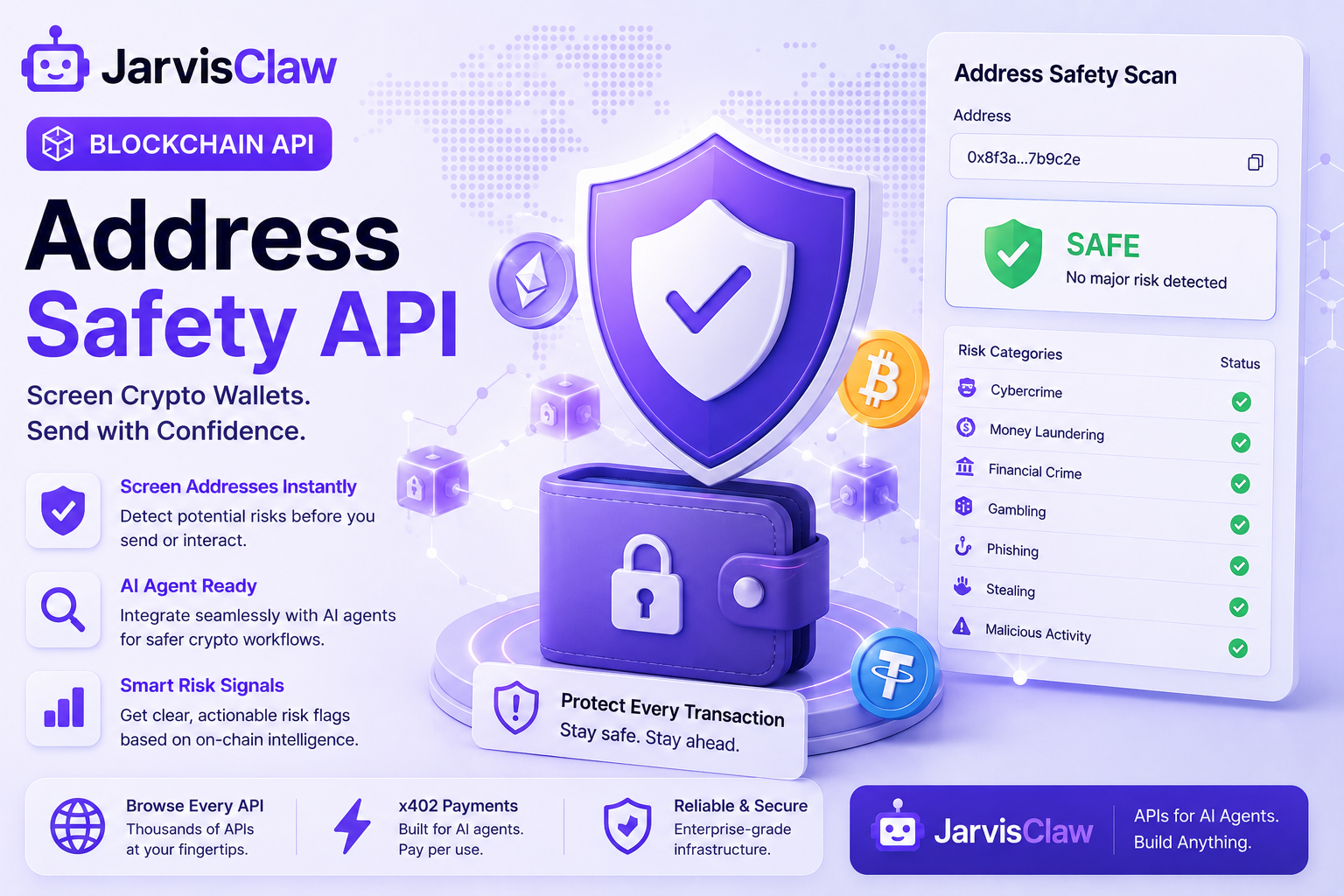
Blockchain networks make it possible to transfer digital assets, but interacting with an unknown wallet can introduce risks.
A cryptocurrency address may be associated with scams, stolen funds, suspicious activity, or other warning signals.
For developers building crypto applications and AI agents, screening addresses before action can be valuable.
That is where an Address Safety API becomes useful.
An Address Safety API provides automated screening information for a blockchain address.
Developers can connect an API to retrieve safety signals for transaction decisions, monitoring, and blockchain analysis.
JarvisClaw includes an Address Safety endpoint in its API marketplace, giving developers access to blockchain capabilities alongside thousands of other API endpoints.
What Is an Address Safety API?
An Address Safety API is a blockchain intelligence service designed to screen cryptocurrency addresses for potential risk indicators.
The Address Safety endpoint shown in JarvisClaw’s marketplace is designed for EVM addresses and provides risk flags covering areas such as cybercrime, money laundering, financial crime, gambling, phishing, stealing, and other potentially suspicious activity.
The basic workflow is:Wallet address → Address Safety API → Safety signals → Application or AI agent
The information can support wallets, analytics platforms, monitoring systems, and AI applications.
Why Do AI Agents Need Address Screening?

AI agents are connected to tools that allow them to perform actions rather than simply answer questions.Imagine an AI agent helping a user send cryptocurrency to another address.
Before the transaction proceeds, the agent could call an Address Safety API and check whether the destination has risk indicators.
The workflow could become:User request → AI agent → Address Safety API → Risk signals → Agent reasoning → Transaction decisionThis adds a verification step before an external blockchain action.
For autonomous systems, that extra layer matters.
Address Safety API Use Cases
Crypto Wallets
Wallet applications can use address screening to provide users with information before they send assets. A wallet could check a destination address and display warnings when signals appear.
Blockchain Analytics
Analytics platforms can combine address safety information with transaction histories, token transfers, and historical balances. This helps analysts understand blockchain activity broadly.
AI-Powered Crypto Assistants
An AI crypto assistant can use address safety as one of its tools. A user could provide an address and ask the assistant to investigate it. The agent could retrieve safety information, examine transfers, and explain the signals.
Transaction Monitoring
Applications can screen addresses as part of monitoring workflows. This can help platforms interacting with external wallets.
How Does an Address Safety API Work?
The process starts with a blockchain address.
An application sends the address to the API endpoint.
The service evaluates the address against intelligence and returns safety or risk-related information.
The application can then process the result.A simplified workflow is:Address → API request → Safety screening → Risk signals → Application responseFor an AI agent:Address → Safety API → Risk data → LLM analysis → Explanation or actionThe API handles blockchain screening while the AI model interprets the result.
Address Safety and Agentic AI
The value of address screening becomes clearer when it is part of an autonomous workflow.
Imagine a blockchain AI agent evaluating a payment request.
The agent could identify the destination address, check its safety signals, retrieve recent transfer information, compare historical balances, and explain the evidence before recommending whether the user should continue.
The workflow could look like:Payment request → Address identification → Safety screening → Blockchain analysis → AI reasoning → User decisionThe agent coordinates services and uses their outputs to improve its response.
This tool-based approach is central to agentic AI.
Why Use Address Safety Through JarvisClaw?
JarvisClaw’s API marketplace provides access to thousands of endpoints across categories including Blockchain, Audio, Search, LLM, Image, Video, and Web.
The Address Safety endpoint can become one component of a blockchain application.
Developers can combine it with other APIs to create wallet monitoring, transaction analysis, crypto research, and AI-agent workflows.
JarvisClaw also focuses on AI-agent infrastructure, including API access, smart routing, and x402 payment capabilities.
API infrastructure makes capabilities easier to integrate.
The Future of Automated Blockchain Safety
As cryptocurrency applications become more automated, safety checks will increasingly become part of software workflows.
AI agents may monitor addresses, evaluate transaction requests, gather blockchain intelligence, and explain concerns before action.
That requires tools that provide information when an agent needs it.
An Address Safety API can serve as one of those tools.
Final Thoughts
An Address Safety API gives developers a way to screen cryptocurrency addresses and retrieve blockchain safety signals.
From crypto wallets and blockchain analytics to transaction monitoring and AI-powered assistants, address screening can support applications that need context before interacting with blockchain addresses.
Through JarvisClaw API marketplace, developers can access Address Safety alongside other blockchain capabilities.
The future of agentic AI depends on connecting models with useful tools. When an AI agent can retrieve safety information, analyze blockchain activity, and combine APIs, it can move from answering questions toward helping users make informed decisions.
For developers building AI-powered crypto applications, an Address Safety API can be an important building block for safer, more tool-aware blockchain workflows.
You can now download, install, and test our developer tools for free.📦 JarvisClaw MCP on NPM(https://www.npmjs.com/package/jarvisclaw-mcp)🐍 Agent Intent Protocol on PyPI(https://pypi.org/project/agent-intent-protocol/)
Built for developers working with AI Agents, MCP, AIP, and multi-model AI workflows.