
Blockchain networks generate streams of activity.
Tokens move between wallets, assets change state, and on-chain events create valuable information.
For developers building blockchain analytics tools and AI agents, the challenge is turning raw activity into useful, structured data.
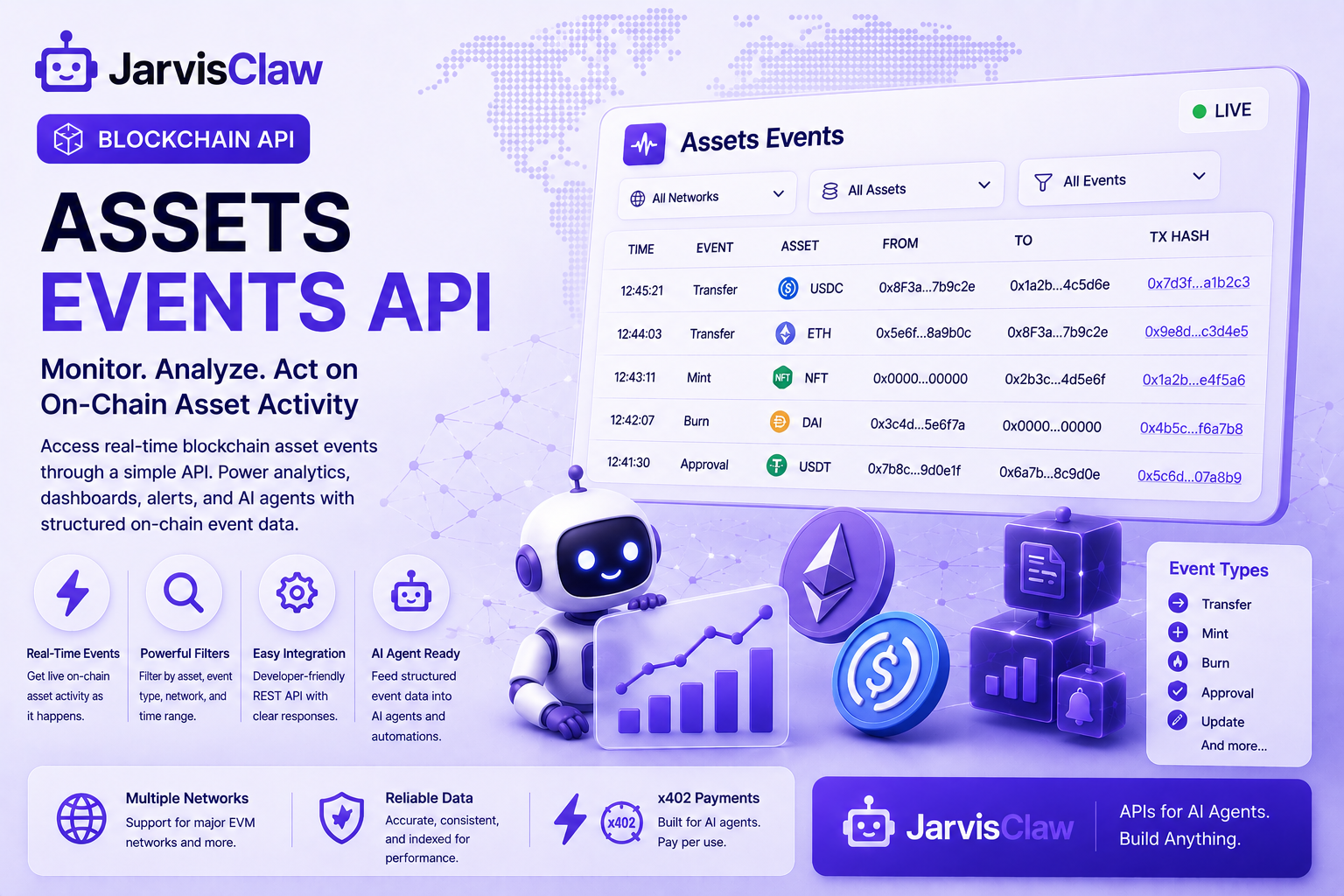
An Assets Events API gives applications programmatic access to events related to blockchain assets.
Instead of building an event-indexing system from scratch, developers can connect an API to retrieve asset activity and use it in dashboards, analytics platforms, automated workflows, and AI-agent applications.
JarvisClaw includes an Assets Events endpoint in its AI API Marketplace, making this blockchain capability available alongside thousands of other API endpoints.
What Is an Assets Events API?
An Assets Events API is a blockchain data API designed to provide information about events associated with digital assets.
Blockchain applications produce events when important on-chain actions occur. These events can help applications understand what is happening without requiring developers to inspect raw blockchain data manually.
The basic workflow is:Asset or blockchain activity → API request → Event data → Application or AI agent
Developers can process returned information, store it, visualize it, or pass it to an AI model for analysis.
Why Do AI Agents Need Blockchain Event Data?
AI agents are capable of using external tools.
Instead of relying only on information stored inside a language model, an agent can call APIs to retrieve current, specialized data.
An Assets Events API can become the data layer:User → AI agent → Assets Events API → Blockchain events → AI analysis → Response
The API retrieves event information, while the AI agent interprets it and explains what it means.
Assets Events API Use Cases
Blockchain Analytics
AI-Powered Blockchain Research
A blockchain research agent can retrieve asset events and summarize significant activity.
Instead of forcing users to examine blockchain explorers manually, the agent can turn technical data into a natural-language explanation.
Automated Monitoring
Applications can use blockchain event data to trigger automated workflows.
A monitoring system could retrieve relevant events and send an alert when activity meets specific conditions.
Crypto Applications
Wallets, portfolio tools, and decentralized applications can use event data as part of blockchain intelligence workflows.
How Does an Assets Events API Work?
A typical workflow starts when an application identifies the asset or blockchain activity it wants to investigate.
The application sends the appropriate request to the API.
The endpoint retrieves relevant event information and returns structured data.
The workflow can be represented as:Blockchain activity → API request → Event retrieval → Structured data → ApplicationThis separation makes the system modular.
The API specializes in retrieving blockchain information, while the AI model specializes in interpreting it.
Why Use an API Instead of Building Blockchain Indexing?
Collecting blockchain events directly can require substantial development work. Teams may need to connect to blockchain infrastructure, process event logs, maintain indexing pipelines, handle network changes, and make systems reliable at scale.
A specialized blockchain API can reduce that engineering burden.
Developers can focus on their application while the API provides an interface for accessing data.
This can be useful for startups, AI developers, and teams experimenting with blockchain automation.
Assets Events and Agentic AI
The combination of blockchain events and agentic AI creates opportunities for responsive applications.
Imagine an AI agent responsible for monitoring a portfolio.
The agent could retrieve asset events, identify significant changes, compare them with other blockchain data, and notify the user when something important happens.
A broader workflow could look like:Monitor → Retrieve events → Analyze activity → Apply rules → Call another API → Notify user
The agent can coordinate multiple services rather than depending on a single source of information.
This is one reason APIs are becoming important infrastructure for agentic AI.
Why Use Assets Events Through JarvisClaw?
JarvisClaw’s API marketplace brings together thousands of endpoints across categories including Blockchain, Audio, Search, LLM, Image, Video, Web, and more.
The Assets Events endpoint can serve as one component of a larger blockchain intelligence workflow.
Developers can combine event information with other blockchain APIs, LLM services, search tools, or AI-agent systems.
For example, an application could retrieve asset events, send relevant data to an LLM, and generate a plain-language summary for users.
JarvisClaw also focuses on infrastructure for AI agents, including API access, smart routing, and x402 payment capabilities.
This is relevant as autonomous agents increasingly need to discover, access, and pay for specialized digital services.
The Future of Blockchain Event APIs
As blockchain applications become more automated, blockchain data will become increasingly important.
AI agents could continuously monitor asset activity, identify unusual events, research related information, and communicate important changes without requiring users to inspect raw blockchain records.
An Assets Events API can provide one of the data layers required for these workflows.
The future of AI agents depends on more than powerful language models. Agents need tools, data, and APIs that allow them to interact with real-world digital systems.
By connecting blockchain event data with AI reasoning, developers can build applications that monitor activity, explain complex events, and automate useful actions.