
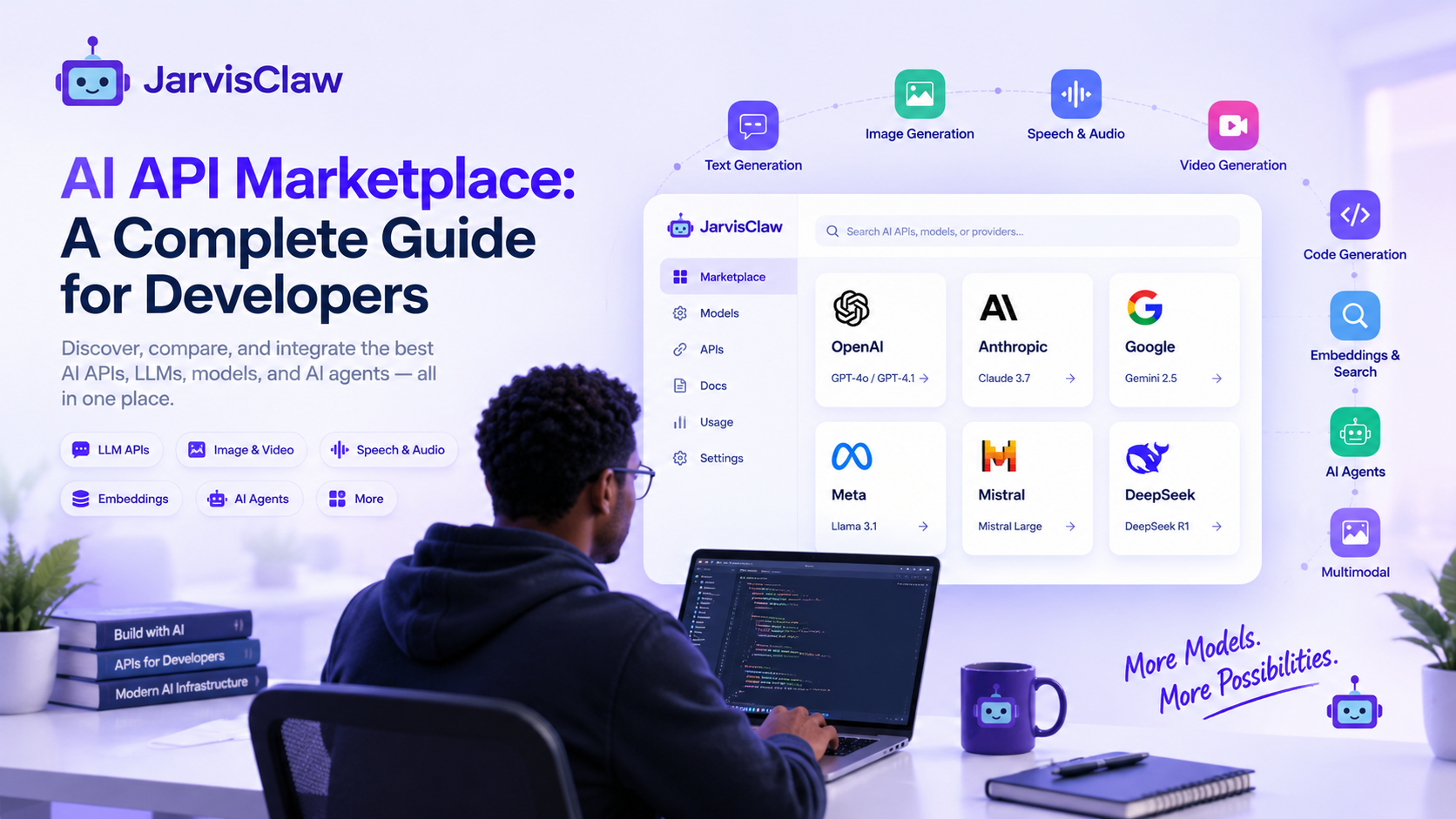
Building an AI-powered application used to mean choosing one model provider, getting an API key, and integrating it into your product.
Today, developers have access to a much broader ecosystem of AI APIs, LLM APIs, image generation APIs, speech APIs, embedding models, AI agents, and specialized AI tools.
That growing ecosystem creates an opportunity—and a problem.
How do you discover the right API, compare models, manage multiple providers, and integrate AI without creating unnecessary infrastructure?This is where an AI API marketplace comes in.
What Is an AI API Marketplace?
An AI API Marketplace is a platform where developers can discover, compare, access, and integrate AI APIs and models from different providers.Instead of searching through individual provider websites, developers can use a marketplace to find APIs for specific tasks such as:
- Text generation and chat
- Image generation and editing
- Video generation
- Speech-to-text and text-to-speech
- Embeddings and vector search
- Vision and multimodal AI
- AI agents and automation
- Code generation
- Translation and summarization
Modern AI infrastructure is also moving toward unified gateways that allow applications to access multiple models through a common interface.
Why Are AI API Marketplaces Becoming Important?
The AI API ecosystem is becoming increasingly fragmented.
Developers may need different models for different jobs rather than relying on a single provider.
For example, one application might use:
| Requirement | Possible API Type |
| Customer support | LLM API |
| Image creation | Image generation API |
| Voice assistant | Speech-to-text + text-to-speech |
| Document search | Embedding API |
| AI coding | Code generation model |
| Autonomous workflow | AI agent API |
This creates integration and infrastructure challenges.
An AI API marketplace can simplify discovery and reduce the amount of time developers spend evaluating individual services.
It can also make it easier to experiment with different models before committing to a particular provider.
AI API Marketplace vs. Direct API Integration
With direct integration, your application communicates separately with each AI provider.
For example:
Your App → Provider A
Your App → Provider B
Your App → Provider C
This can work well when you only need one model.
But as your application grows, maintaining several integrations can become more complicated.
A marketplace or AI API gateway can provide a more centralized architecture:Your App → AI API Marketplace/Gateway → Multiple Models
This approach can make model switching, provider management, usage monitoring, and routing easier.
Unified AI gateways are increasingly designed around exactly these capabilities, including model switching, fallbacks, spend monitoring, and routing.
What Should Developers Look for in an AI API Marketplace?
Not every marketplace offers the same developer experience. Before integrating an API, consider these factors
1.Model and API Selection
A useful marketplace should provide enough variety to support different development requirements.
Look for access to:
- Large language models
- Open-weight models
- Multimodal models
- Image and video models
- Audio APIs
- Embedding models
- Specialized AI services
The growing role of open-weight models is particularly important.
Recent gateway usage data shows significant growth in open-weight model usage, indicating that developers increasingly have alternatives beyond closed frontier models
2. API Compatibility
Documentation and integration quality matter.
Developers should look for:
- Clear API documentation
- REST APIs
- SDK support
- Code examples
- Authentication guides
- Error documentation
- Streaming support
- OpenAI-compatible interfaces where available
Good documentation can dramatically reduce the time between discovering an API and putting it into production.
3. Pricing and Usage
AI API pricing can vary significantly between models and providers.
Don’t compare only the advertised price.
Consider:
- Input token costs
- Output token costs
- Image or audio pricing
- Request limits
- Minimum commitments
- Free creditsRate limits
- Enterprise pricing
For applications operating at scale, AI API cost optimization can become an important part of architecture.
4. Latency and Reliability
A model that produces excellent results but responds too slowly may not be suitable for a real-time application.
Developers should evaluate:
- Response latency
- Availability
- Rate limits
- Error rates
- Regional availability
- Provider redundancy
- Fallback options
AI gateways increasingly use routing and fallback mechanisms to improve availability and optimize requests for cost or latency.
AI API Marketplaces and AI Agents
The rise of AI agents makes API marketplaces even more interesting.
An AI agent may need access to multiple capabilities rather than a single language model. It might need to search the web, generate an image, analyze a document, call an external service, or interact with another application.
This means developers increasingly need an ecosystem of APIs and tools that agents can call.
MCP is also becoming an important part of this ecosystem by providing a standardized way for AI systems to connect with external tools and services.
For developers building agentic applications, the API marketplace can therefore become more than a model directory—it can become an infrastructure layer for connecting AI applications to capabilities.
How to Choose the Right AI API
Start with the use case, not the model name.
Ask:
- What does my application need to accomplish?
- Do I need text, image, video, audio, or multimodal capabilities?What response time can users tolerate?
- How much traffic will the application handle?
- What is my expected AI API budget?
- Do I need one model or multiple models?
- Will I eventually build AI agents?
- How important are fallback and provider redundancy?
Then test several APIs with the same workload.
Compare quality, latency, reliability, pricing, context limits, developer experience, and integration complexity before selecting your production setup.
Why JarvisClaw Fits the AI API Marketplace Model
JarvisClaw API is designed around the idea that developers shouldn’t have to build their AI infrastructure around a single model provider.
A unified API approach can give developers a simpler way to experiment with different AI capabilities while keeping their application architecture more flexible.
For developers building AI agents, SaaS products, automation workflows, generative AI applications, or multimodal applications, having centralized access to AI APIs can make experimentation and integration significantly easier.
The Future of AI API Marketplace
The AI API market is moving beyond simply providing access to individual models.The next generation of AI infrastructure is increasingly focused on:
- Multi-model applications
- Intelligent model routing
- AI agents
- Multimodal APIs
- Open-weight models
- MCP and tool integrations
- Cost-aware inference
- Low-latency AI
- Provider redundancy
- Unified API interfaces
For developers, this means the question is no longer simply “Which AI model should I use?”It is increasingly “Which combination of models, APIs, tools, and infrastructure should power my application?”An AI API marketplace can provide the layer that makes that choice easier.
FAQ
What is an AI API marketplace?
An AI API marketplace is a platform where developers can discover and access AI models and APIs for tasks such as text generation, image generation, speech, embeddings, vision, and AI agents.
What is the difference between an AI API and an AI API marketplace?
An AI API provides access to a specific AI capability or model.
An AI API marketplace brings multiple APIs or models together so developers can discover and integrate different services from one platform.
Why use an AI API marketplace?
It can simplify API discovery, model comparison, integration, and multi-provider development while giving developers more flexibility when selecting AI infrastructure.
What is an AI API gateway?
An AI API gateway provides a centralized interface between an application and multiple AI providers or models. It can support capabilities such as routing, fallbacks, usage monitoring, and model switching.
Are AI API marketplaces useful for AI agents?
Yes. AI agents often need access to multiple models and external tools.
A marketplace can help developers discover the APIs and capabilities required to build these workflows.
How should developers choose an AI API?
Evaluate the API based on your specific use case, model quality, latency, pricing, reliability, documentation, integration requirements, and scalability.
Build With More AI APIs, Without More Integration Complexity
The AI ecosystem is expanding quickly, and developers have more choices than ever. The challenge is turning those choices into a reliable application architecture.
With JarvisClaw, developers can explore a unified approach to AI APIs and build applications without unnecessarily locking their architecture to a single model or provider.
Explore JarvisClaw, discover the APIs your application needs, and start building your next AI-powered product.
Start building with JarvisClaw today!