
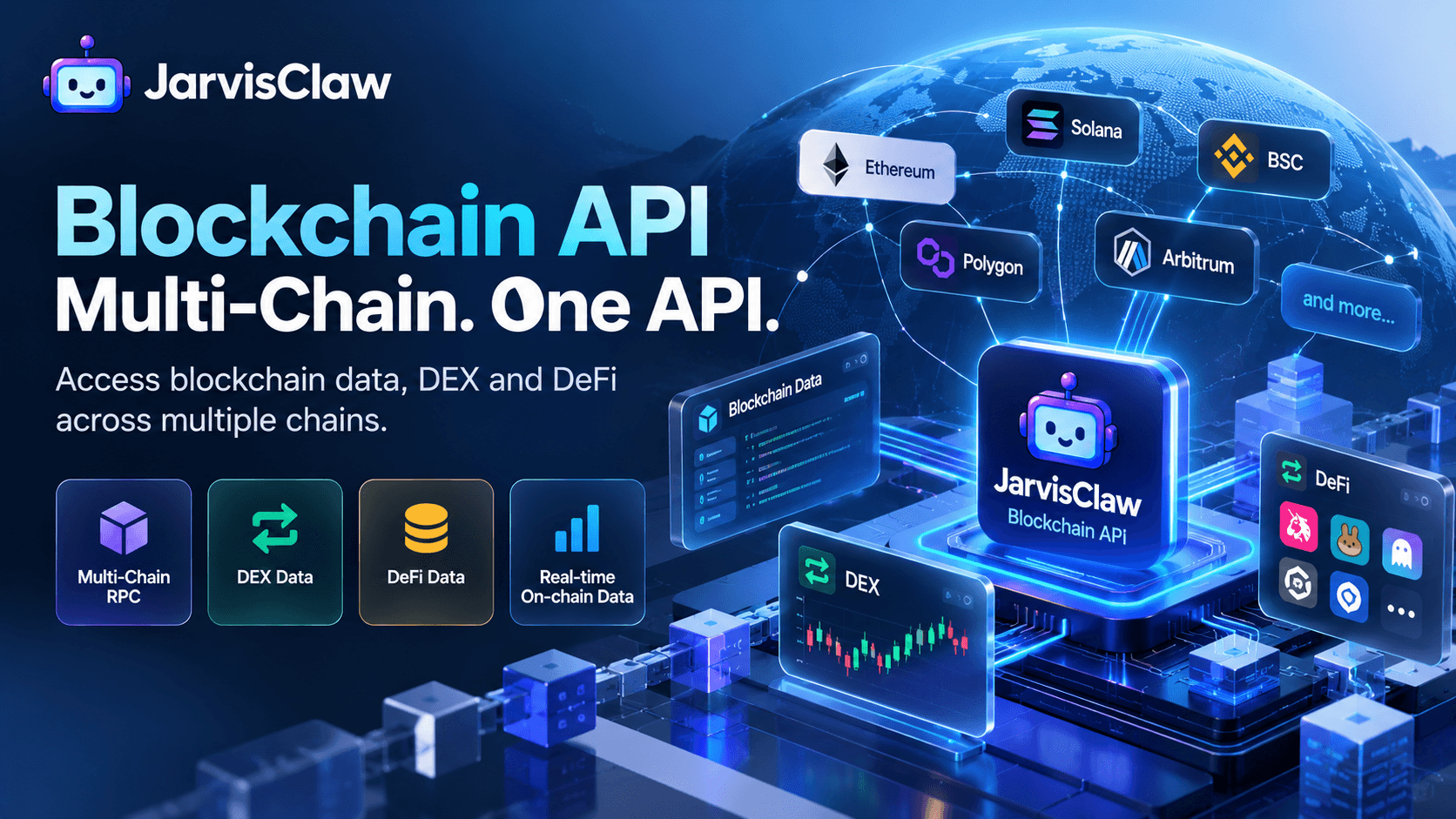
Building a multi-chain application sounds simple until the application needs to work across Ethereum, Base, Arbitrum, Solana, Bitcoin and several other networks.
Each new chain may require another RPC provider, account, API key, billing plan, network configuration and failure-handling strategy. Adding swaps and DeFi data creates more work because developers must also connect aggregators, normalize token information and maintain integrations with protocol-data services.
The JarvisClaw Blockchain API brings multi-chain JSON-RPC, DEX routing and DeFi protocol data into one developer workflow.
Instead of creating a separate infrastructure stack for every network, developers can use one base URL and change the chain in the request path.
This approach is particularly useful for wallets, portfolio trackers, DeFi dashboards, cross-chain applications and AI Agents that need to read blockchain state or prepare transactions dynamically.
What Does the JarvisClaw Blockchain API Provide?
The Blockchain API is divided into three main capability groups.
| Capability | What it provides | Typical applications |
|---|---|---|
| Multi-chain RPC | Standard JSON-RPC access across EVM and non-EVM networks | Wallets, monitors, indexers and Agents |
| DEX routing | Indicative and firm swap quotes across multiple liquidity sources | Swap interfaces and automated workflows |
| DeFi data | Protocol TVL, historical data, yields and token prices | Research dashboards and portfolio analysis |
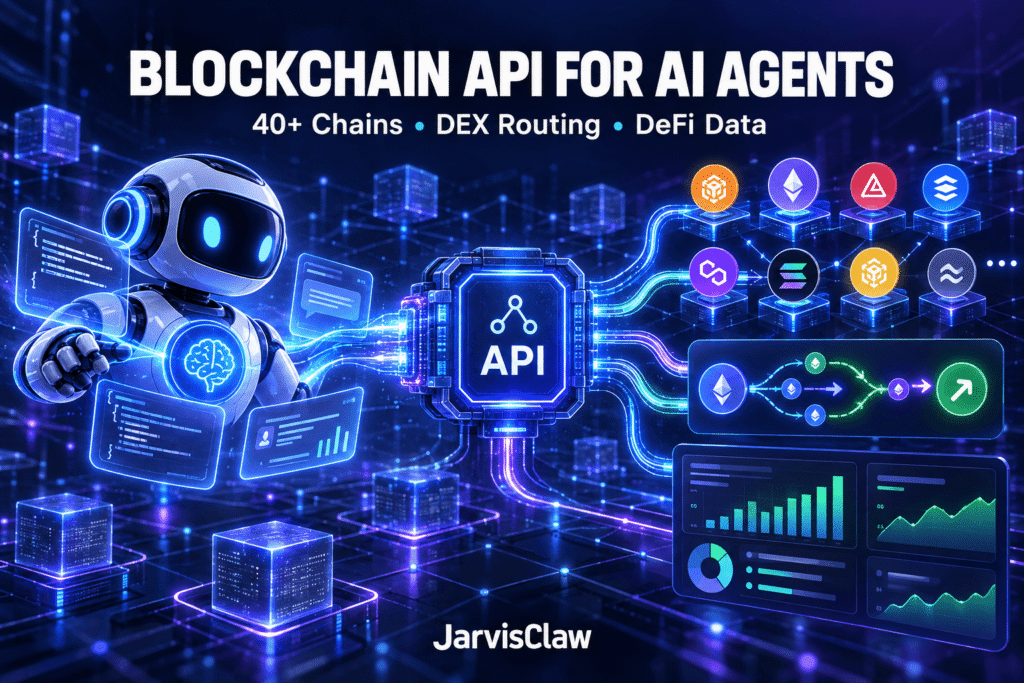
The current service covers more than 40 networks, including major EVM chains and non-EVM ecosystems.
Developers can access networks such as Ethereum, Base, Arbitrum, Optimism, Polygon, BNB Chain, Avalanche, Solana, Bitcoin, NEAR, Sui, XRP and Polkadot without maintaining a separate provider account for every chain.
Why Multi-Chain Development Becomes Complicated
Blockchain networks do not all use the same methods.
EVM-compatible networks commonly use methods such as:
eth_blockNumbereth_getBalanceeth_calleth_getTransactionReceipteth_getLogs
Solana uses methods such as getSlot, getBalance and getTransaction. Bitcoin and other networks have their own RPC conventions.
The application must therefore know both the correct network and the correct method.
Infrastructure management adds another layer of complexity:
- Different provider dashboards
- Different credentials
- Different rate limits
- Different archive-data policies
- Inconsistent error formats
- Separate usage bills
- Provider-specific failover logic
A unified gateway does not make every blockchain identical, but it gives developers one connection point through which chain-native methods can be sent.
Making a Multi-Chain JSON-RPC Request
The JarvisClaw Blockchain API uses the following base URL:
https://api.jarvisclaw.ai/v1/marketplaceThe chain is included as part of the URL path.
For example, a request for the latest Base block number can be sent to:
curl -X POST "https://api.jarvisclaw.ai/v1/marketplace/rpc/base" \
  -H "Authorization: Bearer sk-your-api-key" \
  -H "Content-Type: application/json" \
  -d '{
    "jsonrpc": "2.0",
    "id": 1,
    "method": "eth_blockNumber",
    "params": []
  }'
To query another supported EVM network, the developer changes the chain path while keeping the standard JSON-RPC structure.
The important detail is that the chain belongs in the URL:
Correct: /rpc/base
Incorrect: /rpc?chain=base
Method names still follow the rules of the selected network. An EVM method should not be sent to Solana simply because both networks are accessible through the same gateway.
Practical Use Case 1: Multi-Chain Wallet Dashboard
A wallet dashboard may need to display assets across Ethereum, Base, Arbitrum and Solana.
A practical workflow is:
- Validate the wallet address and selected network.
- Retrieve the native-token balance.
- Query supported token contracts or portfolio data.
- Retrieve prices for valuation.
- Normalize token decimals.
- Display balances with their chain identifiers.
- Record the block number used for each result.
The final response should never combine balances without preserving the chain.
The same token symbol can exist on several networks, and unrelated tokens can share a name. A reliable portfolio record should include:
- Chain ID
- Token contract address
- Token symbol
- Token decimals
- Raw balance
- Human-readable balance
- Price source
- Block number or timestamp
This prevents a common error in which assets with the same symbol are incorrectly treated as one token.
Practical Use Case 2: AI Agents That Read Blockchain State
An AI Agent can use blockchain RPC data to answer questions that a language model cannot answer from its training data.
For example:
Check the current native balance of this wallet on Base, verify whether a transaction succeeded, and summarize the result.
The Agent could:
- Identify the requested chain.
- Validate the address and transaction hash.
- Call the appropriate RPC methods.
- Convert hexadecimal values into readable units.
- Check the transaction receipt.
- Return the data source and block number.
The model should explain retrieved data rather than inventing chain state.
A production prompt should clearly instruct the Agent:
Use only the returned RPC data. If a request fails or the result is missing, report that the information could not be confirmed.
This simple rule reduces unsupported answers.
Practical Use Case 3: DEX Swap Quotes
JarvisClaw also provides DEX-routing endpoints that can compare liquidity across multiple exchanges.
A typical swap workflow has two quote stages.
An indicative price helps the application estimate the exchange rate before requesting a transaction-ready quote.
A firm quote can include the data needed to prepare the transaction.
A controlled process should look like this:
- Confirm the network.
- Validate the sell and buy token addresses.
- Convert the amount into raw token units.
- Request an indicative price.
- Check price impact and expected output.
- Request a firm quote.
- Display the route, fees and gas estimate.
- Ask the user to approve the transaction.
- Sign through the user’s wallet.
- Broadcast and monitor the transaction.
The API can prepare or route a swap, but it should not silently authorize wallet activity.
Private keys must remain inside a secure wallet or signing environment. Never place a private key in a prompt, client-side source file or ordinary application log.
Indicative Quotes vs. Firm Quotes
| Quote type | Best use | Important limitation |
|---|---|---|
| Indicative price | Previewing expected output | May not include executable transaction data |
| Firm quote | Preparing a transaction | Can expire as liquidity and gas conditions change |
| Gasless quote | Checking a relayer-supported flow | Availability depends on the route and supported assets |
A quoted output is not the same as a guaranteed completed swap.
Between quotation and execution, the result can change because of market movement, liquidity, slippage, gas conditions or transaction ordering.
Applications should therefore display the quote timestamp and expiration information when available.
Practical Use Case 4: DeFi Yield and TVL Research
The Blockchain API also provides protocol-level information such as total value locked, yield data and token prices.
Developers can use this information to build:
- DeFi research dashboards
- Protocol comparison tools
- Yield-monitoring Agents
- Treasury-allocation reports
- Protocol TVL alerts
- Portfolio-exposure summaries
APY alone should not determine whether a protocol is suitable.
A higher advertised yield may be associated with:
- Token incentives that can end
- Low liquidity
- Volatile reward tokens
- Smart-contract risk
- Impermanent loss
- Withdrawal restrictions
- Bridge exposure
- Rapidly changing utilization
An Agent should present yield as one field in a wider risk assessment, not as a recommendation.
Handling Large DeFi Responses
The complete yield dataset can be large. Retrieving and sending the entire response to a language model may increase bandwidth, latency and token costs.
A better workflow is:
- Retrieve the data once.
- Filter by chain or protocol category.
- Remove fields that are not needed.
- Apply minimum TVL and liquidity thresholds.
- Sort the remaining records.
- Send only the relevant subset to the model.
For example, an Agent researching stablecoin yields on Base does not need every pool on every blockchain.
Filtering before model analysis reduces both cost and noise.
Hidden Costs Developers Should Plan For
The published API price is not the complete cost of a blockchain workflow.
Batch Requests Are Charged Per Element
A JSON-RPC batch can reduce network round trips, but it does not necessarily reduce the number of billable reads.
A batch containing ten RPC objects should be budgeted as ten calls.
On-Chain Gas Is Separate
The API fee covers access to the endpoint or quote.
If a transaction is broadcast on-chain, the wallet may also need to pay network gas. Gasless endpoints are an exception where a relayer supports the transaction cost.
Polling Can Multiply Usage
Checking a receipt every second can create many unnecessary calls.
Use a reasonable polling interval, set a timeout, and stop when the transaction reaches a final state.
Historical Data Can Be Expensive
Large log ranges may time out, return excessive data or require repeated calls.
Split long time ranges into predictable blocks and store completed results.
Large Responses Increase Processing Costs
A large DeFi dataset may be inexpensive to retrieve but costly to transfer, store and analyze with an LLM.
Filter the response before downstream processing.
Common Blockchain API Mistakes
Using the Wrong Token Decimals
Token amounts are often returned in raw units.
Displaying the raw integer without applying the token’s decimal value can produce a seriously incorrect balance or trade amount.
Treating a Pending Transaction as Final
A transaction hash only confirms submission.
Applications should check the receipt and required confirmation depth before updating a payment or order as complete.
Ignoring Chain Reorganizations
Recent blockchain state may change during a reorganization.
For sensitive workflows, wait for an appropriate number of confirmations rather than treating the newest block as permanently settled.
Mixing Address Formats
Ethereum-style addresses, Solana addresses and addresses from other networks follow different formats.
Validation must be chain-specific.
Trusting APY Without Context
Yield data can change quickly and may depend on incentive tokens or temporary liquidity conditions.
Store the retrieval time and avoid presenting APY as a guaranteed return.
Production Checklist
Before launching a blockchain-powered application, confirm:
- All supported chains have explicit identifiers.
- Address validation is network-specific.
- Token contract addresses and decimals are stored.
- RPC responses include a block reference.
- Batch requests are budgeted per element.
- Polling uses intervals, limits and timeouts.
- Swap quotes display slippage and expiration details.
- Private keys never reach the application backend unnecessarily.
- Human approval is required before signing transactions.
- On-chain gas is separated from API fees.
- DeFi data is filtered before LLM processing.
- Failed calls return a clear error instead of invented data.
- Logs exclude wallet secrets and payment signatures.
Why Use JarvisClaw for Blockchain Workflows?
JarvisClaw combines AI models, Agent infrastructure and specialized APIs through a unified platform.
For blockchain applications, this means a developer can connect chain state, DEX routing and DeFi data to an AI Agent without maintaining a different service account for every capability.
A complete Agent workflow could be:
User request
→ Select blockchain
→ Read chain state
→ Retrieve swap or DeFi data
→ Validate the response
→ Generate an explanation
→ Request user approval
→ Sign and submit through a secure wallet
JarvisClaw also supports API-key access and agent-oriented pay-per-call settlement. Current availability and pricing should always be confirmed on the live Blockchain API page before production execution.
Final Takeaway
A modern blockchain application often needs more than a basic Ethereum RPC connection.
It may need multi-chain balances, transaction receipts, DEX quotes, gasless routes, protocol TVL and yield data. Building and maintaining a separate integration for every chain and provider creates unnecessary complexity.
The JarvisClaw Blockchain API provides one entry point for JSON-RPC across more than 40 networks, DEX routing and DeFi research data.
Start with one controlled use case, validate every network-specific input, separate API charges from gas, and keep transaction signing under explicit wallet control.
Build the Future of AI with JarvisClaw
AI is moving beyond individual models toward a connected ecosystem of models, APIs, agents, and intelligent services.
JarvisClaw provides the infrastructure developers need to build this future — combining 80+ AI models, OpenAI-compatible APIs, Smart Routing, MCP support, x402 payments, and AI Agent-ready capabilities in one platform.
Whether you are building AI SaaS products, autonomous agents, automation workflows, or next-generation applications, JarvisClaw helps you integrate faster, optimize costs, and scale with confidence.
One API. Multiple Models. Agent-Ready AI Infrastructure.