
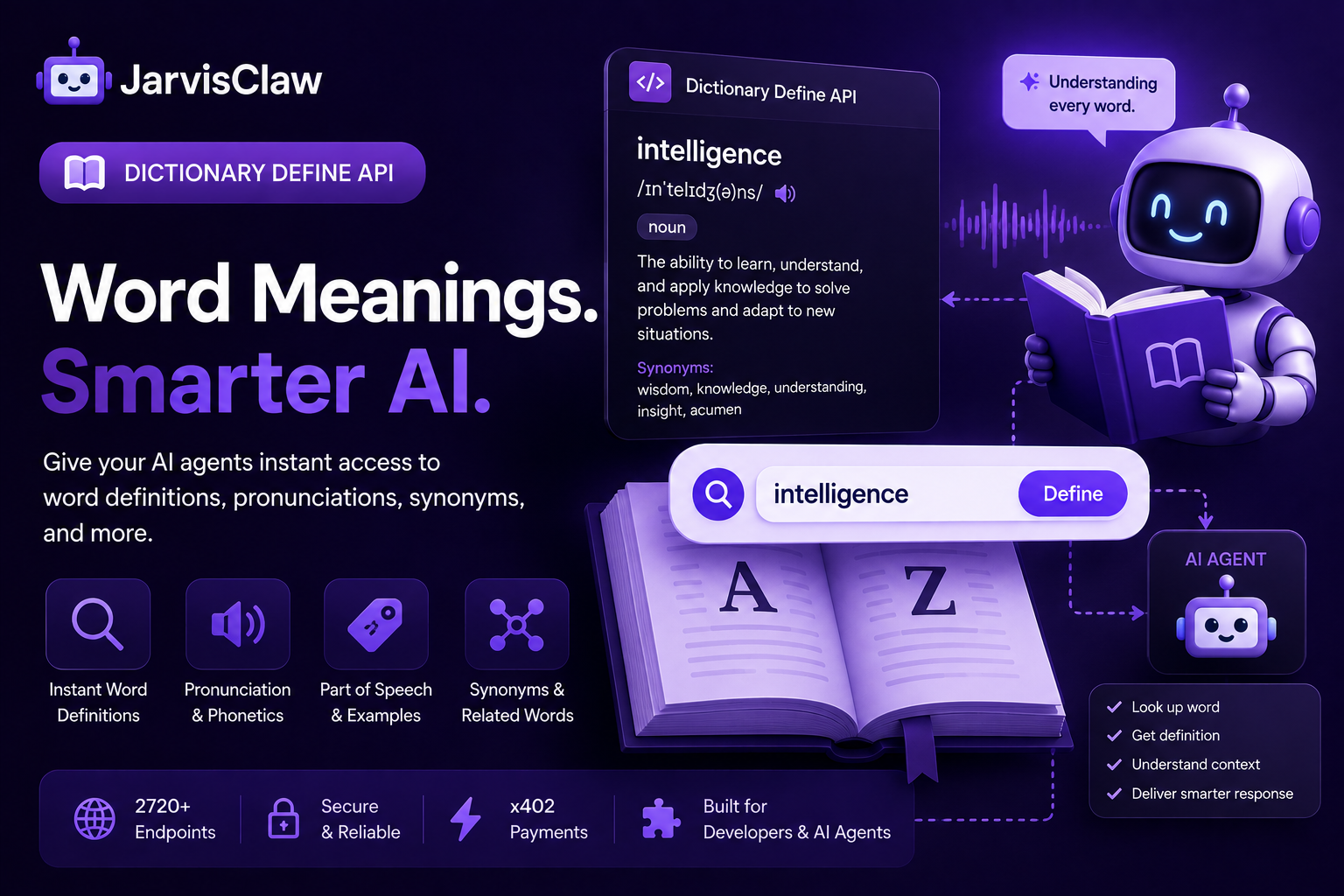
Language is one of the most important sources of information for AI applications. Whether an AI agent is answering a question, analyzing a document, helping a student, or processing customer messages, it needs to understand words and their meanings accurately.
That is where a Dictionary Define API becomes useful.
A Dictionary Define API provides programmatic access to word definitions and related linguistic information.
Instead of manually searching a dictionary, developers can connect an application or AI agent to an API and retrieve information about a word when it is needed.
JarvisClaw includes a Dictionary Define endpoint in its Browse Every API marketplace, giving developers access to specialized language capabilities alongside thousands of other API endpoints.
What Is a Dictionary Define API?
A Dictionary Define API is a language API that allows software to look up the meaning of a word.
A typical request can provide a word, while the API returns relevant information such as its definition, pronunciation, part of speech, synonyms, or other available linguistic details.
The basic workflow is:Word → API request → Definition → Application or AI agentThese APIs support education, writing tools, search, chatbots, and AI applications.
Why Do AI Agents Need Dictionary APIs?
Large language models are powerful at understanding and generating language, but AI agents often need access to specialized information while completing tasks.
Consider an AI agent analyzing a technical document.
It may encounter an unfamiliar term or need to verify the meaning of a particular word.
Instead of relying entirely on its existing model knowledge, the agent can use a dictionary API to retrieve a definition.
The workflow could look like this:User → AI Agent → Dictionary Define API → Definition → Agent reasoning → ResponseThis gives the agent an external language resource that can support its reasoning and improve how it explains unfamiliar terminology.
Dictionary Define API Use Cases
AI-Powered Writing Tools
Writing applications can use a dictionary API to help users understand unfamiliar words, improve vocabulary, and discover alternative expressions.
An AI writing assistant could identify a difficult word and provide its definition without requiring the user to leave the application.
Education and Learning
Educational applications can use dictionary APIs to create interactive vocabulary tools.
An AI tutor could explain unfamiliar words while helping students read an article or complete an assignment, making digital learning more interactive.
Search and Information Retrieval
Search applications can use dictionary data to help users understand search results.
A definition endpoint can also become part of a larger information-retrieval workflow where an AI agent searches for information and explains unfamiliar terminology.
AI Agent Workflows
Autonomous AI agents can call a Dictionary Define API whenever they encounter a word requiring clarification.
This is useful for agents processing text, documents, customer messages, or web content.

How Does a Dictionary API Work?
The process is generally straightforward.
First, an application or AI agent identifies the word it needs to understand.Second, it sends the word to the Dictionary Define API.
Third, the API processes the request and returns the available definition and linguistic information.
The application can then display the result or provide it to an AI model as additional context.
For example:Text → AI Agent → Identify unfamiliar word → Dictionary API → Definition → Explain to user
Dictionary APIs and AI Agents
The combination of dictionary APIs and AI agents creates interesting possibilities.
Imagine a research assistant receiving a technical report containing unfamiliar terminology.
The agent could identify difficult words, request their definitions, use those definitions to improve its understanding of the document, and then produce a simpler summary for the user.The workflow could become:Document → AI Agent → Terminology detection → Dictionary Define API → Contextual understanding → SummaryThe dictionary API does not replace the AI model.
Instead, it provides a specialized capability that the agent can call when necessary.
This is an important principle in agentic AI: specialized APIs can give AI agents access to capabilities beyond their core reasoning model.
Why Use Dictionary Define Through JarvisClaw?
JarvisClaw’s Browse Every API marketplace brings together thousands of endpoints across different categories and use cases.
The marketplace includes capabilities for Audio, Search, LLM, Blockchain, Image, Video, Web, and more.
The Dictionary Define endpoint can become one component of a larger AI application. Developers could combine dictionary lookup with an LLM, search API, document processing service, or AI agent to build intelligent language workflows.
JarvisClaw also provides infrastructure focused on AI-agent API access, smart routing, and x402 payment capabilities.
This is relevant as AI agents increasingly need to interact with specialized digital services dynamically.
Final Thoughts
A Dictionary Define API gives developers a simple way to add dictionary and language lookup capabilities to modern applications.
From AI writing assistants and educational platforms to language-learning tools and autonomous AI agents, word-definition APIs can support a wide range of applications.
Through JarvisClaw’s Browse Every API marketplace, developers can access Dictionary Define alongside other specialized APIs and build intelligent workflows.
The future of AI is not only about having a powerful model.
It is about giving AI agents the right tools and APIs to accomplish real-world tasks.
Start Building with JarvisClaw today!!