
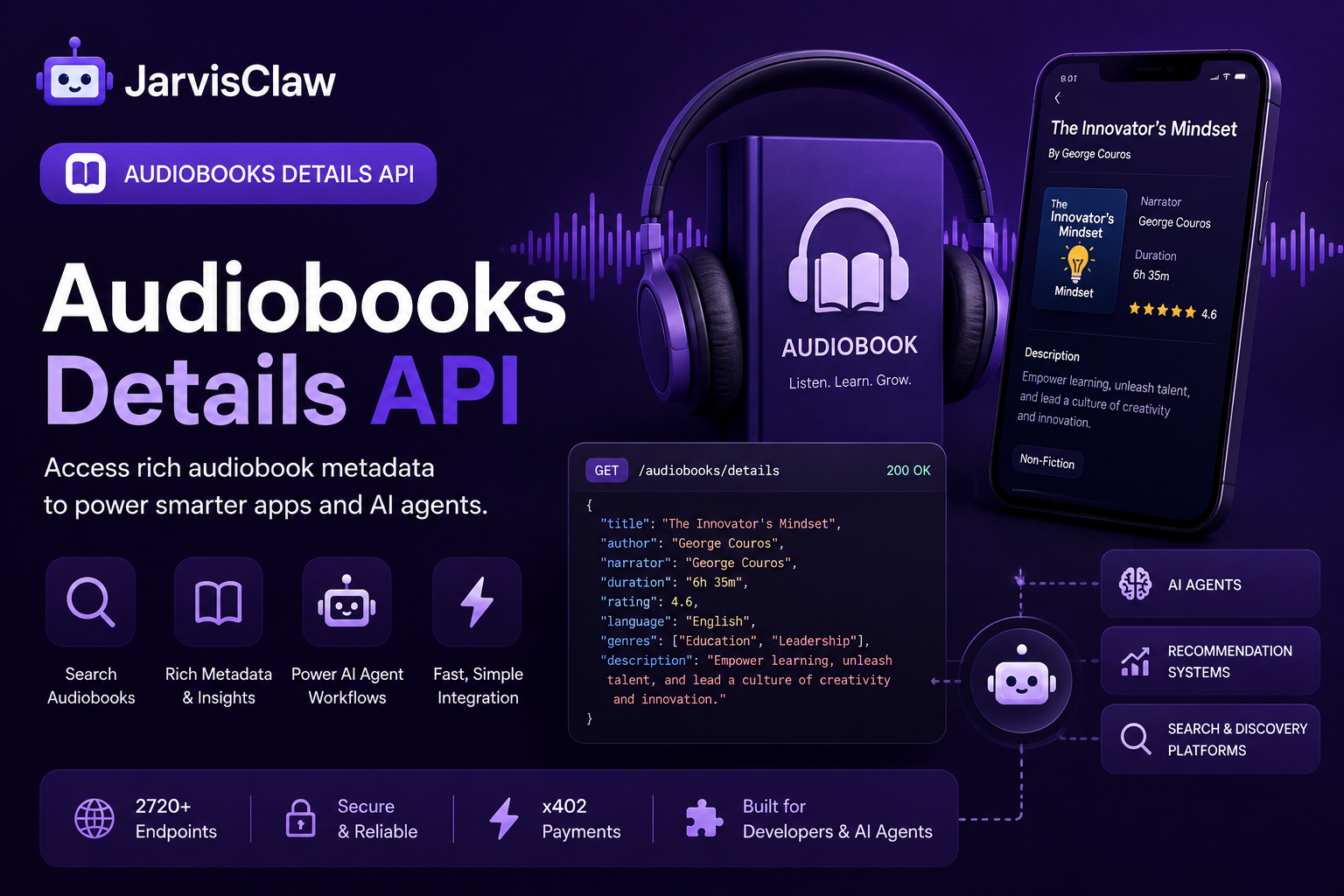
Audiobooks are becoming an increasingly important part of digital content. Millions of people use audiobooks for education, entertainment, professional development, and learning on the go.
As the audiobook ecosystem grows, developers need reliable ways to access structured information about books, authors, narrators, and other audiobook metadata.
That is where an Audiobooks Details API can help.
An Audiobooks Details API allows applications to retrieve information about audiobooks programmatically instead of requiring developers to manually collect and organize book information.
For developers building AI agents, recommendation systems, search applications, and content platforms, audiobook metadata can become a valuable source of structured information.
JarvisClaw includes an Audiobooks Details endpoint in its Browse Every API marketplace, allowing developers to access specialized API capabilities alongside thousands of other endpoints.
What Is an Audiobooks Details API?
An Audiobooks Details API is an API designed to retrieve information about an audiobook.
Instead of manually searching websites or maintaining a large audiobook database, an application can make an API request and receive relevant details in a machine-readable format.
A typical workflow looks like this:Audiobook query → API request → Audiobook information → Application or AI agentDepending on the service and available data, audiobook information can include details such as the title, author, narrator, description, publication information, and other metadata.
This makes an audiobook API useful for applications that need to search, organize, compare, or analyze audiobook content.
Why Audiobook Data Matters for AI Agents

AI agents are increasingly being used to search for information and complete tasks on behalf of users.
Consider a user asking:“Find me an audiobook about artificial intelligence that is suitable for beginners.”
An AI agent needs more than a language model to complete this task effectively.
It may need access to an external source containing audiobook information.
The workflow could look like this:
User request → AI agent → Audiobooks Details API → Analyze results → RecommendationThe agent can use audiobook information as context before producing a recommendation.
This demonstrates an important concept in agentic AI: an AI agent becomes more useful when it can access specialized APIs rather than relying exclusively on information stored inside an LLM.
Audiobooks Details API Use Cases
Audiobook Discovery
An application can use audiobook metadata to help users discover books based on their interests.
For example, a platform could allow users to search for audiobooks related to technology, business, personal development, history, or fiction.
AI-Powered Recommendations
An AI recommendation system can combine audiobook metadata with user preferences to generate personalized suggestions.
An AI agent could analyze the user’s request and identify audiobooks that match specific topics, authors, or other requirements.
Audiobook Search
Developers building search platforms can use an audiobook API to retrieve relevant information without manually creating every database entry.
This can make audiobook discovery faster and more convenient.
Content Applications
Audiobook information can also be incorporated into websites, mobile applications, digital libraries, and AI-powered content platforms.Developers can combine audiobook metadata with other APIs to create more advanced experiences.
How Does an Audiobook API Work?
The basic process is straightforward.
First, an application or AI agent determines what audiobook information it needs.Second, it sends a request to the Audiobooks Details API.
The API processes the request and returns the available audiobook information.
Finally, the application can display the results or pass them to another service.
For an AI agent, the workflow could become:User → AI Agent → Audiobooks Details API → LLM → RecommendationThis modular architecture allows developers to give an AI system access to specialized information without building every data source from scratch.
Audiobook APIs and AI Agent Workflows
The real potential becomes more interesting when an audiobook API is combined with other AI tools.
Imagine an AI learning assistant that receives this request:“Find three beginner-friendly audiobooks about entrepreneurship and explain which one I should start with.”
The agent could use an audiobook API to find relevant titles. It could then use an LLM to analyze descriptions and compare the results according to the user’s requirements.
The final answer could include recommendations and an explanation of why each audiobook matches the user’s needs.
This is an example of how AI APIs and specialized data APIs can work together.
Why Developers Use APIs for Audiobook Data
Building and maintaining an audiobook information database internally can require significant development and maintenance.
Developers need to think about data collection, updates, search functionality, infrastructure, and integration.
Using an API provides an alternative.
An audiobook API can act as a specialized data layer that applications access when they need audiobook information.
For AI startups and developers building agentic applications, this approach can reduce the amount of infrastructure they need to create themselves.
Why Use the Audiobooks Details API Through JarvisClaw?
JarvisClaw’s Browse Every API marketplace is designed to give developers access to a broad collection of specialized API endpoints.The marketplace includes categories covering areas such as Audio, Search, LLM, Blockchain, Image, Video, Web, and more.
The Audiobooks Details endpoint can become one component in a larger AI application.
For example, developers could combine audiobook information with an LLM, search APIs, recommendation logic, or other AI tools to create a more capable application.
JarvisClaw also focuses on infrastructure for AI agents, including API access, smart routing, and x402 payment capabilities.This is particularly relevant as autonomous AI agents increasingly need to interact with different digital services to complete tasks.
Audiobook APIs and the Future of AI
The future of AI applications will not depend on language models alone.AI agents need access to specialized information and external tools.
An Audiobooks Details API is a good example of a focused capability that can become part of a larger AI agent workflow.
Instead of building an application that only generates text, developers can create systems that search for information, evaluate data, make recommendations, and interact with external APIs.
As AI agents become more autonomous, access to specialized APIs will become increasingly important.
Final Thoughts
An Audiobooks Details API gives developers a practical way to connect audiobook information with modern applications.
From audiobook search and personalized recommendations to AI-powered discovery and autonomous agent workflows, structured audiobook data can support many different use cases.
With JarvisClaw, developers can explore the Audiobooks Details endpoint alongside thousands of other APIs and build applications that combine specialized data, AI models, automation, and agent capabilities.The bigger opportunity is not simply accessing audiobook information.
It is giving AI agents the tools they need to discover, understand, and act on specialized information.