
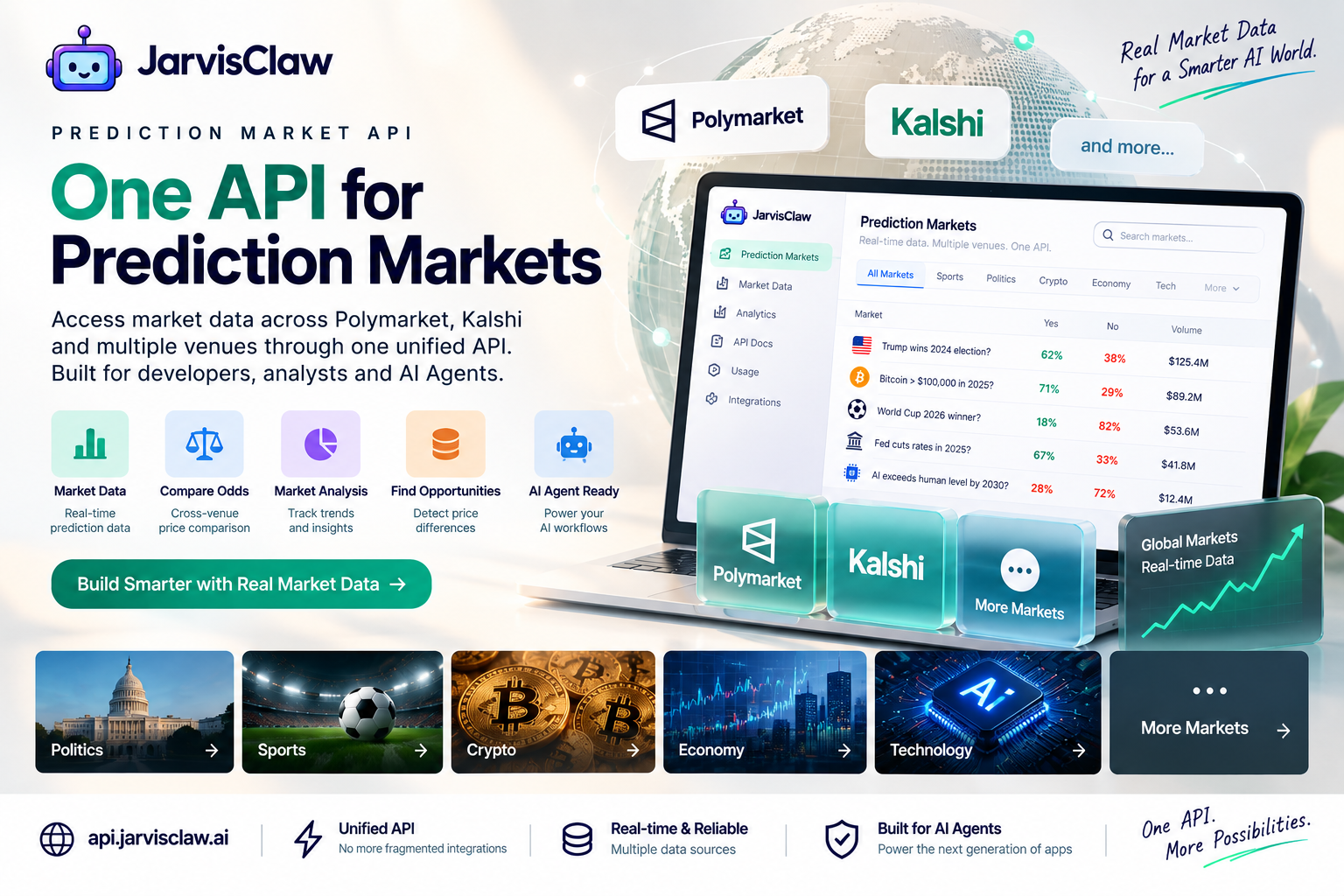
Building a crypto analytics dashboard or AI Agent usually starts with one data source.
Then the requirements grow.
The application needs token prices, wallet activity, transaction history, prediction-market odds, orderbooks, historical volume, trader performance, and event-resolution data. Each new provider introduces another account, API key, response format, billing system, and set of rate limits.
The JarvisClaw Crypto Marketplace is designed to reduce this integration overhead. It gives developers access to crypto, blockchain, market, and analytics capabilities that can be combined into one controlled workflow.
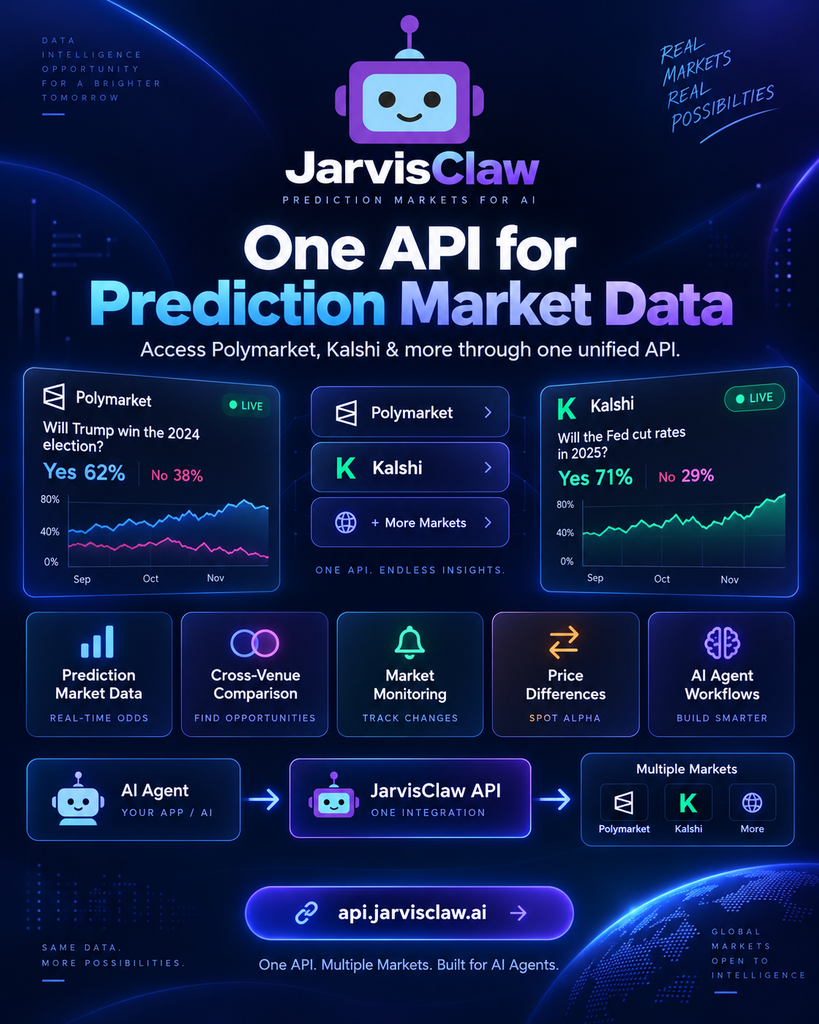
For teams working with event-based market data, the JarvisClaw Prediction Market API extends that workflow across Polymarket, Kalshi and other prediction venues.
Instead of building one integration per platform, developers can retrieve and compare market data through a more consistent API layer.
What Can You Build With a Crypto Marketplace?
A Crypto Marketplace is more than a list of coin-price endpoints.
A complete crypto-data workflow may require several types of information:
| Data type | Practical use |
|---|---|
| Token prices | Portfolio valuation and market monitoring |
| Wallet balances | Asset tracking and treasury dashboards |
| Token transfers | Payment confirmation and activity alerts |
| Transaction history | Wallet research and fund-flow analysis |
| Address-risk data | Pre-transaction screening |
| Prediction-market prices | Event probability and sentiment analysis |
| Orderbooks and trades | Liquidity and price-movement analysis |
| Trader analytics | Wallet ranking and smart-money research |
| Oracle status | Market-resolution monitoring |
An AI Agent can combine these sources to answer more useful questions.
For example:
Find active Bitcoin-related prediction markets, compare prices across venues, check recent volume, and summarize where market expectations differ.
That request requires search, market matching, price normalization, comparison, and explanation. It is a workflow—not a single model prompt.
Why Prediction-Market Data Belongs in a Crypto Workflow
Prediction markets convert expectations about future events into tradable prices.
A market price can provide a useful signal about how participants assess the probability of an outcome. However, prices can differ between venues because of liquidity, participant composition, market rules, settlement criteria, fees, or information delays.
This creates several practical applications:
- Cross-venue price comparison
- Crypto-event monitoring
- Sports-odds analysis
- Market-sentiment dashboards
- Smart-money tracking
- Resolution alerts
- Research and reporting tools
- AI Agent data workflows
Prediction-market data should not be treated as a guaranteed forecast. It is a market signal that needs context.
One Schema Across Multiple Venues
The integration problem is not only finding the data.
Polymarket, Kalshi and other platforms may use different identifiers, market structures, outcome labels, orderbook formats, timestamps, and pagination systems.
Without a normalized layer, developers may need separate logic for every venue:
if venue == "polymarket":
    parse_polymarket_response()
elif venue == "kalshi":
    parse_kalshi_response()
else:
    parse_another_format()
A unified API reduces this branching.
JarvisClaw’s Prediction Market API makes market identifiers, outcome prices and orderbook data available in a consistent structure across connected venues. This is particularly useful for AI Agents because the model can work with one predictable response pattern instead of learning a new schema for every provider.
Practical Use Case 1: Cross-Venue Price Comparison
Suppose Polymarket and Kalshi offer markets about the same economic or political event.
A comparison tool can:
- Search for the event across connected venues.
- Match markets referring to the same outcome.
- Normalize YES and NO prices.
- Compare implied probabilities.
- Display liquidity and update time.
- Flag differences above a defined threshold.
A simplified output might look like this:
| Venue | YES price | NO price | Updated |
|---|---|---|---|
| Venue A | 0.61 | 0.39 | 14:02 UTC |
| Venue B | 0.67 | 0.33 | 14:02 UTC |
| Difference | 0.06 | — | — |
A visible price difference does not automatically represent executable arbitrage.
Before presenting it as an opportunity, the application should check:
- Whether both markets use the same settlement conditions
- Whether the outcomes are truly equivalent
- Available liquidity and orderbook depth
- Venue fees
- Deposit and withdrawal requirements
- Geographic or account restrictions
- Expected slippage
- Market-closing time
- Data latency
The safer description is “cross-venue price difference” until the application verifies that the two contracts are economically equivalent and realistically tradable.
Practical Use Case 2: Crypto Event Monitoring
Crypto markets react to token launches, protocol upgrades, regulatory decisions, ETF developments, security incidents, and macroeconomic announcements.
A monitoring Agent can combine prediction-market data with crypto prices and blockchain activity.
For example:
Prediction-market probability
        +
Bitcoin spot-price movement
        +
Large-wallet activity
        +
Relevant news
        ↓
Structured market-monitoring report
The Agent could report:
- What changed
- Which market moved
- When the movement began
- Whether spot prices moved at the same time
- Whether large wallets became more active
- Which findings are confirmed data
- Which conclusions are interpretations
This separation is important. An AI summary should not present correlation as proof of causation.
Practical Use Case 3: Smart-Money Research
Prediction markets contain public trading activity that can be analyzed at the wallet level.
A research workflow may rank wallets by realized profit and loss, examine their open positions, compare performance across markets, and monitor new activity.
A practical sequence is:
- Retrieve a trader leaderboard.
- Apply a minimum activity threshold.
- Review wallet-level performance.
- Inspect open and closed positions.
- Identify markets where consistently profitable wallets are active.
- Track changes over time.
Do not rank wallets using profit alone.
A wallet with one successful position may appear more impressive than an active wallet with a long performance history. Useful comparison fields include:
- Realized P&L
- Return on investment
- Number of trades
- Total volume
- Active period
- Market concentration
- Open-position exposure
- Drawdown
“Smart money” is a research label, not proof that a future position will succeed.
Practical Use Case 4: Sports Market Comparison
Sports data becomes difficult to compare when each platform uses different team names, market IDs and outcome structures.
A unified workflow can group markets by game, map equivalent outcomes, compare prices across venues, and feed normalized data into one model.
This can support:
- Cross-platform odds dashboards
- Pre-game market summaries
- Line-movement alerts
- Liquidity comparisons
- Historical probability charts
- Automated sports reports
The application should still check whether markets have identical overtime rules, cancellation policies, settlement sources, and start-time definitions.
Small rule differences can make apparently identical markets fundamentally different.
Making Your First Prediction Market API Call
The base path for the JarvisClaw Prediction Market API is:
https://api.jarvisclaw.ai/v1/marketplace/predictionFor example, developers can search connected venues for Bitcoin-related markets:
curl "https://api.jarvisclaw.ai/v1/marketplace/prediction/markets/search?q=bitcoin" \
  -H "Authorization: Bearer sk-your-api-key"
A responsible application should not move directly from search to automated action.
Use the response to:
- Confirm the venue
- Check the market identifier
- Read the exact question
- Review settlement terms
- Verify current price and timestamp
- Retrieve liquidity or orderbook data
- Compare equivalent outcomes
- Record the source used in the final report
The Prediction Market API is a read-only data service. Trading or placing a position must happen through the relevant venue and its permitted workflow.
Important Parameters and Common Errors
Several small implementation errors can produce failed requests or misleading results.
Use Unix Seconds
Historical endpoints expect timestamps expressed as Unix seconds.
Do not send an ISO date string unless the selected endpoint explicitly supports it.
Correct: 1748736000
Incorrect: 2026-06-01T00:00:00Z
Use the Correct Market Identifier
A platform may expose several identifiers, including a market slug, condition ID, token ID or venue-specific ticker.
Do not assume they are interchangeable.
Normalize Outcomes Carefully
One venue may list “YES,” while another uses a team name, candidate name or contract label.
Compare the meaning of the outcome—not only its position in the response array.
Paginate Large Results
Market lists, trades and wallet histories may span multiple pages.
A dashboard that retrieves only the first page can silently produce incomplete analysis.
Define Smart-Money Thresholds
Set minimum P&L, ROI, trade count or volume requirements before classifying a wallet as high-performing.
Without thresholds, inactive or statistically insignificant wallets may distort the results.
Hidden Costs Behind “Simple” Market Data
The API call price is only one component of the total operating cost.
Repeated Polling
Checking hundreds of markets every few seconds can generate unnecessary requests.
Adjust polling frequency based on the use case. A live trading interface and a daily research email do not need the same refresh rate.
Duplicate Data Retrieval
Cache market metadata that changes slowly, while refreshing prices and orderbooks separately.
There is no reason to download the complete market description every time the price is updated.
Market-Matching Errors
The biggest hidden cost may be a false comparison.
Two questions can look similar while using different dates, definitions, settlement sources or eligibility rules.
Automated matching should produce a confidence score, and low-confidence pairs should be reviewed manually.
Ignoring Liquidity
A price may look attractive but be available only for a very small position.
Use orderbook depth when estimating whether a quoted spread is meaningful.
Incomplete Failure Handling
Production workflows should handle:
- Timeouts
- Empty orderbooks
- Closed markets
- Delayed resolution
- Invalid identifiers
- Rate limits
- Temporary venue outages
- Partially returned data
An Agent should report missing data instead of filling the gap with an invented value.
How JarvisClaw Fits Into an AI Agent Workflow
JarvisClaw brings models and specialized APIs into unified, agent-ready infrastructure.
A controlled research Agent can:
- Interpret the user’s request.
- Search for relevant prediction markets.
- Retrieve prices, trades or orderbooks.
- Compare equivalent outcomes across venues.
- Add crypto spot-price or wallet data when relevant.
- Calculate differences.
- Ask an LLM to summarize the confirmed results.
- Return the sources, timestamps and limitations.
- Trigger an alert if a defined rule is met.
For autonomous workflows, developers should also configure budget limits, caching, logging and approval rules.
JarvisClaw supports both API-key access and agent-oriented pay-per-call workflows. Each production implementation should check the live marketplace for current endpoint prices and availability before execution.
Production Checklist
Before launching a crypto or prediction-market data product, confirm:
- The supported venues match your target markets.
- Market questions and settlement rules are stored.
- Prices include timestamps and venue names.
- Historical requests use the correct time format.
- Market matching considers dates and resolution criteria.
- Orderbook depth is checked before highlighting a spread.
- Pagination is implemented.
- Duplicate calls are cached.
- Failed or missing data is clearly labeled.
- AI-generated interpretation is separated from retrieved facts.
- Alerts have minimum liquidity and difference thresholds.
- Trading actions require appropriate authorization and risk controls.
- Your product complies with relevant platform rules and local laws.
Final Takeaway
A useful crypto-data product needs more than a token-price feed.
Developers increasingly need to combine wallet activity, market prices, prediction-market probabilities, trader analytics, orderbooks and resolution information.
The JarvisClaw Crypto Marketplace provides access to crypto-oriented APIs, while the Prediction Market API brings data from Polymarket, Kalshi and additional venues into a unified developer workflow.
This makes it easier to build market-monitoring dashboards, cross-venue comparison tools, smart-money research systems, sports models and AI Agents without maintaining a separate integration for every data source.
Start with one defined use case, validate the data carefully, and expand only after the workflow handles market matching, latency, missing data and cost controls reliably.
Build the Future of AI with JarvisClaw
AI is moving beyond individual models toward a connected ecosystem of models, APIs, agents, and intelligent services.
JarvisClaw provides the infrastructure developers need to build this future — combining 80+ AI models, OpenAI-compatible APIs, Smart Routing, MCP support, x402 payments, and AI Agent-ready capabilities in one platform.
Whether you are building AI SaaS products, autonomous agents, automation workflows, or next-generation applications, JarvisClaw helps you integrate faster, optimize costs, and scale with confidence.
One API. Multiple Models. Agent-Ready AI Infrastructure.