Voice is becoming one of the most natural ways for people to interact with AI agents. Instead of typing prompts, users can speak commands, ask questions, describe problems, and have conversations in real time.
But for an AI agent to understand spoken input, audio must first be converted into text that the agent can process.
This is where a live transcription API becomes essential.
A real-time transcription API allows applications to transform speech into text as it happens, creating the foundation for voice-enabled AI agents, assistants, customer-service systems, meeting tools, and autonomous workflows.
For developers building modern AI applications, combining real-time speech-to-text with an AI gateway such as JarvisClaw can create a flexible workflow where voice input is transcribed, processed by an AI model, and converted into an intelligent response.
What Is a Live Transcription API?
A live transcription API is a service that converts spoken audio into text continuously rather than waiting for an entire recording to finish.
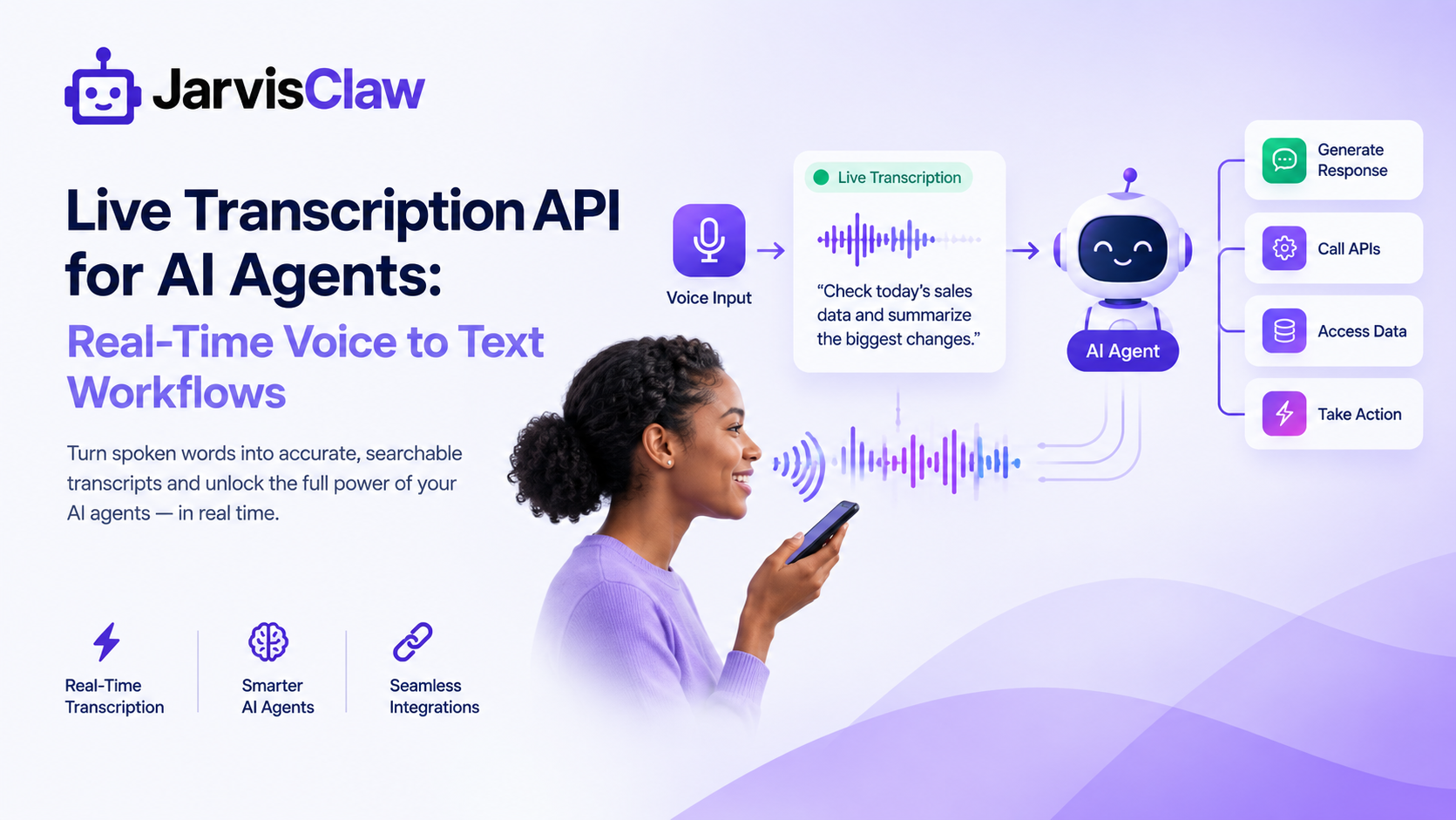
Traditional speech-to-text workflows often look like this:Record audio → Upload file → Transcribe → Process textA real-time workflow is different:Speak → Stream audio → Transcribe → Process text → Generate responseThis distinction is important for AI agents because many agent interactions require immediate responses.
For example, a user could say:“Check today’s sales data and summarize the biggest changes.”
The transcription API converts the spoken request into text.
The AI agent can then interpret the instruction, retrieve the required information, analyze it, and respond.
How Real-Time Voice-to-Text Workflows Work
A typical live transcription workflow contains several components.
| Component | Function |
| Microphone | Captures the user’s speech |
| Audio stream | Sends audio continuously to the application |
| Transcription API | Converts speech into text |
| AI gateway | Routes requests to the appropriate AI service |
| AI model | Understands the transcribed request |
| Agent workflow | Executes tools, APIs, or business logic |
| Response layer | Returns text, audio, or an action |
The process usually begins when the user starts speaking. Audio is captured and streamed to the transcription service.
As speech is recognized, partial or complete transcript segments can be returned to the application.
The AI agent can then use the resulting text as an input for reasoning or tool execution.
This makes the interaction feel much more natural than waiting for a recording to finish processing.
Why AI Agents Need Real-Time Transcription
AI agents are increasingly expected to operate across different interfaces, including chat, applications, websites, mobile devices, and voice.Real-time transcription provides several important advantages.
1. Faster Agent Responses
Latency matters when users are communicating with an AI agent through voice.
A live transcription workflow can begin processing speech before the user has finished an entire interaction.
This can reduce unnecessary waiting and make the experience feel conversational.
2. Natural Human-Agent Interaction
People generally speak faster than they type.
Voice interfaces allow users to explain complex requests naturally instead of converting everything into written prompts.
This can be particularly useful for customer support, field operations, healthcare applications, sales assistants, and productivity tools.
3. Continuous Conversations
Real-time transcription makes it possible to build AI agents that maintain ongoing conversations.
Instead of treating every voice message as an isolated audio file, developers can continuously feed transcribed segments into an agent workflow and maintain conversational context.
4. Voice-Controlled Tool Execution
The most interesting use case is not simply converting speech into text.An AI agent can take the transcribed instruction and perform an action.
For example:User speaks → Transcription → AI agent → Tool/API call → Result → ResponseA user might say:“Find the cheapest available flight to Lagos next Friday.”
The agent could interpret the request, call a travel API, compare results, and return an answer.
Where JarvisClaw Fits Into the Workflow
A transcription API handles the speech-to-text layer, but modern AI applications often require additional infrastructure for routing AI requests, connecting models, and managing API interactions.
This is where JarvisClaw can fit into the broader architecture.
A voice-enabled AI agent can use the following workflow:Voice Input → Live Transcription API → JarvisClaw → AI Model → Tools/APIs → Agent ResponseJarvisClaw can serve as the AI gateway layer between the application and its AI infrastructure.
This architecture allows developers to separate voice processing from model interaction.
The transcription service focuses on converting audio into text, while the AI gateway handles the downstream AI request.
For applications using multiple AI models or providers, this separation can also make the architecture easier to manage and evolve.
Practical Applications of Live Transcription APIs
Real-time speech-to-text can support many AI-agent use cases.
AI customer support: Customers can speak naturally while an AI agent transcribes and responds to their requests.
Voice assistants: Users can control applications through spoken commands.
Meeting agents: AI systems can transcribe conversations and generate summaries or action items.
Sales agents: Sales representatives can dictate notes and ask an AI agent to organize or analyze them.
Field-service applications: Technicians can describe equipment problems verbally while an AI agent processes the information and retrieves relevant data.
Autonomous agents: Voice commands can trigger tool calls, searches, API requests, or business workflows.
Key Considerations When Choosing a Transcription API
Developers should evaluate more than transcription accuracy.
Important factors include:
- Latency: How quickly does the API return transcript data?
- Accuracy: Can it handle different accents, terminology, and background noise?
- Streaming support: Does it support continuous audio streams?
- Language support: Which languages and dialects are available?
- Scalability: Can it support increasing numbers of simultaneous users?
- Integration: How easily can it connect with your AI-agent architecture?
- Cost: Is pricing suitable for high-volume voice interactions?
The best option depends on the application’s requirements, expected traffic, and desired user experience.
Building the Next Generation of Voice AI Agents
Voice is becoming an important interface for AI agents because it removes much of the friction associated with typing.However, a successful voice agent requires more than speech recognition.
Developers need an architecture capable of connecting transcription, AI models, tools, APIs, and agent logic into one reliable workflow.
A live transcription API provides the voice-to-text foundation, while an AI gateway such as JarvisClaw can help developers build the infrastructure around the AI processing layer.
The result is a more flexible architecture for building voice-enabled applications that can understand requests, reason about them, call external services, and respond in real time.
FAQ
What is a live transcription API?
A live transcription API converts spoken audio into text continuously while the user is speaking. It is commonly used for voice assistants, AI agents, customer support, and real-time conversational applications.
How does real-time transcription work with an AI agent?
Audio is streamed to a transcription service, which converts speech into text. The resulting transcript is passed to the AI agent, which can interpret the request, use tools or APIs, and generate a response.
Can JarvisClaw work with voice-enabled AI applications?
Yes. JarvisClaw can be positioned as the AI gateway layer in a voice-agent architecture, connecting transcribed user input with AI models and downstream API or tool workflows.
What is the difference between transcription and an AI voice agent?
Transcription converts speech into text.
An AI voice agent goes further by understanding the text, maintaining context, making decisions, calling tools, and generating a response.
Is real-time transcription better than uploading an audio file?
For conversational AI applications, real-time transcription can provide a faster and more interactive experience because transcript data can be processed while the conversation is happening.
With JarvisClaw as the AI gateway layer, developers can build a more organized architecture for connecting voice input to AI processing and autonomous workflows.
You can now download, install, and test our developer tools for free.📦 JarvisClaw MCP on NPM(https://www.npmjs.com/package/jarvisclaw-mcp)🐍 Agent Intent Protocol on PyPI(https://pypi.org/project/agent-intent-protocol/)Built for developers working with AI Agents, MCP, AIP, and multi-model AI workflows.