
AI Agents are becoming increasingly capable of handling conversations, customer support, meeting assistance, voice commands, and real-time automation.
But for an AI agent to understand spoken language, it first needs to convert audio into text.
This is where a Live Transcription API becomes essential.
A real-time speech-to-text API allows AI agents to process spoken words as they happen instead of waiting for an entire audio recording to finish.
With the right API, developers can build voice-enabled AI workflows that listen, transcribe, understand, and respond with minimal delay.
What Is a Live Transcription API?
A Live Transcription API is an API that converts spoken audio into text continuously while the speaker is talking.
Unlike traditional audio-to-text processing, where an application uploads a completed audio file and waits for the transcription, real-time transcription processes an ongoing audio stream.
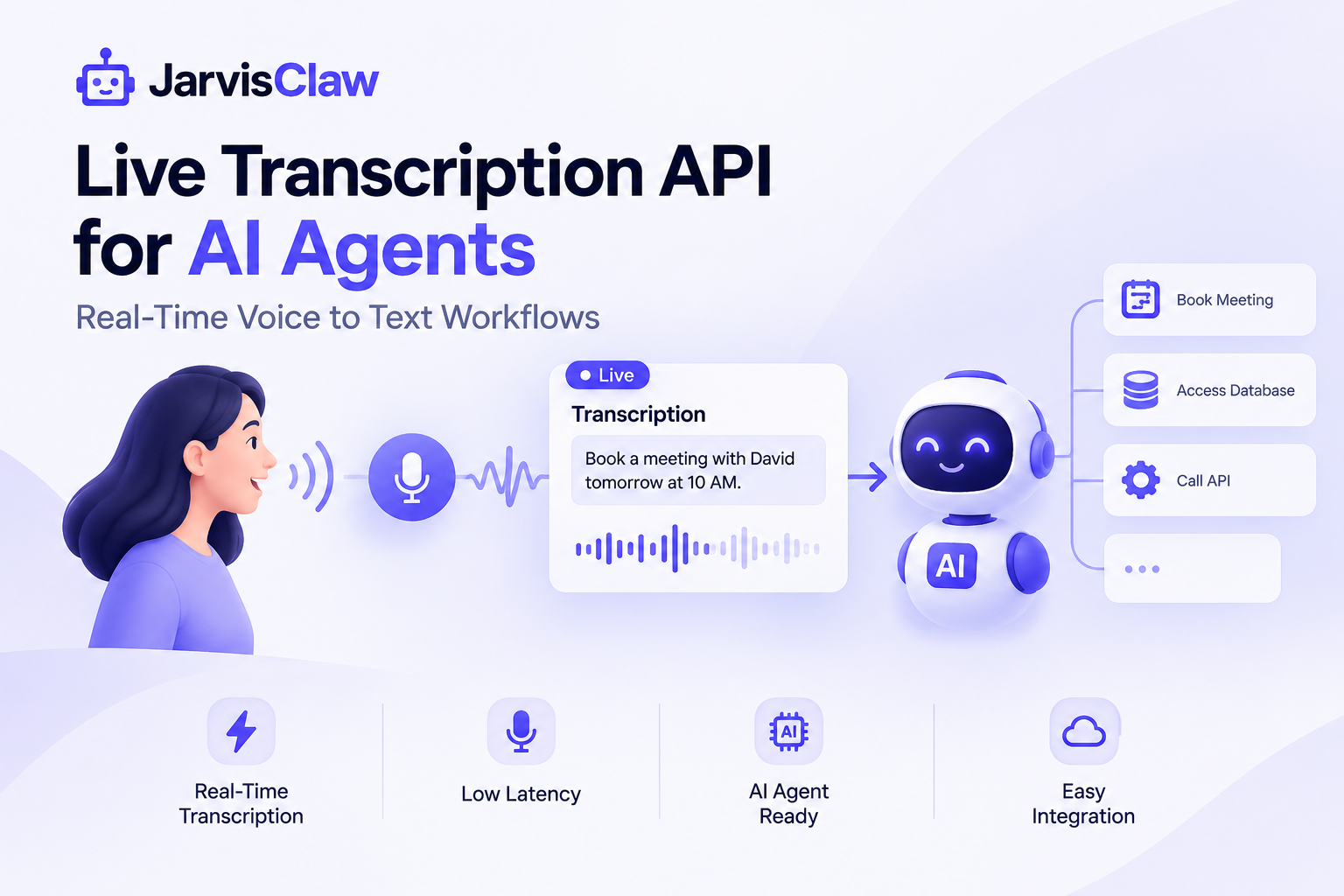
For AI agents, this creates a more natural interaction model:Voice → Live Audio Stream → Speech-to-Text API → Transcribed Text → AI Agent → Action or ResponseThis architecture is particularly useful when an AI agent needs to react to information immediately.
Why AI Agents Need Real-Time Voice Transcription
AI agents traditionally work with structured inputs such as text, JSON, or API responses.
However, many real-world interactions happen through speech.Consider a customer calling an AI support agent.
The agent needs to understand what the customer is saying while the conversation is happening—not several minutes later.
A real-time transcription workflow can help an AI agent:
- Understand spoken instructions
- Process customer conversations
- Detect questions and requests
- Extract important information
- Trigger APIs or automated actions
- Generate real-time responses
- Maintain conversational context
This makes speech-to-text for AI agents an important component of modern voice automation.
Live Transcription vs. Standard Audio Transcription
The main difference is when the text becomes available.
| Feature | Live Transcription | Standard Audio Transcription |
| Input | Live audio stream | Recorded audio file |
| Output | Text generated continuously | Text generated after processing |
| Latency | Low | Usually higher |
| Best for | Voice agents, calls, live meetings | Podcasts, recordings, archives |
| AI agent response | Can happen during conversation | Usually happens after transcription |
| Workflow | Real-time | Batch processing |
For applications where an AI agent must respond immediately, live transcription can provide a major advantage.
How a Real-Time Voice-to-Text Workflow Works
A typical AI agent workflow can be broken into several stages.
1. Capture the Audio
The application receives audio from a microphone, phone call, browser, meeting platform, or another voice source.
2. Stream Audio to the API
Instead of waiting until the conversation ends, the application sends audio continuously to the transcription API.
3. Generate Transcription
The API processes the incoming speech and returns text as the conversation progresses.
4. Send Text to the AI Agent
The transcribed text becomes an input that an AI model or agent can understand.
5. Determine the Next Action
The AI agent analyzes the text and decides what to do.For example, it might answer a question, search a database, call another API, update a CRM, or execute an automated workflow.
6. Respond to the User
The agent can generate a response, potentially convert it back into speech, and continue the conversation.
This creates a complete voice-agent loop:Listen → Transcribe → Understand → Act → Respond → Listen Again
Key Benefits of Live Speech-to-Text for AI Agents
Lower Interaction Latency
Real-time transcription allows text to become available while someone is speaking. This can help reduce the delay between a user’s request and an AI agent’s response.
More Natural Voice Experiences
Users can communicate with an AI agent using normal speech instead of typing structured commands.
Better Voice-Based Applications
Developers can use live transcription to build:
- AI customer service agents
- Voice assistants
- Meeting assistants
- Call-analysis systems
- Voice-controlled applications
- Real-time interview tools
- Conversational AI platforms
Why Developers Can Use an API Instead of Building Speech Recognition From Scratch
Building an accurate speech-recognition system internally can require significant engineering effort, infrastructure, audio processing, model management, and ongoing optimization.
A Speech-to-Text API provides an easier integration path.Instead of building the entire transcription infrastructure, developers can connect their applications to an API and focus on the agent logic, user experience, and business workflow.
For AI-agent developers, this API-first approach can make voice capabilities easier to integrate into existing applications.
Building AI Agents That Can Listen in Real Time
The most powerful use case is not transcription alone. It is connecting transcription to an intelligent agent.
For example:Customer speaks → Live transcription → AI agent understands intent → Agent calls business API → Result returned → AI generates responseThis turns a speech-to-text API into part of a larger autonomous workflow.
With an API marketplace such as JarvisClaw, developers can integrate external APIs into AI-agent workflows without treating every capability as a separate infrastructure project.
FAQ
What is a Live Transcription API?
A Live Transcription API converts spoken audio into text continuously as audio is received. It is designed for applications that need speech-to-text results with low latency.
How does real-time transcription help AI agents?
It gives AI agents text from spoken conversations while they are happening, allowing the agent to understand requests and potentially trigger actions without waiting for a complete recording.
What is the difference between live transcription and audio transcription?
Live transcription processes ongoing audio streams, while standard audio transcription generally processes completed recordings.
Can AI agents use speech-to-text APIs?
Yes. A speech-to-text API can provide the textual input that an AI agent needs to understand spoken commands, conversations, and requests.
What can developers build with live transcription?
Developers can build voice assistants, customer-service agents, meeting assistants, call-analysis applications, voice-controlled software, and other real-time conversational systems.
Get Your API KEY
Connect your AI agent to the APIs it needs and start building smarter, voice-enabled workflows with JarvisClaw.
You can now download, install, and test our developer tools for free.📦 JarvisClaw MCP on NPM(https://www.npmjs.com/package/jarvisclaw-mcp)🐍 Agent Intent Protocol on PyPI(https://pypi.org/project/agent-intent-protocol/)Built for developers working with AI Agents, MCP, AIP, and multi-model AI workflows.