
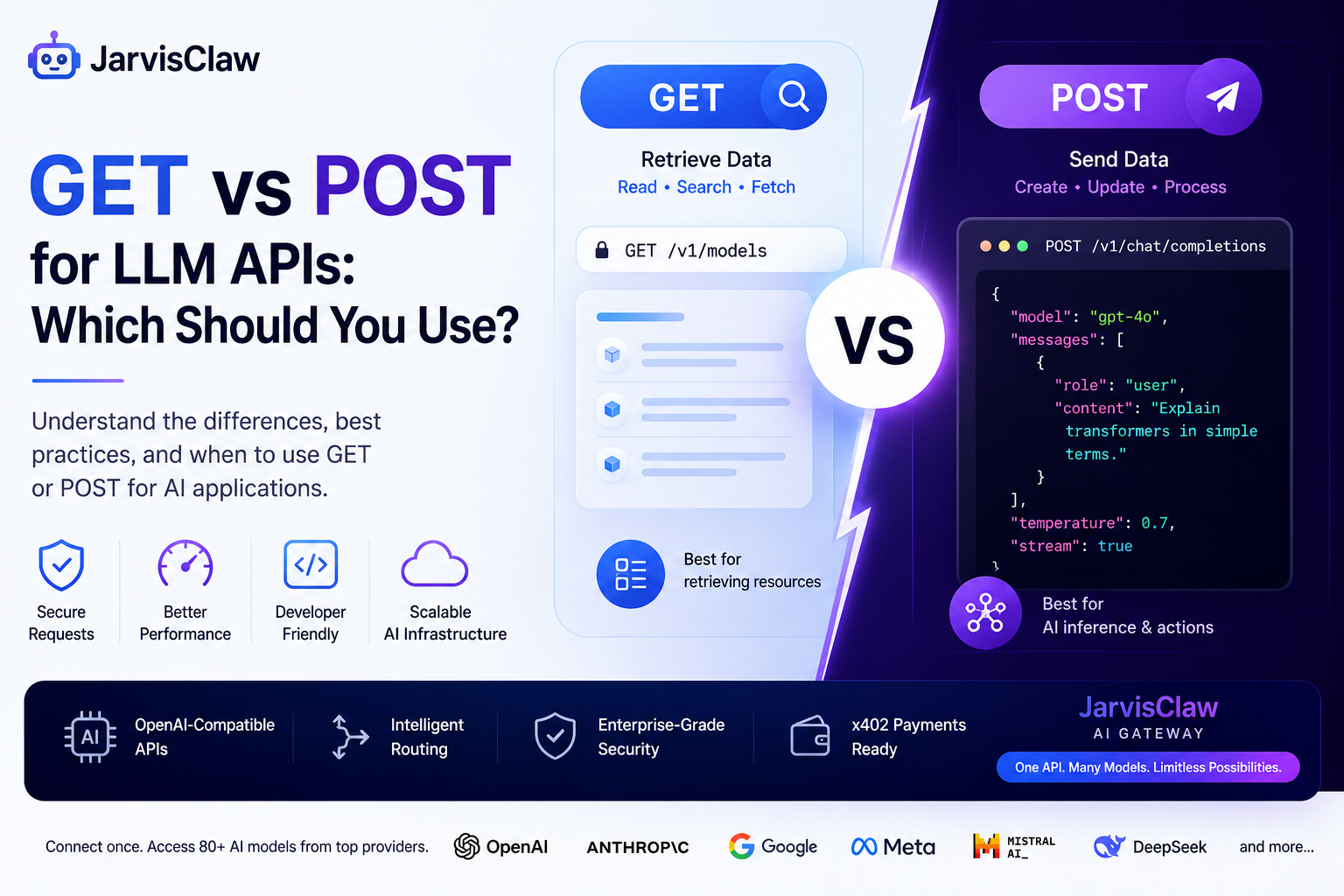
Large Language Models (LLMs) have become the backbone of modern AI applications, powering everything from intelligent chatbots and coding assistants to autonomous AI agents and enterprise automation platforms.
As developers build increasingly sophisticated AI systems, one seemingly simple question often arises: Should you use GET or POST for LLM APIs?While both HTTP methods are fundamental to web development, they serve very different purposes when interacting with AI models.
Choosing the wrong method can affect security, performance, scalability, and even the reliability of your application.
Understanding when to use GET versus POST is essential for building production-ready AI infrastructure.In this guide, we’ll explain the differences between GET vs POST for LLM APIs, explore best practices, and show how JarvisClaw simplifies AI development with OpenAI-compatible APIs, intelligent routing, and enterprise-grade AI gateway capabilities.
Understanding HTTP Methods

HTTP methods define how a client communicates with a server. The two most commonly used methods are GET and POST.A GET request retrieves information from a server without changing any data.
Parameters are usually included in the URL, making GET requests easy to cache, bookmark, and share.A POST request, on the other hand, sends data to a server for processing.
The request payload is placed inside the request body, allowing applications to transmit large amounts of structured information securely.Because LLM APIs process prompts rather than simply retrieving data, understanding these differences is crucial.
What Is a GET Request?
GET is designed for retrieving existing resources.
Typical GET requests include:
- Fetching API documentation
- Retrieving model lists
- Checking account usage
- Viewing billing information
- Reading application settings
- Accessing health or status endpoints
GET requests are fast, cache-friendly, and ideal for read-only operations.
Advantages of GET
- Lightweight and efficient
- Easy to cache
- Simple debugging
- Suitable for public resources
- Faster for repeated read operations
However, GET has important limitations when working with AI.
Why GET Is Usually Not Used for LLM Inference
Large Language Models require developers to send prompts, conversation history, system instructions, temperature settings, and other configuration parameters.
Passing this information through a URL creates several problems:
URL Length Limits
Browsers, proxies, and servers impose URL length restrictions.Long prompts can easily exceed these limits.
Security Concerns
GET parameters appear in URLs, browser history, server logs, analytics platforms, and proxy caches.
Sensitive prompts or confidential business information should never be exposed this way.
Limited Flexibility
Modern LLM requests often contain JSON payloads with nested objects, tool definitions, function calls, images, and conversation history.
GET requests simply were not designed for this complexity.
Why POST Is the Standard for LLM APIs
POST allows developers to send structured JSON data inside the request body.
This makes it ideal for AI applications.
A typical POST request can include:
- User prompts
- System messages
- Conversation history
- Model parameters
- Function calling
- Tool definitions
- Images
- Audio
- Streaming configuration
Because there are no practical URL limitations, POST supports the complex workflows required by modern AI applications.
For this reason, nearly every OpenAI-compatible API uses POST for inference requests.
Benefits of POST for AI Development
POST offers several advantages that make it the preferred choice for production AI systems.
Better Security
Request bodies are significantly more secure than URL parameters because sensitive information is less likely to appear in browser history or server logs.
Supports Large Payloads
AI prompts can range from a few words to thousands of tokens.
POST easily handles large JSON payloads.
Flexible Request Structure
Developers can include advanced options such as streaming, function calling, tool usage, and structured outputs within a single request.
Better Scalability
Enterprise AI applications require flexible request formats that evolve over time.
POST allows APIs to add new capabilities without changing endpoint structures.
GET vs POST: A Quick Comparison
| Feature | GET | POST |
| Primary Purpose | Retrieve data | Send data |
| URL Parameters | yes | no |
| Request Body | no | yes |
| Suitable for LLM Prompts | no | yes |
| Supports Large Payloads | Limited | yes |
| Better Security | limited | yes |
| Used for AI Inference | Rarely | Almost Always |
For nearly every AI generation request, POST is the recommended method.
Best Practices for LLM APIs
When designing AI applications, follow these best practices:
- Use GET for retrieving metadata such as available models, account details, and service status.
- Use POST for prompt generation, chat completions, embeddings, image generation, and tool calling.
- Never include sensitive prompts in URLs.
- Validate request payloads before sending them.
- Use HTTPS for all API communication.
- Monitor request latency and error rates.
- Route requests intelligently across multiple AI providers.
Following these practices improves both security and application performance
Why AI Gateways Matter
As organizations integrate multiple AI providers, managing separate APIs becomes increasingly difficult.An AI gateway simplifies this complexity by providing a unified interface for multiple LLM providers.Instead of maintaining separate integrations for OpenAI, Anthropic, Google Gemini, DeepSeek, or Mistral, developers connect once through a centralized platform.
Modern AI gateways provide:
- OpenAI-compatible APIs
- Intelligent model routing
- Automatic failover
- Cost optimization
- Centralized authentication
- Enterprise observability
- Multi-provider support
These capabilities reduce operational complexity while improving reliability.
Why Developers Choose JarvisClaw
JarvisClaw is a production-ready AI gateway designed for developers building scalable AI applications.
Using a single OpenAI-compatible API, developers gain access to multiple leading AI models without changing application code.
JarvisClaw adds production-focused capabilities including:
- Intelligent AI routingAutomatic retries and failover
- Enterprise-grade observability
- Model Context Protocol (MCP) support
- x402 payment support
- Multi-provider AI infrastructure
- Secure API management
Whether you’re building AI chatbots, coding assistants, enterprise workflows, or autonomous AI agents, JarvisClaw simplifies deployment while improving reliability and cost efficiency.
Common Mistakes Developers Make
Many developers unintentionally misuse HTTP methods when building AI applications.
Some common mistakes include:
- Sending prompts through GET parameters
- Logging sensitive request URLs
- Hardcoding API credentials
- Ignoring request validation
- Building separate integrations for every AI provider instead of using an AI gateway
Avoiding these mistakes improves application security and long-term maintainability.
Frequently Asked Questions (FAQs)
1. Can GET requests have a body?
Technically, the HTTP specification does not completely forbid a GET request from including a request body. However, most web servers, proxies, browsers, and API frameworks either ignore or reject it. Because of this inconsistent behavior, developers should avoid sending request bodies with GET requests. For AI applications and LLM APIs, use POST whenever you need to send prompts, JSON payloads, or conversation history.
2. Is POST more secure than GET?
Yes, in most production scenarios, POST is more secure than GET. GET requests place parameters in the URL, where they may appear in browser history, server logs, analytics tools, and proxy caches. POST sends data in the request body, making it less exposed.
While both methods should always use HTTPS, POST is the preferred choice for transmitting prompts, API keys, and sensitive AI data.
3. Why do LLM APIs use POST?
Most LLM APIs use POST because AI requests contain complex JSON payloads that include prompts, conversation history, system instructions, temperature settings, function calls, images, and other parameters. POST supports large request bodies and offers the flexibility required for modern AI applications. This is why OpenAI-compatible APIs, including those supported by JarvisClaw, rely on POST for chat completions and inference requests.
4. Is GET faster than POST?
The speed difference between GET and POST is usually negligible. Performance depends far more on network latency, server processing, and AI model inference time than on the HTTP method itself. For AI workloads, choosing the correct method is more important than chasing minimal speed differences. Use GET for retrieving metadata and POST for processing AI requests.
5. Should REST APIs use GET or POST for AI?
The best practice is to use both, depending on the operation.
- Use GET for read-only endpoints such as model lists, API status, account information, usage statistics, and billing details.
- Use POST for AI inference, chat completions, embeddings, image generation, tool calling, and any request that sends prompts or structured JSON data.
Platforms like JarvisClaw follow these REST principles by exposing OpenAI-compatible APIs that use POST for AI inference while supporting GET endpoints for retrieving metadata and service information. This approach improves security, scalability, and compatibility with modern AI infrastructure.
Start building with JarvisClaw today!!.