
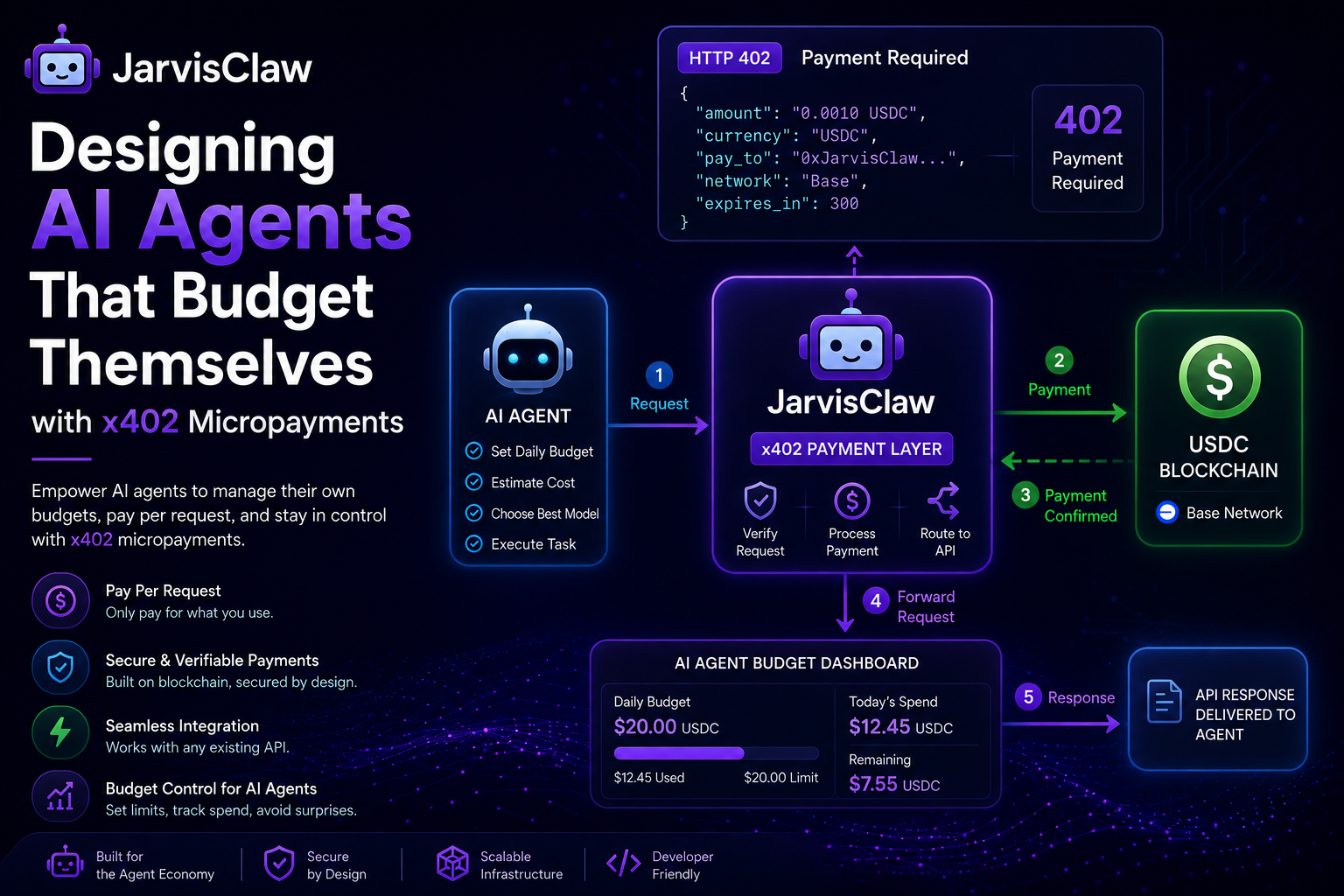
Autonomous AI agents are no longer experimental demos. They research, write code, call tools, generate content, and run workflows for hours or days without human intervention.
The biggest remaining bottleneck is not intelligence — it is money. How does an agent that runs 24/7 know when it has spent enough? Traditional API keys and prepaid balances force a human into the loop every time the wallet needs topping up.
That defeats the entire purpose of autonomy. The solution is x402 micropayments. With the x402 protocol, AI agents can pay for every LLM call, tool invocation, or data request in real time using USDC.
More importantly, they can be designed to budget themselves — setting hard limits, soft thresholds, and adaptive spending rules so they never overspend. This post shows exactly how to design self-budgeting AI agents using x402 micropayments and an OpenAI-compatible AI API gateway.

This post shows exactly how to design self-budgeting AI agents using x402 micropayments and an OpenAI-compatible AI API gateway.
Why Traditional Billing Breaks Autonomous Agents
Most LLM providers still rely on:
- Credit cards or prepaid account balances
- Monthly invoices
- Human-managed API keys
An autonomous agent cannot open a browser, enter a card number, or wait for a finance team approval.
When the balance hits zero, the agent simply stops.
For production systems this is unacceptable.x402 solves this by turning HTTP 402 Payment Required into a working payment rail.
The agent sends a request, receives a payment challenge, signs a USDC transfer from its own wallet, and continues — all without human involvement. Settlement happens in seconds on Base or Solana.
This creates true agentic commerce and machine-to-machine payments at the request level.
Core Design Principles for Self-Budgeting Agents
Successful self-budgeting AI agents follow four principles:
- Every call has a known cost before execution The agent must estimate cost (tokens × price + any tool fees) before committing.
- Hard and soft budget limits. A hard daily or per-task ceiling that cannot be exceeded. Soft thresholds that trigger cheaper model routing or task prioritization.
- Atomic settlement only Payment is only finalized when the model actually begins returning data. Failed or rejected requests cost nothing.
- Transparent cost attribution Every spend is logged against a specific task, sub-agent, or workflow so the system can learn and optimize.
Practical Architecture: Self-Budgeting Agent with x402
Here is a clean, production-ready pattern using an OpenAI-compatible endpoint and x402 wallet mode.
from jarvisclaw import JarvisClaw
import time

# Initialize with wallet (x402 mode – no API key required)
client = JarvisClaw(private_key="0x_your_agent_wallet_private_key")

class BudgetedAgent:
    def __init__(self, daily_budget_usd=5.0, soft_limit_pct=0.8):
        self.daily_budget = daily_budget_usd
        self.soft_limit = daily_budget_usd * soft_limit_pct
        self.spent_today = 0.0
        self.reset_time = time.time() + 86400

    def estimate_cost(self, model, estimated_tokens):
        # Simple example – in production pull live rates
        rates = {
            "auto/smart": 0.0008,          # smart routing average
            "anthropic/claude-sonnet": 0.003,
            "openai/gpt-4o-mini": 0.00015
        }
        return (estimated_tokens / 1000) * rates.get(model, 0.001)

    def can_afford(self, estimated_cost):
        if time.time() > self.reset_time:
            self.spent_today = 0.0
            self.reset_time = time.time() + 86400
        return (self.spent_today + estimated_cost) <= self.daily_budget

    def run_task(self, prompt, preferred_model="auto/smart"):
        estimated_tokens = len(prompt.split()) * 1.5 + 500  # rough estimate
        cost = self.estimate_cost(preferred_model, estimated_tokens)

        if not self.can_afford(cost):
            # Adaptive behavior: switch to cheapest available model
            preferred_model = "openai/gpt-4o-mini"
            cost = self.estimate_cost(preferred_model, estimated_tokens)
            if not self.can_afford(cost):
                return {"error": "Daily budget exhausted. Agent paused."}

        # Soft limit – prefer cheaper routing
        if self.spent_today > self.soft_limit:
            preferred_model = "auto/smart"  # force cost-optimized routing

        # Execute via JarvisClaw – x402 settles automatically
        response = client.chat.completions.create(
            model=preferred_model,
            messages=[{"role": "user", "content": prompt}],
            max_tokens=800
        )

        # Update spent (in real systems parse actual usage from response headers or logs)
        actual_cost = cost  # replace with precise usage
        self.spent_today += actual_cost

        return {
            "content": response.choices[0].message.content,
            "cost": actual_cost,
            "remaining_budget": self.daily_budget - self.spent_today
        }
This simple class already gives the agent the ability to:
- Track its own spending
- Refuse expensive calls when the budget is low
- Automatically switch to cheaper models via smart routing
- Reset budgets daily without human help
Security Considerations for Self-Budgeting Agents
Self-budgeting is only useful if the wallet itself stays secure. AI agents introduce new attack surfaces: prompt injection can trick an agent into signing malicious payments or revealing keys; supply-chain attacks on SDKs can steal credentials; and keys sitting in process memory or logs are high-value targets.
Best practices:
- Always use a dedicated low-balance wallet — never the main treasury or personal keys.
- Enforce hard daily and per-transaction caps both in application code and, where possible, at the wallet or policy layer.
- Prefer architectures where the LLM never holds the raw private key (secure enclave or separate signing service).
- Maintain allow-lists of approved endpoints and detailed, tamper-resistant logging with alerts on anomalous spend.
- Start with only a few dollars of USDC so the maximum loss is bounded.
Advanced Patterns That Work in Production
Task-level budgets
Assign a maximum spend to each high-level goal (“research this topic – max $0.40”). The agent can spawn sub-agents that inherit remaining budget.
Priority queues
When approaching the soft limit, only high-priority tasks are allowed to use premium models. Low-priority work is deferred or routed to free/open models.
Predictive budgeting
Before starting a multi-step workflow, the agent runs a cheap estimation pass (using a tiny model) to forecast total cost and decide whether to proceed.
Multi-agent cost pools
A manager agent holds the main wallet and allocates USDC allowances to worker agents via internal accounting. Each worker still settles its own x402 calls but cannot exceed its allocation.
Why JarvisClaw Makes Self-Budgeting Straightforward
JarvisClaw was built as AI agent infrastructure.
Its single OpenAI-compatible API endpoint gives agents access to 80+ models with zero markup. Smart routing (AIP) automatically selects the best price-performance option for each request.
Most importantly, the x402 path requires no API key and no account top-up. The agent simply signs each payment from its own wallet. Atomic settlement ensures funds are only taken when the model starts responding.
Daily quotas of $10,000 on the x402 path give even aggressive agents plenty of headroom while still allowing tight programmatic control.
Developers can start with a few dollars of USDC on Base or Solana and immediately run fully autonomous, self-budgeting agents.

Getting Started Today
1- Create a dedicated wallet for the agent (never reuse personal keys).Fund it with a small amount of USDC on Base or Solana.
2- Point your OpenAI-compatible client (or the official JarvisClaw SDK) to
https://api.jarvisclaw.ai/v13- Implement the budget logic shown above.
4- Add logging so you can review every spend and improve the agent’s estimation accuracy over time.
Self-budgeting is no longer a research idea.
With x402 micropayments and a modern AI API gateway, any developer can ship AI agents that manage their own money, stay within limits, and keep working indefinitely.
The agents that succeed in the next wave of automation will not just think — they will spend wisely. Design them that way from day one.
Start building with JarvisClaw today!!