
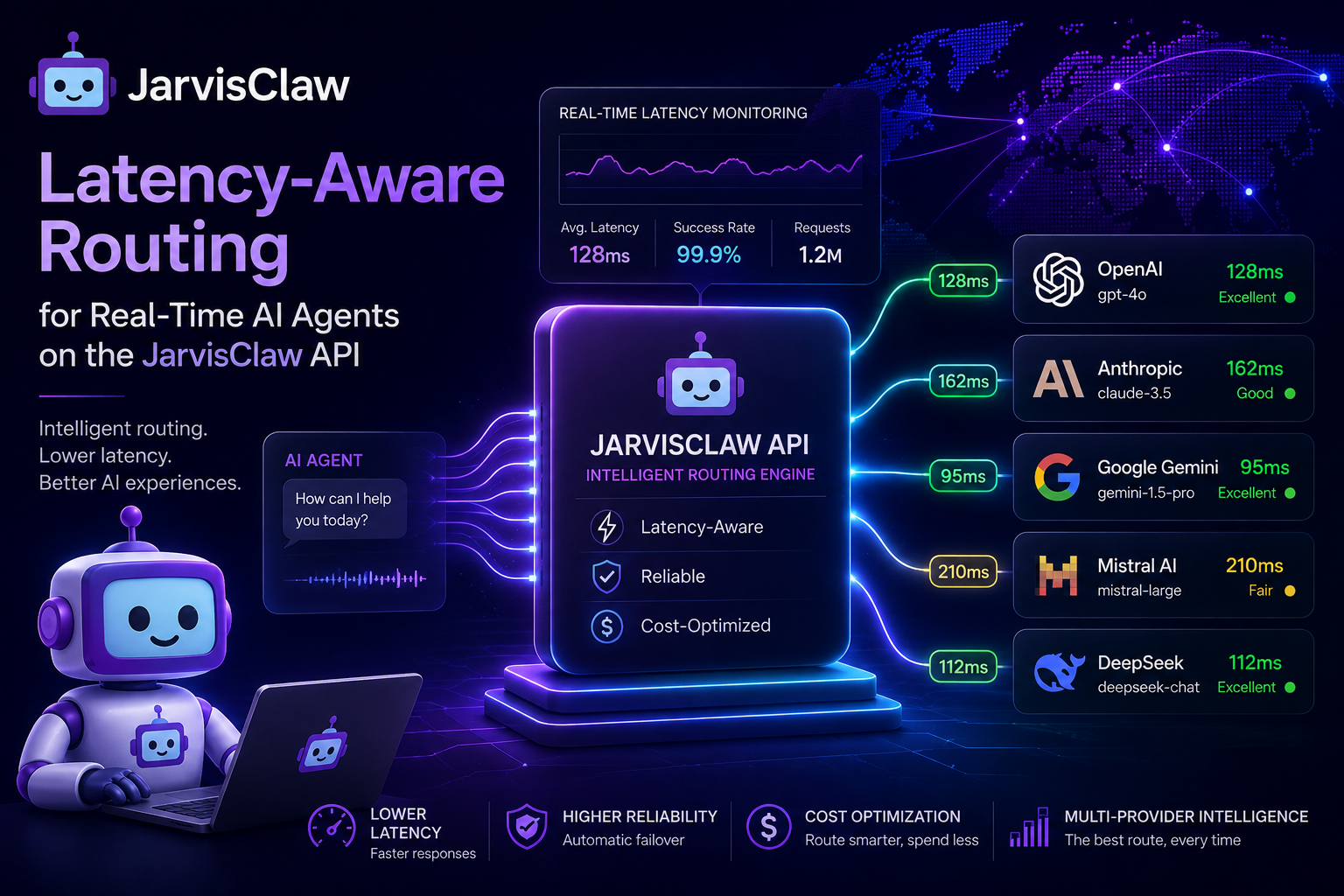
Real-time AI agents are changing how applications handle customer support, voice assistants, coding tools, autonomous workflows, and business automation. But as AI applications become more interactive, API latency becomes one of the biggest factors affecting user experience.
An AI agent can use the most capable language model available, but if every request takes several seconds to complete, users may abandon the application or the agent may fail to meet real-time requirements.This is where latency-aware routing becomes important.
Instead of sending every AI request to the same model or provider, a latency-aware AI gateway can evaluate current network conditions, provider responsiveness, model availability, and request requirements before selecting the best route.
With JarvisClaw API, developers can build AI applications that intelligently route requests across AI providers while focusing on speed, reliability, cost, and model performance.

What Is Latency-Aware Routing?
Latency-aware routing is an intelligent API routing strategy that selects an AI model or provider based partly on how quickly it can respond.
Traditional AI applications often use a simple architecture:Application→ AI Provider → Model → Response
This works for basic applications, but it becomes less efficient when an application depends on multiple LLM providers.
A latency-aware AI gateway introduces an intelligent routing layer:AI Agent → JarvisClaw API → Routing Logic → Best Available AI Model → ResponseThe routing layer can consider factors such as:
- Current API response latency
- Provider Availability
- Model performance
- Geographic location
- Network conditions
- Request complexity
- Token requirements
- Historical performance
- Rate limits
- cost
This allows an AI agent to choose a suitable provider dynamically instead of relying on a fixed endpoint.
Why Latency Matters for Real-Time AI Agents
Latency is especially important when AI is part of an interactive workflow.
Consider a customer-service AI agent.
If a user sends a question and waits several seconds before receiving a response, the experience can feel slow and unnatural.
The same problem becomes even more noticeable with:
- Voice AI agents
- AI customer-support systems
- Autonomous AI agents
- Real-time copilots
- AI coding assistants
- Interactivechatbots
- AI search applications
- Agentic workflow platforms
For these applications, developers often need to optimize time to first token (TTFT) as well as total response time.
A routing system that understands latency can help an AI application select a faster available route without forcing developers to manually monitor every provider.
How Latency-Aware AI Routing Works
A latency-aware routing architecture typically follows several steps.
1. The AI Agent Sends a Request
The application sends an AI request through the JarvisClaw API instead of directly connecting to an individual model provider.The request can include information such as the model preference, task type, context, and required capabilities.
2. JarvisClaw Evaluates Available Routes
The API gateway evaluates the available model and provider options.
Rather than assuming that one provider is always fastest, the routing layer can use performance information to determine which route is most appropriate.
For example, suppose an AI application can use several compatible models.
Provider A may normally respond quickly, but experience temporary congestion. Provider B may currently have lower latency and better availability.
A static integration would continue using Provider A.
A smart AI gateway can make a different routing decision.
3. The Request Is Routed to an Appropriate Model
Once the routing decision is made, the request is forwarded to the selected AI provider.
This can reduce unnecessary delays and help applications maintain more consistent performance.
4. Performance Data Can Improve Future Routing
Latency-aware systems become more valuable when routing decisions are informed by historical and real-time performance.
Over time, the gateway can help developers understand:
- Which providers respond fastest
- Which models have higher latency
- Which routes experience failures
- Which models provide the best performance for specific workloads
- Where bottlenecks are occurring
This creates a more intelligent approach to LLM API routing.
Latency-Aware Routing vs. Static Model Selection
With static model selection, developers typically choose one model and connect their application directly to it.
For example:
Application → Model A
The simplicity is attractive, but it creates a dependency on a single provider and route.
Latency-aware routing provides more flexibility:
Application → AI Gateway → Model A / Model B / Model C
The gateway can make routing decisions according to application requirements and current conditions.
This is particularly useful for businesses building production AI systems where reliability and responsiveness matter as much as model quality.
The Role of JarvisClaw in AI Model Routing
JarvisClaw can act as an AI gateway for developers building multi-model and multi-provider applications.
Instead of maintaining separate integrations for every AI provider, developers can use a centralized API layer to manage their AI traffic.
- LLM provider integration
- Model switching
- AI request routing
- API management
- Provider failover
- Performance optimization
For teams building AI agents, this means the application does not necessarily need to know exactly which provider should handle every request.
The routing layer can sit between the agent and the underlying AI infrastructure.
Combining Latency, Cost, and Model Quality
Latency should not be the only routing factor.The fastest model is not always the best model for a particular task.
For example, an AI agent handling a simple classification task may prioritize speed and low cost.
A complex reasoning workflow may prioritize model capability even if the response takes longer.
A sophisticated AI routing system can therefore consider multiple dimensions:
For example:
Simple requests → faster, lower-cost models
Complex reasoning → more capable reasoning models
Time-sensitive requests → lowest-latency route
Failed provider → automatic alternative route
High-volume workloads → cost-optimized routing
This approach allows businesses to balance performance with infrastructure costs.
Benefits of Latency-Aware Routing for AI Agents
Implementing intelligent routing can provide several advantages.
Faster AI Responses
Selecting lower-latency routes can improve the responsiveness of interactive AI applications.
Better Reliability
If one provider experiences an outage, congestion, or rate-limit problems, alternative routes can help keep applications operational.
Multi-Provider Flexibility
Developers can work with multiple AI providers without hard-coding every provider integration into their application.
Lower Infrastructure Costs
Routing requests according to workload requirements can prevent expensive models from being used unnecessarily.
Better User Experience
Faster and more consistent AI responses can improve customer satisfaction, especially for conversational and real-time applications.
Building the Next Generation of Real-Time AI Agents
As AI agents become more autonomous, infrastructure decisions increasingly need to happen automatically.

An agent should not have to depend on one model, one provider, or one static API route.Latency-aware routing for AI agents provides a foundation for building more responsive and resilient AI systems.
With an AI gateway such as JarvisClaw, developers can create a centralized layer for managing AI requests across providers while optimizing important factors such as latency, availability, cost, and model capability.
For companies building real-time AI agents, the goal is no longer simply to connect an application to an LLM.
The goal is to build an AI infrastructure layer that can select the right model, through the right provider, at the right time.
That is the value of intelligent AI API routing—and it is becoming increasingly important as production AI applications demand faster, more reliable, and more scalable inference.
FAQs
What is latency-aware routing in AI?
Latency-aware routing is an AI API routing strategy that considers response time and provider performance when selecting which model or provider should process a request
Why is latency important for AI agents?
Low latency is important for real-time AI agents because slow responses can negatively affect conversational experiences, voice applications, copilots, and autonomous workflows.
What is an AI gateway?
An AI gateway is an infrastructure layer between an application and AI providers. It can centralize API access, model routing, monitoring, provider management, and other AI infrastructure functions.
Can JarvisClaw route requests between AI providers?
JarvisClaw is designed as an AI gateway that helps developers manage and route AI requests across model providers, making multi-provider AI infrastructure easier to manage.
What is the difference between AI routing and model selection?
Model selection determines which AI model should perform a task. AI routing can go further by deciding which provider or available route should handle the request based on factors such as latency, availability, cost, and workload requirements.