
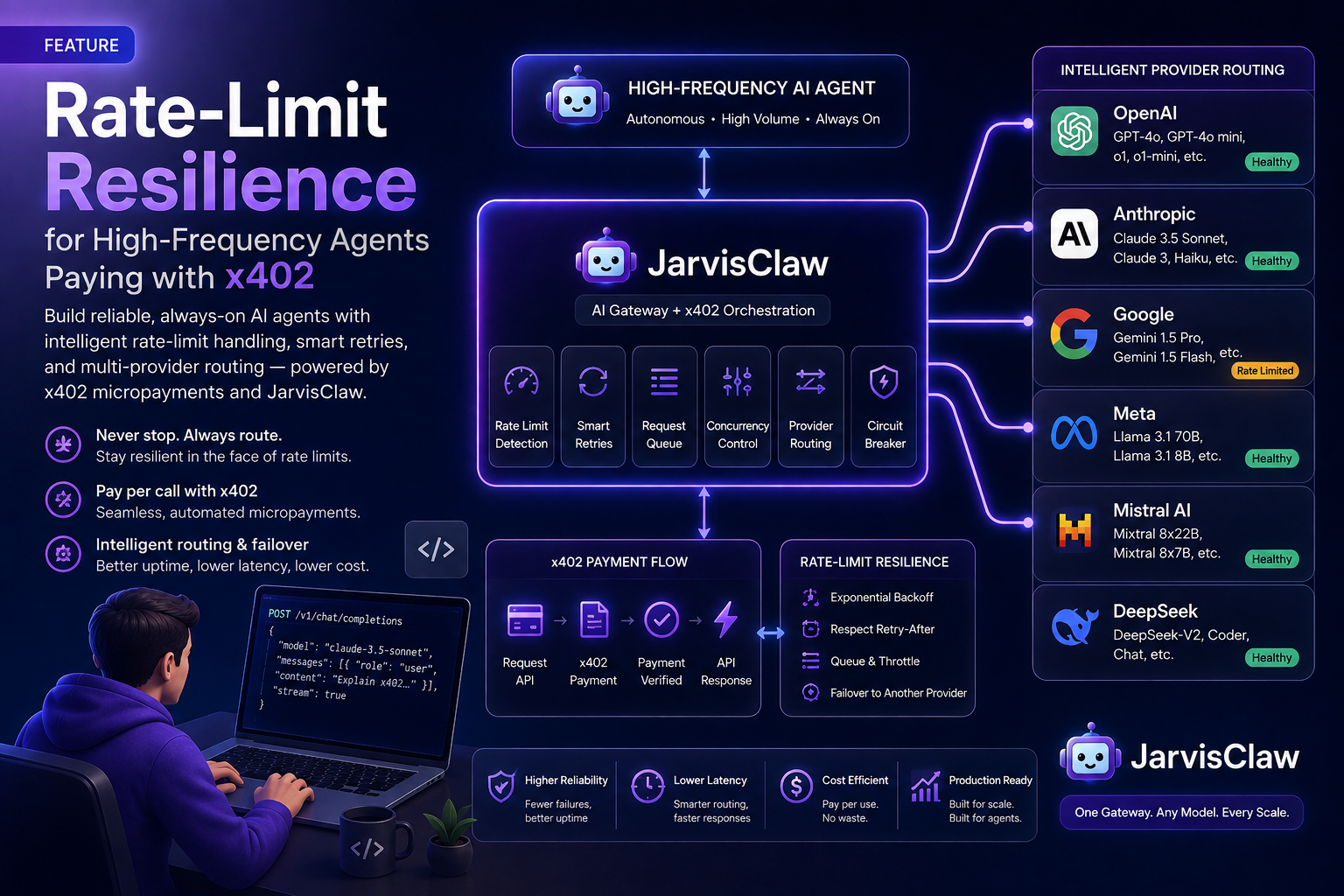
AI agents are becoming increasingly autonomous. Instead of making a handful of API calls per user request, modern agents can execute dozens or even hundreds of calls across search, reasoning, data, payment, and specialized AI services.
That creates a new infrastructure challenge: rate limits.
When an autonomous agent uses x402 payments to pay for API calls, successful payment does not automatically mean the request will be accepted.
The API can still enforce requests-per-minute limits, concurrency limits, burst limits, token quotas, or provider-specific restrictions.
For developers building production-grade AI agents, rate-limit resilience is therefore essential.
This guide explains how to design rate-limit resilient AI agents with x402, how intelligent routing can prevent unnecessary failures, and how JarvisClaw can help developers manage high-frequency API traffic across multiple AI providers.

What Is Rate-Limit Resilience?
Rate-limit resilience is the ability of an application or AI agent to continue operating reliably when an API limits how frequently requests can be made.
For example, an API might allow:
- 60 requests per minute
- 10 concurrent requests
- 1,000 requests per hour
- A specific number of tokens per minute
- Short bursts followed by cooldown periods
A high-frequency AI agent can reach these limits surprisingly quickly.The problem becomes more complicated when the agent is also making x402 payments.
The payment layer determines how the agent pays for access, while the API provider still controls whether and how frequently requests are accepted.
In other words:
Payment authorization ≠ unlimited API capacity.A production agent needs to handle both.
Why x402 Agents Need Better Rate-Limit Handling
Traditional applications often have predictable traffic.
An AI agent is different.
An autonomous agent may:
Receive a task.
Call a search API.
Query an LLM.
Call another model for verification.
Retrieve external data.
Run additional reasoning.
Make several parallel requests.
Pay for each API call through x402.
This creates bursty traffic.Imagine an agent executing 30 API requests within a few seconds. Even if every x402 payment is valid, some requests may receive 429 Too Many Requests.
Without resilience mechanisms, the agent may repeatedly retry the same request, creating even more traffic.
That can produce a damaging feedback loop:Rate limit → retry → more traffic → stronger rate limit → more retries → degraded agent performance.
The Key Components of Rate-Limit Resilience
A reliable x402-powered agent should combine several strategies instead of relying on retries alone.
1. Exponential Backoff
When an API returns a rate-limit response, the agent should wait before retrying.Instead of immediately sending another request, it can progressively increase the delay:
- First failure → short delay
- Second failure → longer delay
- Third failure → longer cooldown
- Continued failures → stop or reroute
Adding jitter, or a small random delay, can prevent multiple agent instances from retrying simultaneously.
This is particularly important for autonomous systems where hundreds of agents could be operating at the same time.
2. Respect Retry-After Headers
Some APIs provide a Retry-After response header indicating how long the client should wait.
A production AI gateway should prioritize this information instead of blindly applying its own retry schedule.
This prevents agents from repeatedly hitting an API that has explicitly requested a cooldown.
3. Control Concurrency
High-frequency agents often fail because they send too many requests simultaneously.
For example, an agent might launch 20 parallel requests when only five are necessary.
A concurrency controller can limit the number of active requests:Incoming tasks → Queue → Concurrency limiter → API requests
This reduces burst pressure while still allowing the agent to process work efficiently.
How x402 and Rate Limiting Work Together
x402 introduces a payment mechanism for HTTP-based services. An agent can encounter a payment-required response, complete the required payment, and then retry the request with the appropriate payment information.But the workflow does not eliminate normal API infrastructure constraints.A simplified production flow looks like this:
Agent → JarvisClaw → Provider → Rate Limit Check → API ResponseIf payment is required:Agent → API → x402 Payment Requirement → Payment → Retry → Provider
If the provider is rate-limited, the gateway should instead apply resilience logic:429 → Inspect Limit → Backoff / Queue / Reroute → Retry
This distinction is critical for developers building autonomous payment-enabled agents.
Smart Retries Are Better Than Blind Retries
Not every failure deserves another attempt.
A resilient gateway should distinguish between:
- Temporary rate limits
- Authentication failures
- Invalid requests
- Payment failures
- Provider outages
- Network failures
- Permanent application errors
For example, retrying an invalid API request five times wastes resources.Similarly, retrying a payment failure without understanding the cause can create unnecessary payment attempts.
The objective should be selective recovery, not simply more retries.
Token-Based Rate Limits Matter Too
AI providers don’t always measure capacity purely by request count.Many LLM APIs use token-based limits such as tokens per minute.
Consider two requests:
Request A: 500 tokensRequest B: 50,000 tokens
Both may count as one API request, but their impact on provider capacity is dramatically different.
A sophisticated AI gateway can therefore consider:
- Requests per minute
- Tokens per minute
- Concurrent requests
- Model-specific limits
- Provider availability
- Historical latency
- Cost per request
This enables better routing decisions than simply choosing the cheapest provider.
Rate-Limit-Aware x402 Routing
For high-frequency agents, routing should consider both payment economics and infrastructure capacity.
For example, an agent may have three possible providers:
| Provider | Cost | Latency | Capacity |
| Provider A | low | low | limited |
| Provider B | medium | medium | High |
| Provider C | Higher | Low | Higher |
Choosing Provider A for every request may appear optimal based on price.
But if Provider A repeatedly hits rate limits, the actual workflow becomes slower and less reliable.
A better routing system evaluates the complete request:Cost + latency + availability + rate-limit headroom + model capability
This creates a more reliable decision-making layer for autonomous agents.
Queueing Prevents Traffic Spikes
Another effective strategy is request queueing.
Instead of allowing an agent to overwhelm a provider, the gateway can temporarily queue requests when demand exceeds the available capacity.
A queue can:
- Smooth traffic bursts
- Protect upstream APIs
- Control concurrency
- Prioritize important requests
- Reduce unnecessary retries
- Improve overall system stability
For x402 workloads, queues can also help prevent unnecessary payment-related processing when requests cannot immediately be fulfilled.
Circuit Breakers Add Another Layer of Protection
If a provider repeatedly returns rate-limit or availability errors, the gateway can temporarily stop sending traffic to that provider.This is commonly known as a circuit breaker.Instead of:
Provider failure → request → failure → retry → failurethe gateway temporarily switches to:Provider failure → circuit opens → traffic reroutedAfter a cooldown period, the provider can be tested again.
This protects both the agent and the provider.
Why This Matters for Autonomous AI Agents
Human users generally tolerate waiting for a few seconds.Autonomous agents operate differently.
They may be managing workflows where one failed request blocks several downstream actions.
A rate-limit failure can therefore cause:
- Higher execution latency
- Failed workflows
- Duplicate API calls
- Increased spending
- Unnecessary x402 payment attempts
- Poor user experiences
Rate-limit resilience should consequently be treated as a core part of AI agent infrastructure, not an optional optimization.
How JarvisClaw Can Help
JarvisClaw can serve as an AI gateway layer between autonomous agents and multiple AI/API providers.
Instead of building rate-limit handling, provider routing, authentication, payment workflows, and failure recovery independently for every agent, developers can centralize these concerns at the gateway layer.
For x402-powered applications, this architecture is especially useful because agents need to combine automated payments with reliable API execution.
A production architecture can look like:AI Agent → JarvisClaw → Rate-Limit-Aware Router → Selected Provider → APIWhen x402 is involved, payment handling becomes part of the request lifecycle rather than a separate manual billing process.
The result is an architecture designed around autonomous API consumption instead of traditional human-driven API usage.
Best Practices for High-Frequency x402 Agents
Developers building high-volume agents should consider these principles:
- Implement exponential backoff with jitter.
- Respect Retry-After responses.
- Limit concurrent requests.
- Track requests and tokens separately.Use queues to smooth traffic spikes.
- Monitor provider-specific rate limits.Use circuit breakers for unstable providers.
- Route traffic across multiple providers when appropriate.Avoid retrying permanent errors.
- Track payment and API failures separately.
- Monitor latency, cost, availability, and rate-limit headroom.
- Set maximum retry and spending policies.

Conclusion
X402 makes automated API payments possible, but payment automation alone does not solve API scalability.
High-frequency AI agents also need sophisticated rate-limit management, concurrency control, intelligent retries, queueing, and provider failover.
The combination of x402 payments + rate-limit-aware routing + AI gateways provides a stronger foundation for autonomous agents operating at production scale.
As agents move from simple chatbots toward continuously operating software systems, infrastructure like JarvisClaw can help developers manage the complexity behind multi-provider AI access, automated payments, routing, and resilient API execution.
The future of agentic AI is not simply about making more Api calls. It is about making those calls reliably, efficiently, and intelligently—even when providers impose limits.
Start building with JarvisClaw today!