
AI development is moving quickly from simple chat interfaces toward applications that can reason, write code, use tools, analyze documents, and complete long-running tasks with limited human intervention.
That shift requires more than a model that produces better answers. Developers increasingly need models that can operate reliably inside real workflows.
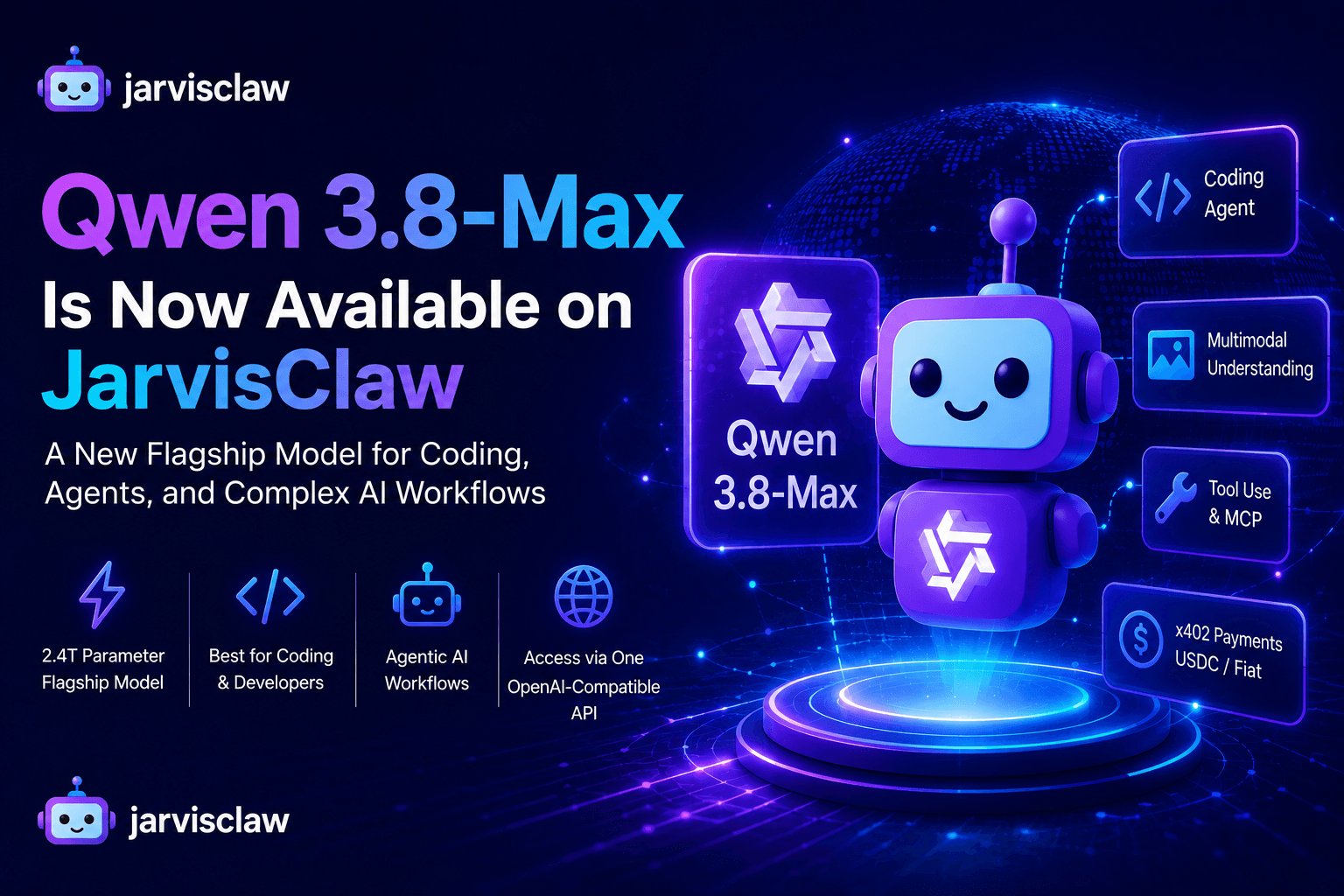
This is why we are excited to announce that Qwen3.8-Max is now available on JarvisClaw.
Qwen3.8-Max is the latest flagship model from the Qwen family, designed for demanding workloads such as software engineering, agentic coding, complex reasoning, multimodal analysis, and professional AI workflows.
With JarvisClaw, developers can access Qwen3.8-Max alongside 80+ AI models through one OpenAI-compatible API, making it easier to test the model, compare it with alternatives, and integrate it into existing AI applications without building another isolated provider integration.
What Is Qwen3.8-Max?
Qwen3.8-Max represents another major step forward in the Qwen model family.
The model has been publicly described as a 2.4-trillion-parameter flagship model, putting it among the largest frontier AI systems announced to date. But parameter count is not the most interesting part for developers.
The more important direction is where Qwen is investing that capability: coding, autonomous agents, multimodal understanding, and longer-running professional tasks.
This follows the broader evolution of Qwen models. Previous Qwen3 releases already emphasized hybrid reasoning, multilingual performance, coding, tool calling, and agentic capabilities. Qwen3 supported 119 languages and dialects and was explicitly designed for agent workflows using external tools and MCP-compatible configurations.
Qwen3.8-Max pushes this direction further.
Instead of treating the model as a chatbot that waits for individual prompts, developers can increasingly think of it as a reasoning engine inside larger AI systems.
Why Qwen3.8-Max Matters for Developers

The most useful question is not:
“Is Qwen3.8-Max smarter than every other model?”
A better question is:
“Which real workloads can it improve?”
For developers, several areas are particularly interesting.
1. Agentic Coding
Traditional coding assistants generate snippets or answer programming questions.
Agentic coding goes further.
An AI coding agent may need to:
- Understand an existing repository
- Plan a multi-step implementation
- Create and modify files
- Execute commands
- Debug failures
- Run tests
- Inspect results
- Continue working until the task is complete
This requires much stronger long-horizon reasoning than ordinary code completion.
Qwen has increasingly focused on this category, and Qwen3.8-Max is positioned for complex software-engineering and autonomous coding workloads.
That makes it particularly relevant for teams building coding agents, developer assistants, automated testing systems, and AI-powered DevOps workflows.
2. Complex AI Agent Workflows
AI agents rarely depend on model intelligence alone.
A useful agent must be able to reason about a task, select tools, process tool outputs, recover from errors, and decide what to do next.
A simplified workflow might look like:
User Goal → Planning → Tool Selection → API Call → Result Analysis → Correction → Final Output
The longer this workflow becomes, the more important instruction following and reasoning consistency become.
Qwen3.8-Max is especially interesting for these multi-step environments because the Qwen family has continued investing in tool use and agent capabilities.
For developers building autonomous research agents, coding agents, enterprise assistants, or multi-agent systems, this can matter more than improvements on a single benchmark.
3. Multimodal and Document-Heavy Work
Modern enterprise AI is rarely text-only.
Developers increasingly need models to work with screenshots, documents, charts, interfaces, reports, and other visual information.
This opens practical use cases such as:
- Document analysis
- UI understanding
- Screenshot-based debugging
- Report interpretation
- Visual information extraction
- Office workflow automation
A model that can connect visual understanding with reasoning and action can be more useful than separate models that only handle isolated parts of the workflow.
The Hidden Metric: How Long Can the Model Keep Working?

Most model comparisons focus on benchmark scores.
But production AI agents expose another important metric:
How long can the model continue working before human intervention becomes necessary?
Imagine two models.
Model A generates slightly better code on a benchmark but frequently loses track of the objective after several tool calls.
Model B performs similarly but can plan, execute, inspect errors, correct itself, and continue for much longer.
For an autonomous coding agent, Model B may deliver significantly more business value.
This is why developers evaluating Qwen3.8-Max should not test it with only simple prompts.
Try giving it real tasks:
- Modify an existing application
- Analyze a large project
- Debug multiple related errors
- Build a feature from requirements
- Process a complex document
- Coordinate several tools
Then measure whether the task was actually completed.
The most important metric is often not cost per million tokens.
It is cost per successfully completed task.
Qwen3.8-Max vs. Using One Model for Everything
Another mistake developers make is assuming that adding a powerful flagship model means every request should use it.
That is rarely the most efficient architecture.
Consider an AI SaaS application handling thousands of requests.
Simple classification may not require Qwen3.8-Max.
Short summaries may not require Qwen3.8-Max.
Basic extraction may not require Qwen3.8-Max.
But complex coding, research, planning, or agent workflows may benefit from a stronger model.
A better architecture might look like:
| Task | Model Strategy |
|---|---|
| Classification | Fast, low-cost model |
| Simple extraction | Lightweight model |
| Customer conversation | Balanced general model |
| Complex reasoning | Advanced reasoning model |
| Coding agent | Qwen3.8-Max or coding-focused model |
| Long-running agent task | High-capability agentic model |
This is where multi-model infrastructure becomes valuable.
Instead of asking which single model should power the entire application, developers can ask which model should handle each task.
Access Qwen3.8-Max Through JarvisClaw

Adding another model directly from another provider normally creates another integration to maintain.
Developers need to manage additional endpoints, API keys, billing systems, error handling, model identifiers, and provider-specific behavior.
JarvisClaw takes a different approach.
As an AI API Gateway and API Marketplace, JarvisClaw provides access to 80+ AI models through one OpenAI-compatible API.
With Qwen3.8-Max added to the platform, developers can test it alongside other leading models without redesigning their application around another provider-specific SDK.
For projects already built around an OpenAI-compatible API structure, integration can remain familiar:
Application → JarvisClaw API → Selected Model
The model changes.
Your core application architecture does not have to.
Why This Matters More as Models Change Faster
There is another hidden reason unified model infrastructure is becoming important.
Model lifecycles are getting shorter.
New models, preview versions, pricing updates, and capability improvements now arrive every few weeks.
Hard-coding an application around one model creates technical debt almost immediately.
A more resilient architecture separates:
Business Logic
from
Model Infrastructure
Your product should decide what needs to be done.
Your AI infrastructure should decide which model is best suited to do it.
This makes it easier to introduce models such as Qwen3.8-Max without rebuilding the entire product.
Qwen3.8-Max and the Agent Economy
Qwen3.8-Max also arrives at an important moment for AI agents.
The next generation of applications will increasingly combine:
Models + APIs + Tools + Data + Payments
JarvisClaw is being built around this broader infrastructure layer.
Beyond multi-model access, the platform supports Smart Routing, MCP, x402 on-chain micropayments, USDC payments, fiat top-ups, and external data services including Prediction Market APIs.
This creates possibilities beyond ordinary chatbot applications.
An AI agent could potentially:
- Understand a user goal.
- Select an appropriate model.
- Call external APIs.
- Retrieve required data.
- Pay for a service through an agent-compatible payment flow.
- Process the result.
- Continue the workflow automatically.
In this architecture, Qwen3.8-Max becomes one powerful reasoning component inside a much larger agent system.
How Should Developers Test Qwen3.8-Max?
Before moving production traffic to any new flagship model, run your own evaluation.
Do not rely entirely on public benchmarks.
Create a test set based on actual application traffic and measure:
- Task completion rate
- Coding accuracy
- Tool-call success rate
- Structured-output reliability
- Response latency
- Number of retries
- Long-task consistency
- Total tokens consumed
- Cost per completed task
For agent applications, also measure how many steps the model can successfully complete before manual intervention is required.
This will tell you much more than a generic leaderboard.
Build with Qwen3.8-Max on JarvisClaw
The release of Qwen3.8-Max reflects a broader change in AI development.
The competition is no longer only about generating better text.
Frontier models are increasingly becoming engines for software development, research, tool use, multimodal analysis, and autonomous workflows.
For developers, that creates both an opportunity and a challenge.
There are more powerful models than ever—but managing them individually is becoming increasingly complicated.
JarvisClaw simplifies that infrastructure by bringing Qwen3.8-Max and 80+ other AI models into one OpenAI-compatible API ecosystem.
Developers can experiment with new models faster, compare alternatives, optimize workloads, and build applications without tying the entire product to one model provider.
One API. Multiple Models. Agent-Ready AI Infrastructure.
Start building with Qwen3.8-Max on JarvisClaw.
FAQ
1. What is Qwen3.8-Max?
Qwen3.8-Max is a flagship model in the Qwen family designed for advanced workloads including coding, complex reasoning, multimodal understanding, and agentic workflows.
2. Is Qwen3.8-Max available on JarvisClaw?
Yes. Qwen3.8-Max has been added to JarvisClaw, allowing developers to access it through JarvisClaw’s unified multi-model infrastructure.
3. What is Qwen3.8-Max best used for?
It is particularly interesting for agentic coding, complex software engineering, research, multimodal document analysis, long-running workflows, and AI agents that need to interact with tools.
4. Is Qwen3.8-Max suitable for every API request?
Not necessarily. Lightweight tasks such as classification, simple extraction, and short summaries may be more cost-effective on smaller models. Qwen3.8-Max is better evaluated for workloads where stronger reasoning and agent capabilities provide measurable value.
5. How should developers evaluate Qwen3.8-Max?
Test it using real business tasks rather than relying only on benchmarks. Measure task completion rate, latency, tool-call reliability, coding accuracy, retries, token consumption, and cost per successful task.
6. Can I access Qwen3.8-Max through an OpenAI-compatible API?
JarvisClaw provides an OpenAI-compatible API architecture, allowing developers to access supported models through a familiar integration pattern.
7. Why use Qwen3.8-Max through JarvisClaw?
JarvisClaw provides access to Qwen3.8-Max alongside 80+ other AI models through one API infrastructure, reducing the need to maintain separate provider integrations and making model comparison and switching easier.
8. Is Qwen3.8-Max suitable for AI agents?
Yes. Its focus on coding, reasoning, multimodal understanding, and longer-running tasks makes it particularly relevant for AI agent workflows that require planning, tool use, execution, and iterative correction.
Build the Future of AI with JarvisClaw
AI is moving beyond individual models toward a connected ecosystem of models, APIs, agents, and intelligent services.
JarvisClaw provides the infrastructure developers need to build this future — combining 80+ AI models, OpenAI-compatible APIs, Smart Routing, MCP support, x402 payments, and AI Agent-ready capabilities in one platform.
Whether you are building AI SaaS products, autonomous agents, automation workflows, or next-generation applications, JarvisClaw helps you integrate faster, optimize costs, and scale with confidence.
One API. Multiple Models. Agent-Ready AI Infrastructure.
Start building with JarvisClaw today.