
AI agents are moving beyond simple question-and-answer workflows.
Modern autonomous AI Agent can search for information, call external APIs, use specialized models, execute transactions, and coordinate multiple services without constant human intervention.
But as agentic applications become more sophisticated, developers face an important architectural challenge: how do you build an AI agent that can adapt when APIs, providers, pricing models, and payment systems change?The answer is abstraction.
A future-proof agent architecture should separate the agent’s intelligence from the underlying API infrastructure and payment rail.
Instead of hard-coding individual AI providers, API authentication methods, pricing models, or payment mechanisms into the agent, developers can use an AI gateway such as JarvisClaw to create a flexible infrastructure layer.
Why AI Agents Need Future-Proof Architecture
Traditional applications often depend directly on specific APIs.
An application might call one AI provider, authenticate using an API key, and pay for usage through a monthly billing account.
That approach can become restrictive for autonomous AI agents.
AI agents may need to:
- Switch between multiple AI models
- Select providers based on latency or cost
- Call paid APIs dynamically
- Handle micropayments
- Respond to changing API prices
- Recover from provider failures
- Support new payment protocols such as x402
- Use different services depending on the task
When all of this logic is embedded directly into the agent, changing one infrastructure component can require significant code changes.A better approach is to create an abstraction layer between the AI agent, API providers, and payment systems.
What Does API Abstraction Mean for AI Agents?
API abstraction means the agent does not need to know exactly which provider is handling a request.
For example, an AI agent may need a large language model to summarize a document.
Instead of writing code specifically for one provider, the agent can send its request through an AI gateway.
The gateway determines which model or provider should handle the request.
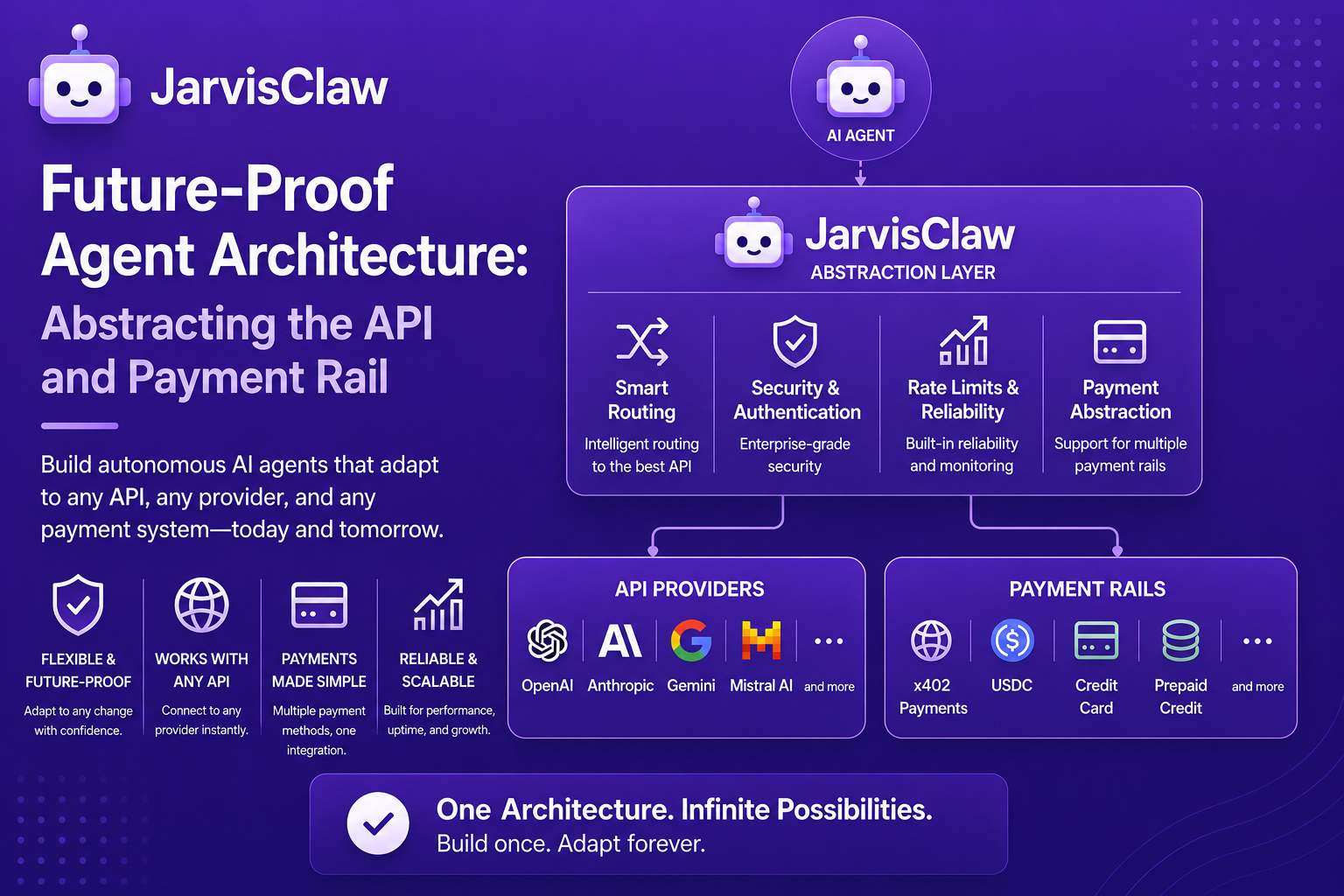
This creates a simple architecture:AI Agent → API Gateway → AI ProviderWith an abstraction layer, developers can change providers without redesigning the entire agent.
For example, an agent could use OpenAI-compatible APIs today while gaining access to other models and providers tomorrow.
This makes the application less dependent on a single vendor and creates greater flexibility for production AI workloads.
Payment Abstraction Is Equally Important
API abstraction solves only half of the problem.Autonomous agents also need a way to pay for the services they consume.
This becomes especially important as AI agents make frequent, automated API calls.
Traditional subscription-based billing is not always ideal for machine-to-machine transactions.An agent might need to pay a few cents—or even fractions of a cent—for individual API calls.
This is where payment abstraction becomes valuable.Instead of embedding one payment mechanism directly into the agent, developers can place the payment logic behind an infrastructure layer.
The architecture becomes:
AI Agent → JarvisClaw → API Provider + Payment Rail
The agent focuses on the task it needs to accomplish while the infrastructure handles the complexity of API access, routing, authentication, pricing, and payment.
x402 and the Rise of Machine-to-Machine Payments
One of the technologies helping enable this model is x402, a payment protocol built around HTTP’s 402 Payment Required status.
x402 allows APIs and digital services to request payment as part of an HTTP-based interaction.
This creates a natural model for AI agents that need to purchase services programmatically.
Instead of forcing developers to build complicated billing systems into every agent, payment can become part of the request lifecycle.
For example:
- The AI agent requests a service.
- The API indicates that payment is required.
- The payment is completed.
- The request is fulfilled.
- The agent continues its workflow
This model is particularly interesting for AI agent payments, API micropayments, autonomous agents, and machine-to-machine commerce.
However, developers should avoid making their application permanently dependent on a single payment rail.
The goal should be to abstract the payment mechanism just as carefully as the API provider.
JarvisClaw as the Infrastructure Abstraction Layer

JarvisClaw can sit between autonomous AI applications and the infrastructure they depend on.Instead of forcing developers to build provider-specific integrations, routing logic, and payment workflows directly into every agent, an AI gateway can centralize these capabilities.
This architecture can provide several advantages.
1. Provider Flexibility
AI providers change quickly.
New models appear, existing models become more expensive, and performance characteristics change.
2. Intelligent Routing
Different AI tasks may require different models.
A coding task might benefit from one model, while image analysis, reasoning, summarization, or high-volume processing could require another.
A gateway can provide routing logic that selects an appropriate provider based on factors such as cost, latency, model capability, availability, and workload.
3. Payment Flexibility
Payment infrastructure is also evolving.API keys, subscriptions, prepaid credits, usage billing, stablecoin payments, and x402-based micropayments may all coexist.
By separating payment logic from agent logic, developers can introduce new payment rails without rewriting the entire application.
4. Better Reliability
A future-proof architecture should assume that providers will occasionally experience outages, latency spikes, or rate limits.
An abstraction layer can make it easier to implement fallback strategies and route requests toward available infrastructure.
This is particularly important for production AI agents that need consistent API access.
A Future-Proof Architecture for the Agent Economy
The emerging agent economy will require infrastructure that can evolve as quickly as AI itself.
AI models will change.
API providers will change. Pricing structures will change.
Payment technologies will change.
Developers who tightly couple all of these components to their agents may face expensive migrations every time the ecosystem evolves.
A better approach is to build around abstraction from the beginning.
With an architecture such as:Agent → JarvisClaw → Routing Layer → API Provider → Payment Raildevelopers can isolate changes at the infrastructure level while keeping the agent’s core logic stable.
Conclusion
The future of autonomous AI agents will not be determined only by better models. It will also depend on flexible infrastructure that allows agents to interact with APIs and pay for digital services efficiently.
API abstraction and payment abstraction are therefore becoming critical components of future-proof agent architecture.
By separating agent logic from AI providers, API authentication, routing, pricing, and payment rails, developers can build systems that are easier to scale and adapt.
With JarvisClaw, developers can move toward an infrastructure model where agents focus on what they need to accomplish while the gateway manages the complexity underneath.
As AI agents become more autonomous, the winning architecture may be the one that is not locked into today’s APIs, models, or payment systems—but is designed to evolve with tomorrow’s agent economy.
Start building with JarvisClaw today!