
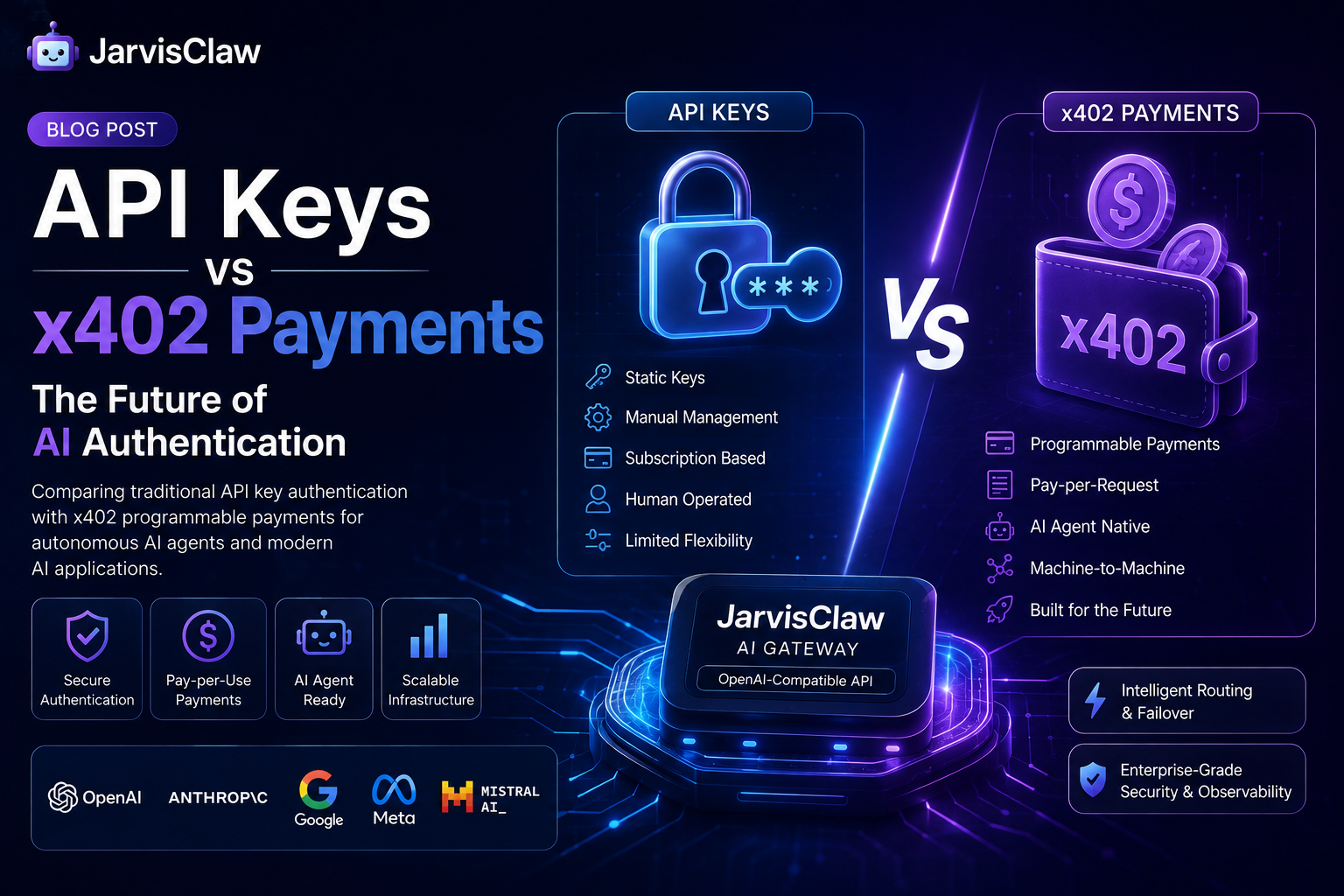
Artificial intelligence is changing the way software is built, deployed, and monetized. From AI chatbots and coding assistants to autonomous AI agents and enterprise automation platforms, modern applications depend on APIs to access powerful large language models (LLMs).
As AI adoption accelerates, developers face a critical question: How should AI applications authenticate and pay for API services?
For years, API keys have been the standard method for authenticating API requests. They are simple, reliable, and supported by virtually every cloud platform.

However, the rise of autonomous AI agents is exposing the limitations of static credentials. Tomorrow’s AI systems won’t just consume APIs—they’ll discover services, negotiate access, purchase resources, and complete transactions without human intervention.
This shift has sparked growing interest in X402, a protocol designed to combine authentication with programmable payments.
Rather than relying solely on subscriptions or prepaid credits, x402 enables pay-per-use APIs, allowing AI agents to securely purchase exactly what they need, when they need it.In this guide, we’ll compare API Keys vs x402 Payments, explain where each approach excels, and show how JarvisClaw helps developers build production-ready AI infrastructure that supports both traditional authentication and the future of AI-native commerce.
What Are API Keys?
An API key is a unique identifier issued by an API provider that authenticates an application requesting access to a service.
When an application sends a request, the API key confirms that the client has permission to use the API.Today, API keys are used by nearly every major AI provider, including platforms offering OpenAI-compatible APIs.
They allow developers to secure requests, monitor usage, apply rate limits, and manage customer access with minimal complexity.
Common use cases include:
- Accessing LLM APIs
- Authenticating AI applications
- Connecting cloud services
- Managing API quotas
- Tracking usage analytics
- Securing SaaS platforms
Because API keys are easy to implement, they have become the default authentication mechanism for millions of developers worldwide.
Why API Keys Have Powered Modern AI
API keys remain popular because they solve several important challenges.They are lightweight, fast to deploy, and supported by virtually every programming language and framework.
Developers can authenticate requests within minutes, making API keys ideal for startups, MVPs, internal tools, and production applications.
Additional advantages include:
- Simple implementation
- Low operational overhead
- Broad platform compatibility
- Easy request monitoring
- Mature security practices
- Flexible rate limiting
For traditional software applications where humans control API access, API keys remain an excellent solution.
The Limitations of API Keys
Although API keys work well today, modern AI applications are becoming increasingly autonomous.
1. Credential Management
Organizations often integrate multiple AI providers, each requiring separate credentials.Managing dozens—or hundreds—of API keys introduces unnecessary operational complexity.
2. Security Risks
API keys are static secrets.
If they’re accidentally exposed through logs, Git repositories, or client-side code, unauthorized users can consume expensive AI resources and generate unexpected costs.
3. Subscription-Centric Billing
Most AI providers using API keys depend on subscriptions, prepaid credits, or manual account management.
This works well for humans—but not for autonomous software.
4. Limited Support for AI Agents
Future AI agents won’t simply authenticate.
They’ll need to:
- Discover APIs
- Compare pricing
- Purchase services
- Execute transactions
- Complete workflows automatically
Static credentials alone cannot support this vision.
What Is x402?
x402 is an emerging protocol that combines authentication with programmable payments.
Instead of only proving identity, applications can securely attach payment information to API requests, enabling providers to charge automatically for each successful transaction.
This creates pay-per-use APIs, allowing developers to monetize services without requiring subscriptions or prepaid accounts.
For autonomous AI agents, x402 represents a major step forward because it enables software to purchase digital services independently.
Why x402 Is Important for the AI Economy
The AI ecosystem is rapidly evolving toward machine-to-machine commerce.Autonomous agents will soon purchase APIs, storage, compute resources, data feeds, and premium AI models without requiring human approval for every transaction.
x402 enables this future by supporting:
- Machine-to-machine payments
- Pay-per-request billing
- AI-native commerce
- Dynamic API marketplaces
- Usage-based pricing
- Frictionless monetization
Rather than replacing API keys, x402 expands what AI applications can accomplish.
API Keys vs x402 Payments
Although both technologies provide API access, they address different problems.
API Keys are best for:
- User authentication
- SaaS applications
- Traditional API access
- Subscription billing
- Internal business software
x402 Payments are best for:
- Autonomous AI agents
- Usage-based pricing
- AI marketplaces
- Machine-to-machine commerce
- Pay-per-use APIs
- Dynamic digital services
In many production environments, developers will use both technologies together.
API keys continue securing applications, while x402 enables programmable economic transactions.
Why AI Gateways Matter
Managing authentication across multiple AI providers quickly becomes difficult.
Organizations often connect to OpenAI, Anthropic, Google Gemini, Mistral, DeepSeek, and other providers simultaneously.Without an AI gateway, developers must manage separate authentication methods, billing systems, retries, monitoring, and routing logic.
A production-ready AI gateway simplifies this complexity by providing:
- Unified API management
- Intelligent model routing
- Automatic failover
- Cost optimization
- Usage analytics
- Security policies
- Centralized authentication
As multi-model AI becomes the norm, AI gateways are becoming essential infrastructure.
Why JarvisClaw Supports Both API Keys and x402
Modern AI infrastructure shouldn’t force developers to choose between today’s standards and tomorrow’s innovations.
JarvisClaw is a production-ready AI gateway designed for developers building scalable AI applications, enterprise platforms, and autonomous AI agents.Using OpenAI-compatible APIs, developers integrate once while connecting to multiple leading AI providers through a single interface.
JarvisClaw adds powerful production capabilities including:
- Intelligent AI routing
- Automatic retries and failover
- Enterprise observability
- Cost optimization
- Secure API management
- Multi-provider support
- Model Context Protocol (MCP) compatibility
- Native x402 payment support
This allows organizations to continue using API keys where appropriate while preparing for AI-native payment workflows.
Real-World Use Cases
The combination of API keys and x402 unlocks entirely new business opportunities.
Examples include:
- AI agents purchasing premium
- APIs automaticallyPay-per-call AI APIs
- AI marketplaces with dynamic pricing
- Enterprise AI orchestration
- Autonomous workflow automation
- Multi-model AI platforms
- Usage-based SaaS billing
- AI infrastructure platforms
These use cases demonstrate why programmable payments are becoming an important part of next-generation AI systems.
Best Practices for Future-Proof AI Authentication
- Store API keys securely using secret managers.
- Rotate credentials regularly.
- Never expose keys in client-side code.
- Use an AI gateway for centralized management.
- Monitor API usage continuously.
- Support OpenAI-compatible APIs.
- Prepare infrastructure for x402 adoption.
- Design systems that support autonomous AI agents.
These practices improve security while making future upgrades significantly easier.

Conclusion
API keys have powered the modern API economy for years and will remain an essential authentication method for countless AI applications.
They provide a secure, familiar, and efficient way to control access to AI services.However, the future of AI extends beyond authentication alone. As autonomous AI agents become capable of discovering services, purchasing resources, and completing transactions independently, programmable payment protocols such as x402 will become increasingly important.
Rather than competing technologies, API keys and x402 complement one another. API keys secure applications, while x402 enables AI-native commerce and pay-per-use APIs.
With JarvisClaw, developers can embrace both.
By combining OpenAI-compatible APIs, intelligent AI routing, enterprise observability, automatic failover, Model Context Protocol (MCP) support, secure API management, and x402 payments, JarvisClaw provides the production-ready AI gateway needed to build reliable, scalable, and future-proof AI infrastructure.
Whether you’re developing an AI startup, launching an enterprise platform, or building the next generation of autonomous AI agents, JarvisClaw gives you the tools to authenticate securely, optimize costs, and prepare for the evolving AI economy.
As programmable AI payments become more common, organizations that adopt flexible infrastructure today will be better positioned to innovate, scale, and compete tomorrow.
Start building with JarvisClaw today!!