
Artificial intelligence is transforming how businesses build software, automate workflows, and deliver customer experiences
As more organizations adopt large language models (LLMs), developers are increasingly relying on AI gateways to simplify access to multiple AI providers while improving reliability and scalability. Two platforms that often come up in this conversation are OpenRouter and JarvisClaw.Both solutions provide a unified way to connect to leading AI models from providers such as OpenAI, Anthropic, Google Gemini, Mistral AI, Meta, and DeepSeek.
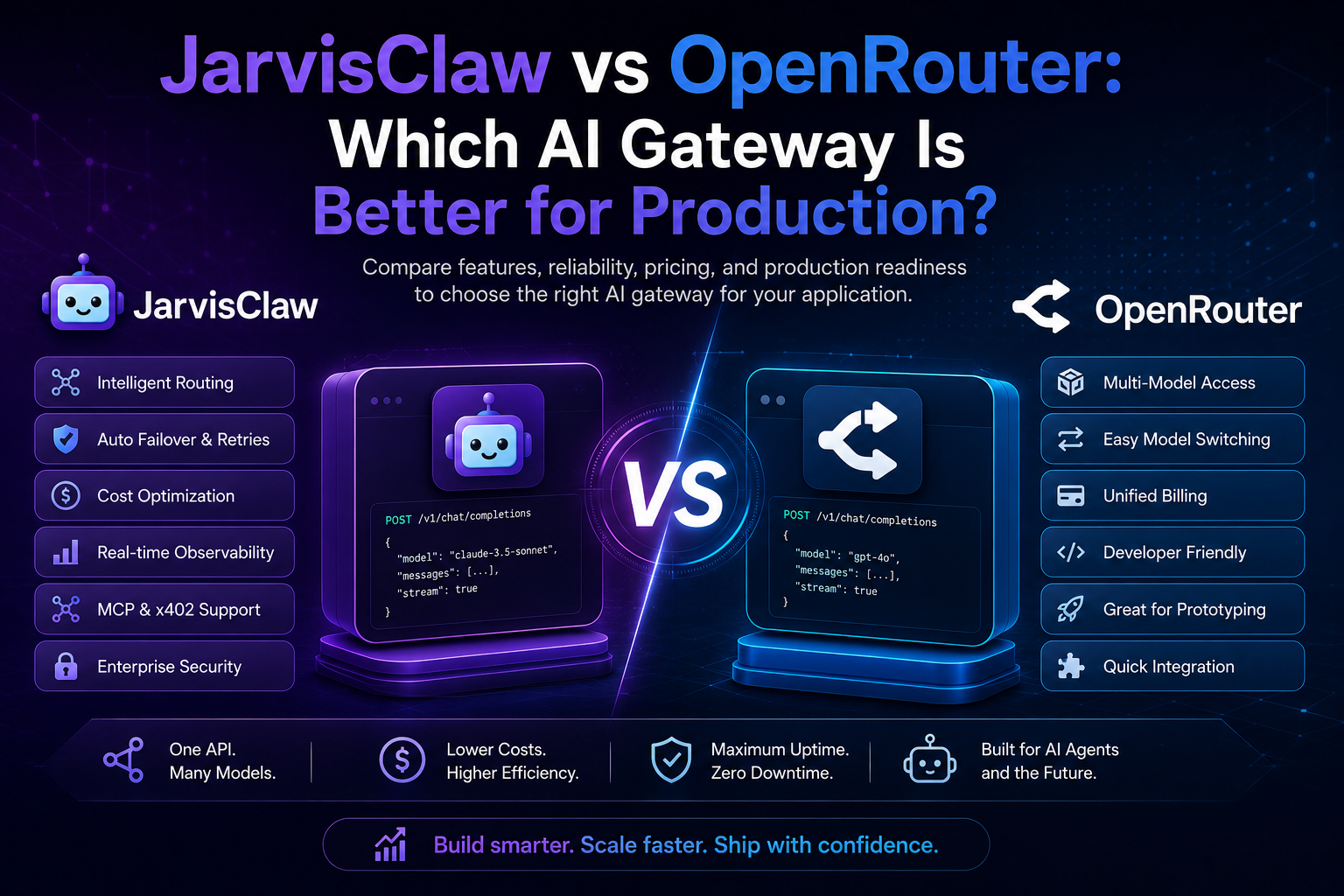
However, they are designed for different stages of an AI application’s lifecycle. OpenRouter focuses on making multi-model experimentation easy, while JarvisClaw is built for teams running production AI workloads that demand intelligent routing, observability, security, and high availability.In this guide, we’ll compare JarvisClaw vs OpenRouter to help you determine which AI gateway is the better choice for your production environment.
What Is an AI Gateway?

An AI gateway is a centralized layer that sits between your application and multiple AI providers. Rather than integrating separate APIs for every model vendor, developers connect to one endpoint that manages authentication, request routing, monitoring, retries, and provider selection.
Using an AI gateway offers several advantages:
- Simplified API integration
- Access to multiple AI models
- Reduced vendor lock-in
- Better reliability and failover
- Centralized usage monitoring
- Lower operational costs
- Easier scaling for production workloads
As AI applications grow, an AI gateway becomes essential infrastructure instead of an optional convenience.
What Is OpenRouter?
OpenRouter is a popular platform that provides developers with a single API for accessing models from numerous AI providers. It removes the complexity of managing different SDKs, authentication methods, and API endpoints, allowing developers to switch models with minimal effort.
This makes OpenRouter an excellent choice for developers who are experimenting with LLMs, comparing model performance, or building an MVP.
With unified billing and a straightforward developer experience, it significantly reduces the time required to launch AI-powered applications.
OpenRouter Advantages
- One API for multiple AI providers
- Quick setup and integration
- Easy model experimentation
- Unified billing
- Simple provider switching
- Ideal for prototypes and early-stage products
For startups and independent developers, OpenRouter is a fast and convenient way to begin building with AI.
What Makes JarvisClaw Different?
While OpenRouter focuses on simplifying model access, JarvisClaw is designed as a production-ready AI gateway built for modern AI infrastructure.
JarvisClaw offers OpenAI-compatible APIs while adding intelligent routing, automatic failover, advanced monitoring, enterprise-grade security, MCP compatibility, and x402 payment support. Instead of simply forwarding API requests, JarvisClaw optimizes how requests are processed, improving reliability, performance, and cost efficiency.
Rather than spending months building internal gateway infrastructure, engineering teams can deploy JarvisClaw and focus on developing AI-powered products.
JarvisClaw vs OpenRouter: Key Differences
Intelligent Model Routing
One of JarvisClaw’s biggest advantages is intelligent routing.Not every request requires the same AI model.
A simple chatbot question may only need a lightweight model, while a complex reasoning task may require a more advanced LLM.
JarvisClaw automatically routes requests based on latency, pricing, quality, request type, or custom business rules.
This helps improve user experience while reducing AI costs.
OpenRouter allows developers to select different models, but JarvisClaw provides deeper routing intelligence for production deployments.
Reliability and High Availability
Downtime is expensive.
If an AI provider experiences outages or rate limits, production applications must continue operating without interrupting users.
JarvisClaw includes automatic retries, health-aware routing, and failover capabilities that redirect traffic to healthy providers whenever necessary. This level of resilience is essential for customer-facing applications and enterprise systems.
Cost Optimization
Managing AI expenses becomes increasingly important as usage grows.
JarvisClaw helps reduce operational costs by selecting the most appropriate model for each request instead of always using the most expensive option. Organizations can create routing policies that balance performance, quality, and pricing.
For businesses processing thousands of AI requests daily, intelligent routing can significantly reduce monthly infrastructure costs.
Developer Experience
Both platforms offer a developer-friendly experience, but they target different needs.OpenRouter excels at helping developers experiment quickly with different AI models.
JarvisClaw combines that simplicity with production-ready capabilities.
Because it supports OpenAI-compatible APIs, developers can migrate existing OpenAI applications with minimal code changes while gaining advanced infrastructure features such as routing, observability, failover, and centralized management.
This reduces engineering complexity while improving operational reliability.
Enterprise Security and Observability
Production AI systems often process sensitive business or customer data.
Organizations need secure API management, usage analytics, access controls, audit logging, and real-time monitoring.
JarvisClaw provides these enterprise-focused capabilities, enabling teams to monitor latency, request volumes, model performance, and operational health from a centralized platform.
These insights help engineering teams optimize AI infrastructure and resolve issues before they affect users.
Built for Autonomous AI Agents
The future of AI is moving beyond chatbots toward autonomous AI agents that can reason, plan, use tools, and complete complex workflows.JarvisClaw is built with this future in mind.
It supports the Model Context Protocol (MCP), making it easier for AI agents to interact with external tools and services.
JarvisClaw also supports x402 payments, enabling developers to build AI-native monetization systems where autonomous agents can securely pay for APIs and digital services.
These capabilities make JarvisClaw an excellent platform for next-generation AI applications.
Which AI Gateway Should You Choose?
Choose OpenRouter if you are:
- Learning AI development
- Building prototypes
- Testing multiple language models
- Launching an MVP
- Looking for quick and simple integration
Choose JarvisClaw if you need:
- Intelligent AI routing
- Automatic failover and retries
- OpenAI-compatible APIs
- Enterprise-grade security
- Real-time monitoring
- Cost optimization
- MCP compatibility
- x402 payment support
- Production-ready AI infrastructure
Final Verdict

Both OpenRouter and JarvisClaw solve the challenge of accessing multiple AI models through a unified API, but they serve different audiences.
OpenRouter is an outstanding platform for experimentation, rapid prototyping, and exploring different LLMs.
It helps developers build quickly without worrying about multiple integrations.
JarvisClaw goes several steps further by delivering the production infrastructure needed to operate reliable AI applications at scale.
With intelligent routing, automatic failover, enterprise observability, OpenAI-compatible APIs, MCP support, and x402 payment capabilities, it gives engineering teams the tools required to build resilient, scalable, and cost-efficient AI systems.
If your goal is to move beyond prototypes and build AI products that customers rely on every day, JarvisClaw is the AI gateway designed for production.
It provides the flexibility, performance, and operational control modern AI applications need, making it a compelling choice for developers and enterprises preparing for the next generation of AI-powered software.