
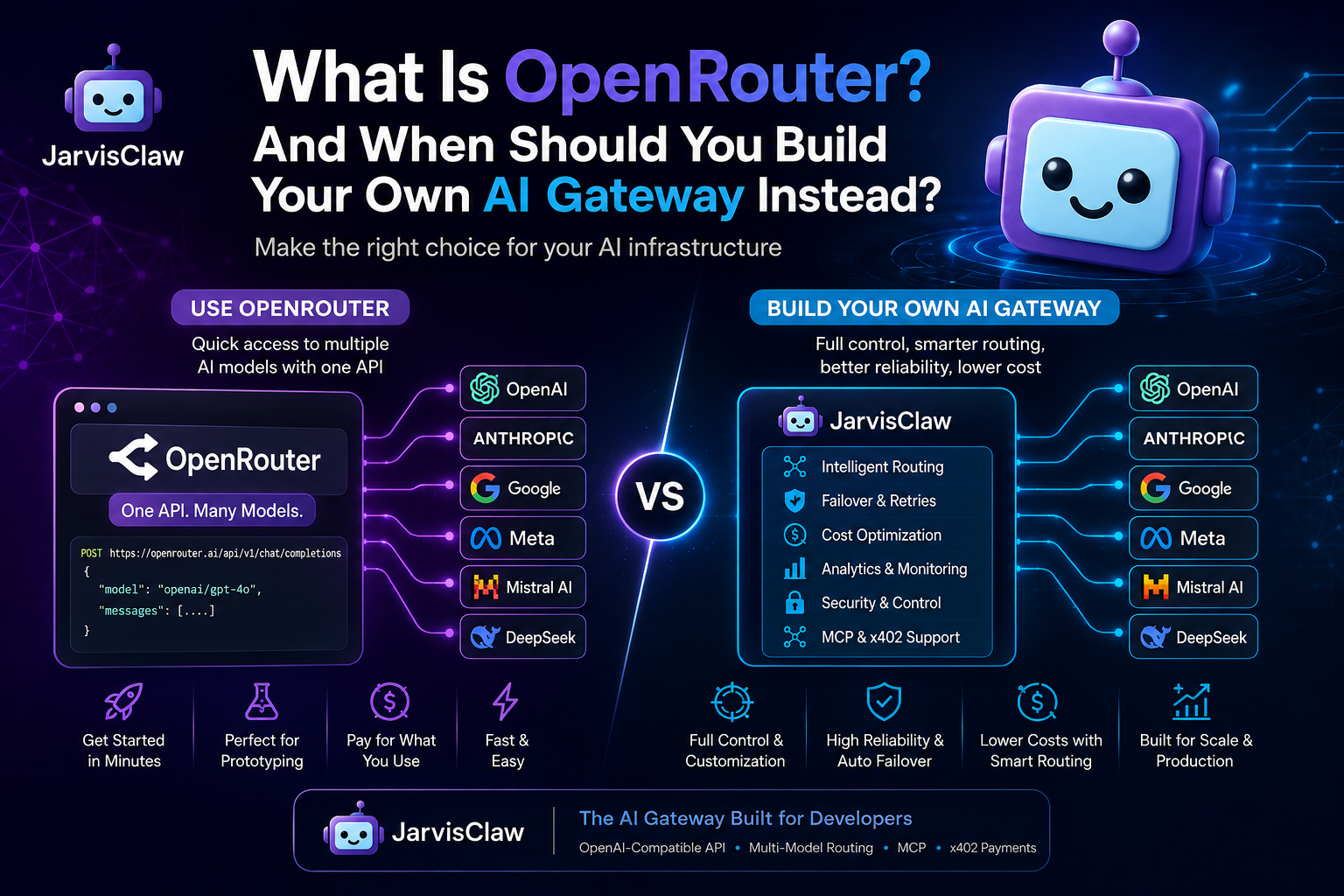
Learn what OpenRouter is, how it works, and when it’s time to build your own AI gateway. Discover why JarvisClaw is built for production AI infrastructure.
Artificial intelligence is evolving at an incredible pace, and developers now have access to dozens of powerful large language models (LLMs) from providers such as OpenAI, Anthropic, Google, Meta, Mistral, and DeepSeek. While this variety creates exciting opportunities, it also introduces a major challenge: managing multiple APIs, authentication methods, pricing models, and performance differences.
This is where OpenRouter has become a popular choice. It offers developers a single API that provides access to multiple AI models without requiring separate integrations for each provider.

However, as AI applications move from prototypes to production systems, many teams begin asking an important question:
Should you continue using OpenRouter, or is it time to build your own AI gateway?
In this guide, we’ll explain what OpenRouter is, its benefits and limitations, and when building your own AI gateway with JarvisClaw becomes the better long-term solution.
What Is OpenRouter?
OpenRouter is a unified API platform that allows developers to access multiple AI models through a single endpoint. Instead of integrating separately with every AI provider, developers can send requests to OpenRouter, which routes them to the selected model.
This approach significantly simplifies development by reducing the complexity of managing multiple SDKs, authentication systems, and API endpoints.
With OpenRouter, developers can quickly experiment with different models, compare outputs, and switch providers without rewriting large portions of their application.
For startups and individual developers, this flexibility dramatically reduces development time.
Why Developers Like OpenRouter
OpenRouter has gained popularity because it removes much of the friction involved in multi-model development.

Some of its biggest advantages include:
- One API for multiple AI providers
- Faster experimentation with different models
- Simplified authenticationReduced integration complexity
- Easy provider switching
- Centralized billing experience
These benefits make OpenRouter an excellent solution for prototypes, hackathons, research projects, and early-stage products.
The Challenges of Scaling with OpenRouter
Although OpenRouter simplifies AI integrations, production applications often require greater control than a shared gateway can provide.
As traffic grows, engineering teams typically need additional capabilities such as:
Custom Routing Logic
Every AI request is different.
A customer support chatbot might prioritize speed, while a coding assistant needs higher reasoning quality.
Production systems often require intelligent routing based on latency, pricing, request type, user tier, or geographic location.
Generic routing cannot always optimize these business-specific decisions.
Reliability and Failover
Production AI applications cannot afford downtime.If one provider experiences outages or rate limits, requests should automatically fail over to another model without interrupting users.
Organizations frequently require customized retry strategies and fallback logic tailored to their workloads.
Cost Optimization
Different models have dramatically different pricing structures.Sending every request to the most expensive model may improve quality but can quickly inflate operating costs.
A dedicated AI gateway enables organizations to route requests dynamically based on complexity, reducing expenses while maintaining excellent user experiences.
Security and Compliance
Many enterprises prefer to keep API credentials, routing policies, logging, and monitoring entirely under their own infrastructure.
This level of control is especially important for regulated industries handling sensitive customer or business data.
When Should You Build Your Own AI Gateway?
Building your own AI gateway becomes worthwhile when your AI infrastructure grows beyond simple experimentation.
You should consider building or adopting your own gateway if:
- You use multiple AI providers in production.
- You require automatic failover and retries.
- You want intelligent model selection.
- You need centralized API management.
- You need detailed monitoring and analytics.
- You want stronger security controls.
- You require custom pricing or payment workflows.
- You plan to support autonomous AI agents.
At this stage, managing AI infrastructure directly provides greater flexibility, performance, and long-term scalability.
Why JarvisClaw Is a Better Production AI Gateway
Rather than building an AI gateway entirely from scratch, many engineering teams choose JarvisClaw to eliminate months of infrastructure development.
JarvisClaw provides a production-ready AI gateway designed specifically for modern AI applications and autonomous agents.
With JarvisClaw, developers can connect to multiple AI providers through a single OpenAI-compatible API while gaining advanced routing, monitoring, and reliability features.
Key capabilities include:
- Intelligent model routing
- Automatic retries and failover
- OpenAI-compatible endpoints
- Multi-provider supportCentralized
- API managementBuilt-in observability
- MCP compatibility
- x402 payment support for AI-native monetization
Instead of spending engineering resources building gateway infrastructure, teams can focus on creating products that deliver value to users.
OpenRouter vs. Your Own AI Gateway
Choosing between OpenRouter and your own gateway depends on your application’s maturity.
OpenRouter is an excellent choice if you’re building prototypes, learning AI development, testing different models, or launching an MVP quickly.
A dedicated AI gateway becomes the better option when reliability, scalability, cost optimization, and operational control become business priorities.
For organizations running AI applications at scale, the gateway evolves into critical infrastructure rather than just another API.
Best Practices for Choosing an AI Gateway
Before selecting an AI gateway, evaluate the following:
- Support for multiple AI providers
- Intelligent routing capabilities
- Automatic failover and retries
- OpenAI compatibility
- Security and access controls
- Usage analytics
- Cost optimization featuresScalability under heavy workloads
- Support for AI agents and MCP
- Future-ready payment models such as x402
Selecting a gateway that grows with your business prevents expensive migrations later.
Conclusion

OpenRouter has made multi-model AI development significantly easier by providing one API for many leading AI providers.
It remains an excellent option for experimentation and early-stage development.However, as applications become mission-critical, businesses often require more control over routing, reliability, monitoring, security, and costs than a shared gateway can provide.
That’s where JarvisClaw stands out.
By offering a production-ready AI gateway with intelligent routing, automatic failover, OpenAI-compatible APIs, MCP support, and x402 payment capabilities, JarvisClaw enables developers to build scalable AI infrastructure without the complexity of creating an AI gateway from scratch.
If your goal is to move beyond prototypes and build reliable, production-grade AI applications, investing in your own AI gateway—or adopting JarvisClaw—is the next logical step.