
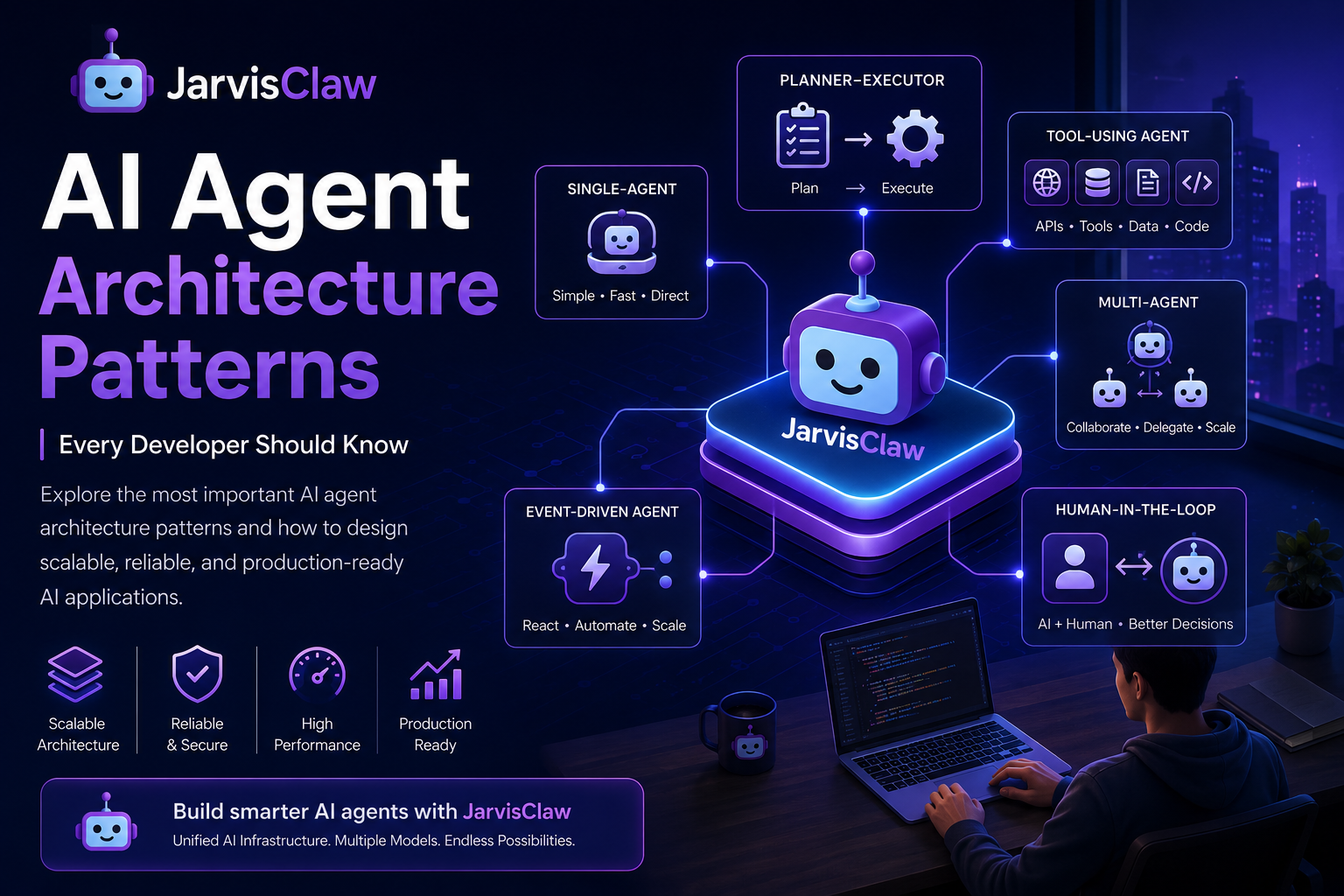
Learn the most important AI agent architecture patterns, how they work, and how to choose the right design for scalable, production-ready AI applications. Discover how JarvisClaw simplifies AI agent infrastructure.
AI Agent Architecture Patterns Every Developer Should Know
Artificial intelligence has evolved far beyond simple chatbots.
Today’s AI agents can plan tasks, interact with APIs, use external tools, retrieve information, collaborate with other agents, and even make autonomous decisions. As these systems become more capable, one factor separates successful AI applications from unreliable ones: architecture.
Choosing the right architecture determines whether your AI agent can scale efficiently, recover from failures, integrate with external services, and deliver consistent results in production.
In this guide, we’ll explore the most common AI agent architecture patterns, explain when each should be used, and discuss how modern AI infrastructure platforms like JarvisClaw help developers build production-ready AI agents without managing unnecessary complexity.
Why AI Agent Architecture Matters
An AI agent is more than a large language model (LLM). Production-grade agents typically combine multiple components, including:
- Large language models
- Memory systems
- External APIs
- Tool execution
- Planning logic
- Workflow orchestration
- Security controls
- Observability and monitoring
How these components interact defines the agent’s architecture.A well-designed architecture offers several benefits:
- Better scalability
- Improved reliability
- Lower operational costs
- Easier maintenance
- Faster response times
- Better user experience
Without a solid architectural foundation, even powerful language models can become slow, expensive, or unpredictable.
1. Single-Agent Architecture

The simplest architecture consists of one intelligent agent responsible for handling an entire request from start to finish.
The agent receives a prompt, reasons about the task, calls external tools if necessary, and returns a response.
Best suited for:
- Customer support assistants
- Internal company chatbots
- Document summarization
- FAQ systems
- Personal productivity assistants
Advantages
- Easy to build
- Low infrastructure complexity
- Lower operating costs
- Faster deployment
Limitations
As applications grow, one agent becomes responsible for every task. This increases reasoning complexity and makes debugging more difficult.
2. Planner–Executor Architecture

Rather than asking one agent to solve everything, this pattern separates planning from execution.
The Planner Agent decides how to solve a problem by breaking it into smaller tasks.The Executor Agent performs each task, such as:
- Searching documentation
- Calling APIs
- Running code
- Accessing databases
- Generating reports
For example, if a user asks for a competitive market analysis, the planner may create steps such as:
- Gather market data
- Analyze competitors
- Identify trends
- Generate recommendations
The executor completes each task before returning the results.
Benefits
- More accurate reasoning
- Better task organization
- Easier debugging
- Improved scalability
This architecture is becoming increasingly popular for enterprise AI applications because it mirrors how humans solve complex problems.
3. Tool-Using Agent Architecture
Modern AI agents become significantly more useful when they can interact with external tools.
Instead of relying solely on their training data, they can:
- Search the web
- Query databases
- Read files
- Send emails
- Generate images
- Process spreadsheets
- Interact with third-party APIs
This architecture transforms an LLM into an intelligent orchestrator capable of completing real-world tasks.
However, tool usage also introduces challenges, including authentication, permission management, API reliability, and error handling.
These issues become even more important as the number of connected services grows.Infrastructure platforms such as JarvisClaw simplify this process by providing a unified gateway for AI applications.
Rather than integrating directly with multiple providers and services, developers can manage routing, retries, and provider selection through a single interface, reducing operational complexity and improving reliability.
4. Multi-Agent Architecture
As AI applications become more sophisticated, a single agent may no longer be enough. In a multi-agent architecture, multiple specialized AI agents work together, with each responsible for a specific role.
For example, a software development workflow might include:
- A Planner Agent that analyzes the user’s request and creates a task list.
- A Research Agent that gathers documentation and references.
- A Coding Agent that generates code.
- A Testing Agent that validates the output.
- A Review Agent that checks for bugs, security issues, and coding standards.
Instead of one AI attempting to handle every responsibility, each agent focuses on what it does best.
This approach often improves accuracy, scalability, and maintainability for complex applications.
However, coordinating multiple agents introduces new challenges, such as communication, task scheduling, and error handling.
Developers need reliable infrastructure to manage these interactions efficiently.
5. Event-Driven AI Agent Architecture
Not every AI agent needs to wait for a user prompt. Many production systems operate in response to events.
An event-driven architecture allows AI agents to react automatically when something happens, such as:
- A customer submits a support ticket.
- A payment is completed.
- A file is uploaded.
- A server reports an error.
- A new lead enters a CRM.
When an event occurs, the agent processes the information, decides on the next action, and can trigger additional workflows or notifications.
This architecture is ideal for automation platforms, customer support systems, DevOps workflows, and enterprise integrations where responsiveness is critical.
6. Human-in-the-Loop Architecture
Despite rapid advances in AI, there are many situations where human oversight remains essential.
A human-in-the-loop architecture combines autonomous decision-making with human approval for sensitive or high-impact actions.
Examples include:
- Approving financial transactions.
- Reviewing legal documents.
- Publishing AI-generated content.
- Authorizing customer refunds.
- Validating medical or compliance-related recommendations.
This pattern balances automation with accountability, helping organizations reduce risks while still benefiting from AI efficiency.
Choosing the Right AI Agent Architecture
There is no one-size-fits-all solution. The best architecture depends on your application’s goals, complexity, and scale.
Here are some general recommendations:
- Single-Agent Architecture: Best for simple assistants, chatbots, and productivity tools.
- Planner–Executor Architecture: Ideal for workflows that require structured reasoning and task decomposition.
- Tool-Using Architecture: Suitable for agents that need to interact with APIs, databases, or external services.
- Multi-Agent Architecture: Recommended for enterprise-grade systems with specialized responsibilities.
- Event-Driven Architecture: Perfect for automation and real-time workflows.
- Human-in-the-Loop Architecture: Essential when human review is required for safety, compliance, or quality assurance.
As your AI application evolves, it’s common to combine multiple patterns into a hybrid architecture that meets your specific requirements.
Why Infrastructure Matters

Designing a robust architecture is only part of the challenge.
Running AI agents reliably in production requires infrastructure that can handle model routing, provider failover, authentication, monitoring, and scaling.
Without the right infrastructure, developers often spend significant time managing API integrations, retries, and vendor-specific implementations instead of building product features.
JarvisClaw simplifies this complexity by providing a unified AI infrastructure layer.
Developers can connect to multiple AI providers through a single, OpenAI-compatible interface while benefiting from features such as intelligent routing, automatic failover, and centralized management.
This allows teams to focus on creating better AI agents rather than maintaining backend integrations.
Conclusion
AI agents are rapidly becoming a core part of modern software, powering everything from customer support and research assistants to autonomous workflows and enterprise automation.
Choosing the right architecture is one of the most important decisions you’ll make as an AI developer. Whether you’re building a simple chatbot or a sophisticated multi-agent platform, selecting the appropriate design pattern improves scalability, reliability, and long-term maintainability.
As these systems continue to evolve, combining strong architectural principles with dependable infrastructure will be essential for building production-ready AI applications.
Frequently Asked Questions
What is an AI agent architecture?
AI agent architecture refers to the overall design of an AI system, including how it reasons, stores memory, communicates with tools, interacts with APIs, and coordinates workflows.
Which AI agent architecture is best for beginners?
A single-agent architecture is the easiest starting point because it is simple to build, test, and deploy.
When should I use a multi-agent architecture?
Multi-agent systems are best suited for complex workflows where different agents can specialize in planning, research, execution, testing, or review.
Can one AI application use multiple architecture patterns?
Yes. Many production AI systems combine planner–executor workflows, tool usage, event-driven automation, and human approval processes to deliver more reliable and scalable solutions.
How does JarvisClaw support AI agent development?
JarvisClaw provides a unified AI gateway that simplifies access to multiple model providers through a single interface. Features such as intelligent routing, automatic failover, and centralized management help developers build production-ready AI applications more efficiently.
Start building with JarvisClaw today!