
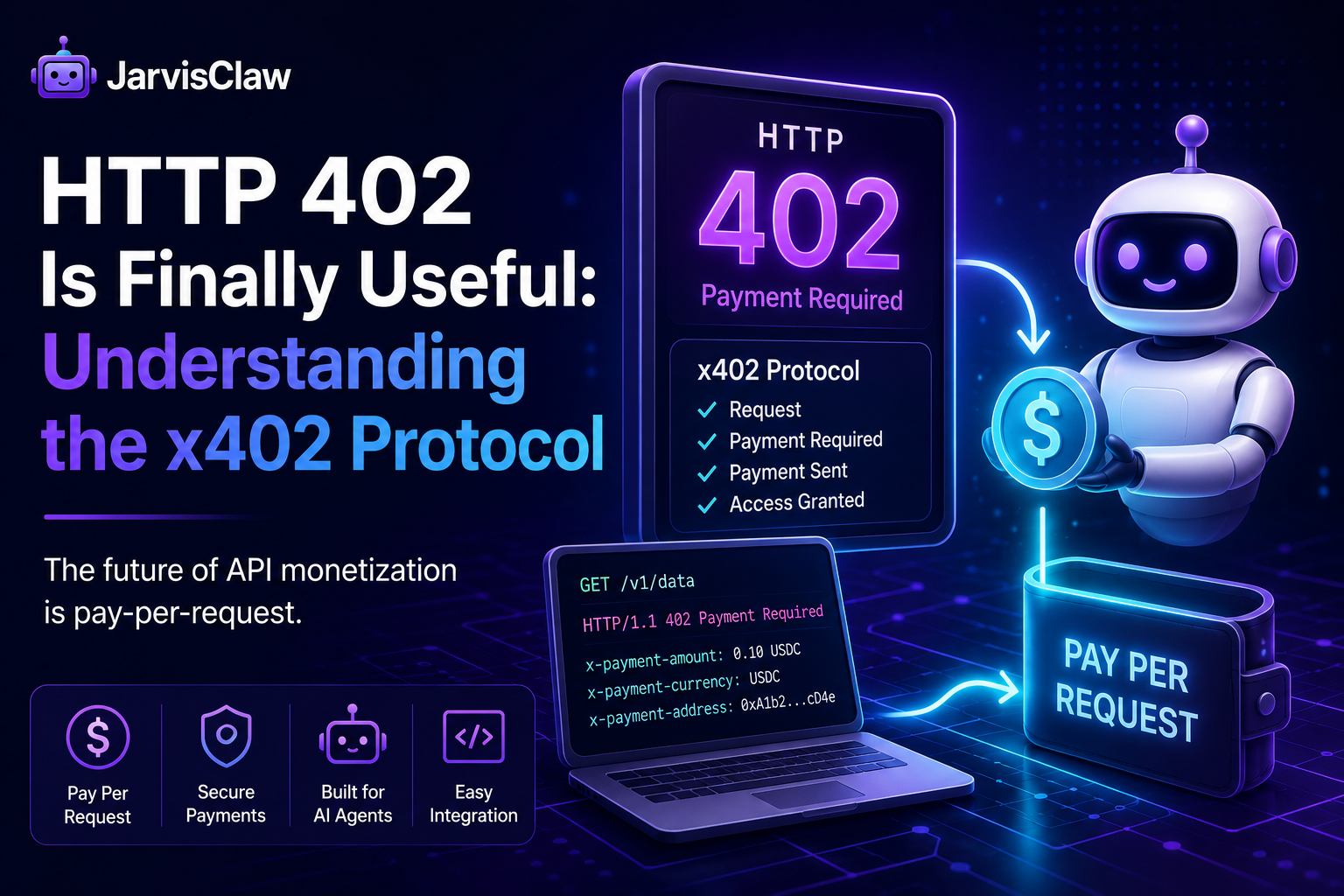
Learn why the HTTP 402 Payment Required status code is finally becoming relevant through the x402 protocol. Discover how x402 enables AI agents to pay for APIs autonomously and how JarvisClaw simplifies implementation.
For decades, the HTTP 402 Payment Required status code has existed as one of the most intriguing parts of the HTTP specification. Developers saw it in documentation, but almost never in production. Unlike 404 (Not Found) or 401 (Unauthorized), HTTP 402 remained largely unused because there was no widely accepted way for web applications to request and verify payments during an API request.
That is beginning to change.
The rise of AI agents, programmable payments, and blockchain infrastructure has created a real need for machine-to-machine commerce. Instead of relying on API keys, subscriptions, or manual billing, applications now need a standard way to pay for digital services automatically.
This is exactly what the x402 protocol was designed to solve.In this guide, we’ll explore why HTTP 402 is finally becoming useful, how the x402 protocol works, and why platforms like JarvisClaw are helping developers build the next generation of AI-native APIs.
What Is HTTP 402?

HTTP 402 is an official HTTP status code called Payment Required.Unlike other HTTP status codes, it was reserved for future use when HTTP was first standardized. However, no universal payment protocol existed to define what should happen after a server returned a 402 response.
As a result, developers rarely implemented it, choosing alternatives such as:
- API keys
- Monthly subscriptions
- Credit systems
- External payment portals
- OAuth authentication
While these methods worked for human users, they weren’t designed for autonomous software capable of discovering and paying for services independently.
Why Traditional API Payments Fall Short
Modern APIs power everything from AI models and image generation to financial data and automation platforms.

Most of them still rely on one of two business models:
- Monthly subscriptions
- Pre-issued API keys
These approaches introduce several challenges:
- Developers must manually register before accessing an API.
- API keys need to be generated, stored, and rotated securely.
- Subscription plans often force customers to pay for unused capacity.
- AI agents cannot independently purchase services when they need them.
As autonomous systems become more common, these limitations create unnecessary friction.
Enter the x402 Protocol
The x402 protocol gives HTTP 402 a practical purpose.
Instead of treating “Payment Required” as an error, x402 turns it into the beginning of a payment negotiation between a client and an API.
When a client requests a premium endpoint without payment, the server responds with HTTP 402 and includes everything needed to complete the transaction.
This transforms HTTP 402 into a programmable payment handshake.
How the x402 Protocol Works
A typical x402 workflow follows these steps:
Step 1: Client Requests a Protected Resource
An application or AI agent sends a request to a paid endpoint.
For example:
GET /v1/generate
The server checks whether payment has been provided.
Step 2: Server Returns HTTP 402
Instead of immediately rejecting the request, the server returns:
HTTP/1.1 402 Payment RequiredThe response includes payment instructions, such as:
- Required payment amount
- Accepted currency (for example, USDC)
- Payment destination
- Transaction metadata
- Verification requirements
The client now knows exactly how to proceed.
Step 3: Client Makes the Payment
Using the provided payment details, the client completes the transaction.
For autonomous AI agents, this process happens automatically without requiring human approval for every request.
This is one of the biggest advantages of x402—it enables software to purchase services independently.
Step 4: Payment Is Verified
The client resubmits the request together with proof of payment.
The server validates:
- The transaction exists.
- The amount is correct.
- The payment hasn’t expired.
- The transaction hasn’t already been used.
Only after successful verification does the request continue.
Step 5: API Returns the Response
Once payment has been confirmed, the API processes the request exactly as it normally would.
The client receives:
- AI inference results
- Search results
- Generated images
- Analytics data
- Any other premium resource
The only difference is that payment happened automatically before access was granted.
Why x402 Matters for AI Agents
The biggest innovation behind x402 isn’t simply charging for APIs.
It’s enabling machine-to-machine commerce.
Imagine an AI research assistant that needs:
- Language translation
- Image generation
- Financial market data
- Weather information
- Document analysis
Instead of requiring five subscriptions and five API keys, the agent can discover these services, pay for each request, and continue its workflow automatically.
This dramatically reduces friction and allows AI systems to become more autonomous.
Benefits of Using x402
Developers adopting x402 can unlock several advantages.
Pay-Per-Request Pricing
Instead of charging monthly fees, APIs can generate revenue from every request.
This creates fairer pricing for both providers and customers.
Simpler Developer Experience
New users don’t need lengthy registration processes before trying an API.
Payment occurs only when they use the service.
Reduced API Key Management
Because payment authorizes access, developers spend less time managing API credentials.
This reduces operational complexity.
Better Monetisation
API providers gain flexible pricing models that scale naturally with usage.
Whether charging fractions of a cent or several dollars per request, x402 supports programmable payments.
AI-Native Infrastructure
Most importantly, x402 was designed for software—not just humans.
That makes it ideal for autonomous AI agents.
Common Use Cases
The x402 protocol is particularly valuable for APIs offering high-value services, including:
- Large Language Models (LLMs)
- Image generation APIs
- Voice synthesis
- Translation services
- Data enrichment
- Financial market APIs
- Premium search
- Geolocation services
- Scientific computing
- Autonomous agent marketplaces
As more digital services move toward consumption-based pricing, x402 provides a standardized way to handle payments.
How JarvisClaw Makes x402 Easier
While the x402 protocol introduces a standard payment workflow, implementing it from scratch still requires payment verification, request validation, transaction management, routing, and infrastructure.
JarvisClaw simplifies this process by acting as an intelligent API gateway for AI-native applications.Instead of embedding payment logic into every endpoint, JarvisClaw sits in front of your services and handles critical infrastructure tasks, including:
- x402 payment validation
- Intelligent request routing
- Automatic retries
- Failover between AI providers
- API management
- Scalable request processing
This allows development teams to adopt x402 without redesigning their existing APIs while preparing their infrastructure for autonomous AI agents.
The Future of HTTP 402
For years, HTTP 402 was little more than a placeholder in the HTTP specification.

Today, the emergence of x402 is finally giving the status code a meaningful role.As AI agents become capable of discovering, purchasing, and consuming services independently, programmable payments will become an essential part of modern API infrastructure.
Developers who embrace x402 today aren’t just adopting a new payment protocol—they’re preparing for a future where software transacts with software seamlessly.
With platforms like JarvisClaw making implementation easier, HTTP 402 is no longer a forgotten status code. It’s becoming the foundation for the next generation of AI-native, pay-per-use APIs.
Conclusion
The x402 protocol transforms HTTP 402 from an unused specification into a practical standard for API monetisation.
By enabling secure, automated, pay-per-request transactions, it removes much of the friction associated with subscriptions and API keys while opening the door to autonomous machine-to-machine commerce.
As the AI ecosystem continues to evolve, developers who adopt x402 will be well positioned to build scalable, AI-native services.
Combined with JarvisClaw’s intelligent routing and payment infrastructure, implementing x402 becomes faster, simpler, and ready for the future of programmable payments.
Start building with JarvisClaw today!!