
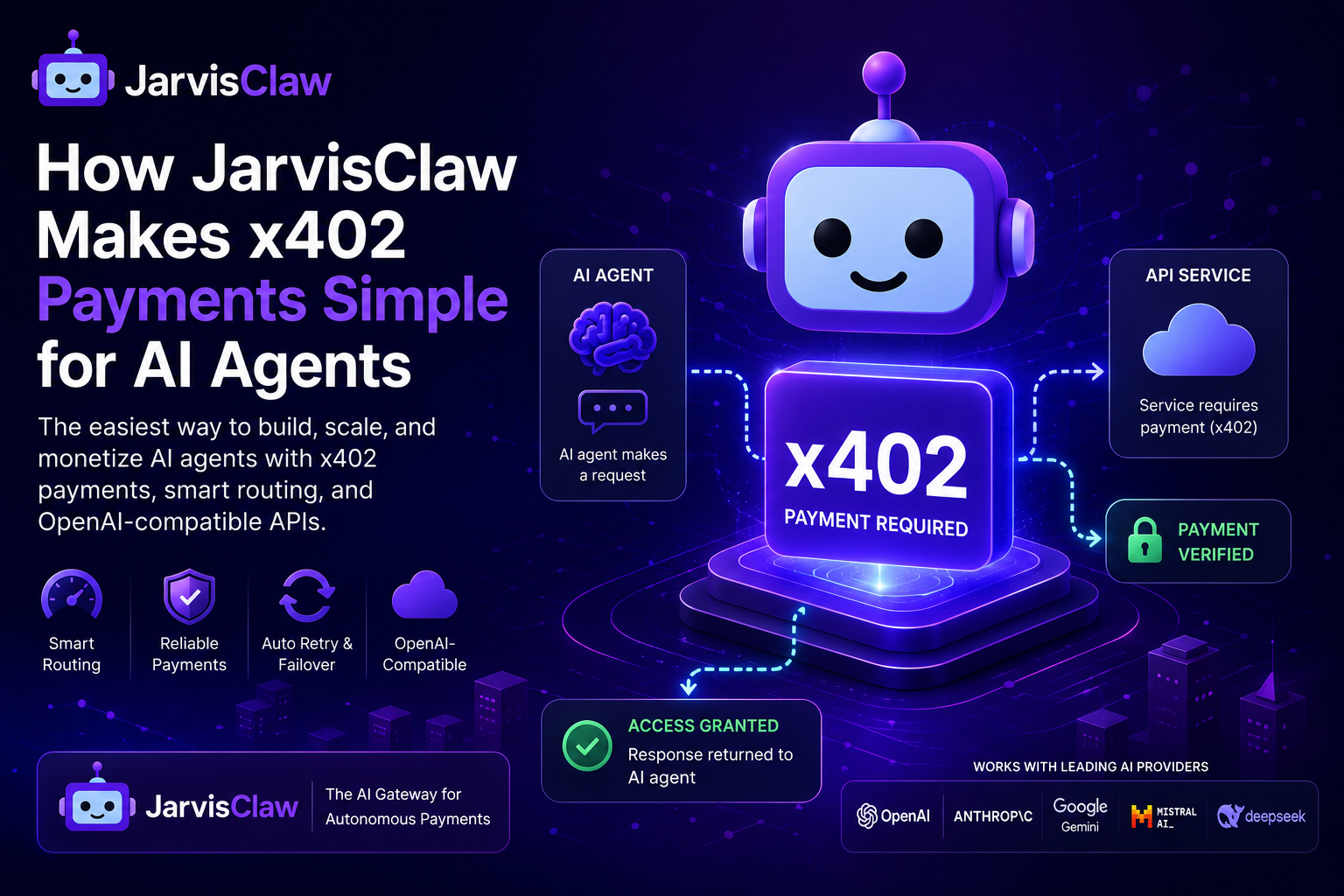

Discover how JarvisClaw simplifies x402 payments for AI agents with automated API routing, AI-native payments, machine-to-machine transactions, and OpenAI-compatible APIs.
How JarvisClaw Makes x402 Payments Simple for AI Agents
Building an AI agent today is easier than ever. Building one that can find services, pay for them automatically, recover from failures, and continue working without human intervention is a completely different challenge.
However, one challenge has remained difficult to solve: how can AI agents securely pay for digital services in real time?Traditional API billing relies on user accounts, API keys, subscriptions, and manual payment methods.
These systems were designed for human developers—not software that needs to purchase services autonomously.
This is where x402 changes everything.
Built on the HTTP 402 Payment Required status code, x402 introduces a standard for machine-to-machine payments, allowing AI agents to pay for APIs and digital services automatically.
But implementing x402 in production still requires developers to manage payment verification, provider integrations, routing logic, retries, and scalable infrastructure.
That’s where JarvisClaw comes in.
JarvisClaw combines OpenAI-compatible APIs, intelligent request routing, and x402-ready infrastructure into a unified platform that helps developers build AI-native applications faster.
Instead of worrying about the complexity behind autonomous payments, developers can focus on building intelligent AI products.
The Hidden Complexity Behind x402
Many developers assume implementing x402 simply means accepting payments before returning an API response.

In reality, production-ready AI systems require much more.
A typical autonomous AI agent may interact with multiple services during a single task:
- Language models
- Search APIs
- Vector databases
- Code execution tools
- Translation services
- Document analysis APIs
- Image generation models
Each request introduces new challenges.
What happens if a provider is unavailable?
What if a payment succeeds but the API request fails?
How should an agent choose between multiple AI providers offering similar capabilities?
How do you monitor thousands of paid API requests?These are infrastructure problems—not payment problems.
Why Building Everything Yourself Doesn’t Scale
Many development teams initially try to build their own AI gateway.
That usually means creating separate systems for:
- Provider integrations
- Authentication
- Smart routing
- Retry mechanisms
- Logging
- Monitoring
- Usage tracking
- Payment verification
- Failover handling
As more AI providers are added, maintenance becomes increasingly expensive.
Every new model introduces another API to integrate, another authentication method, another billing system, and another failure scenario.
Instead of shipping features, engineering teams spend months maintaining infrastructure.
How JarvisClaw Simplifies the Entire Workflow
JarvisClaw removes much of this operational burden by acting as a unified AI gateway.
Instead of connecting directly to multiple providers, your application connects once to JarvisClaw.
From there, JarvisClaw handles the heavy lifting behind the scenes.
Unified OpenAI-Compatible API
One of JarvisClaw’s biggest advantages is its OpenAI-compatible interface.
Developers don’t need to rewrite their applications when switching AI providers.
A single integration gives access to multiple models while preserving a familiar API experience.
This dramatically reduces migration costs and simplifies long-term maintenance.
Smart Routing for Better Performance
Not every request should go to the same AI model.Some models excel at reasoning.
Others are faster.Others provide lower costs.
JarvisClaw intelligently routes requests based on your application’s needs, allowing developers to optimise for performance, latency, availability, or pricing without changing application code.
This becomes especially valuable when AI agents are making thousands of requests every day.
Automatic Retry and Provider Failover
AI applications cannot simply stop working because one provider experiences downtime.
Imagine an autonomous research agent analysing financial reports.
Halfway through processing thousands of documents, one AI provider becomes unavailable.
Without failover, the entire workflow fails.With JarvisClaw, failed requests can automatically retry or switch to another compatible provider, improving reliability while reducing operational risk.
This resilience is essential for enterprise-grade AI systems.
A Typical Workflow Using JarvisClaw
Here’s how an AI agent interacts with paid AI services using JarvisClaw:
Step 1: The AI agent sends a request through JarvisClaw.
Step 2: JarvisClaw selects the most appropriate AI provider.
Step 3: If the destination service requires x402 payment, the payment workflow is initiated.
Step 4: Payment verification is completed automatically.
Step 5: The provider processes the request.
Step 6: JarvisClaw returns the response to the application.
If a provider fails during the process, JarvisClaw can reroute the request without requiring developers to implement custom recovery logic.
Why Developers Are Choosing JarvisClaw
Modern AI applications require much more than access to a language model.
Developers increasingly need:
- OpenAI-compatible APIs
- Multi-provider AI access
- AI gateway infrastructure
- Smart model routing
- High availability
- x402 payment support
- Observability and monitoring
- Enterprise scalability
JarvisClaw brings these capabilities together in one platform.Instead of stitching together multiple services, developers gain a single entry point for building production-ready AI applications.
Real-World Use Cases
JarvisClaw is well suited for organisations building the next generation of AI-powered products.
Examples include:
- Autonomous coding assistants purchasing specialised developer tools.
- AI research platforms accessing premium knowledge APIs.
- Enterprise AI copilots using multiple foundation models.
- Multi-agent systems exchanging paid services automatically.
- AI marketplaces built around pay-per-request business models.
As agentic commerce continues to evolve, these use cases are becoming increasingly common.
Future-Proof Your AI Infrastructure
The AI ecosystem is moving quickly.New models, providers, payment standards, and autonomous workflows are emerging every month.
Building tightly coupled integrations today often leads to expensive rewrites tomorrow.
JarvisClaw helps future-proof your architecture by providing a unified layer between your application and the rapidly evolving AI ecosystem.
Whether new providers are introduced or x402 adoption accelerates, your application remains flexible without major infrastructure changes.
Final Thoughts
x402 is helping redefine how AI agents purchase and consume digital services, but payment protocols alone don’t solve the operational challenges of modern AI systems.
Reliable AI applications also need intelligent routing, provider failover, unified APIs, monitoring, and scalable infrastructure.
That’s where JarvisClaw stands out.By combining OpenAI-compatible APIs, smart routing, resilient request handling, and support for x402-powered workflows, JarvisClaw enables developers to spend less time managing infrastructure and more time building innovative AI products.If your goal is to create AI agents that can work autonomously, scale reliably, and take advantage of emerging AI-native payment standards, JarvisClaw provides the infrastructure to make it happen.