
A crypto application can find the right swap route, prepare the transaction, and obtain the user’s approval—then fail because the wallet does not hold the chain’s native gas token.
The user may own USDC on Base but have no ETH. An automated trading agent may control the token it needs to exchange but lack a reliable method for acquiring gas before every transaction. For consumer applications, this extra requirement creates abandoned transactions. For autonomous agents, it becomes an operational dependency.
A gasless swap API removes that dependency from the user-facing workflow.
Instead of asking the user or agent to construct and broadcast an on-chain transaction, the API returns structured trade data for signing. A relayer then submits the authorized transaction and pays the network gas.
JarvisClaw provides a DEX Trading API built around 0x routing, Permit2 and Gasless V2. It can search liquidity across more than 100 decentralized exchanges and expose quoting, Permit2 execution, gasless submission and transaction-status functions through a common API layer.
What “Gasless” Actually Means
A gasless swap does not mean that the blockchain processes a transaction for free.
Every confirmed on-chain transaction consumes network resources, and someone must pay the validator or sequencer fee. “Gasless” means the relayer pays that network fee when it broadcasts the signed trade.
The user does not need to hold the chain’s native token at the moment of execution.
That distinction matters because a gasless swap can still involve:
- An API usage fee
- A spread between quoted and executed prices
- Price impact
- Slippage
- Liquidity-provider or protocol fees
- A previous token-approval transaction
- A relayer or routing cost built into the execution terms
JarvisClaw’s DEX documentation currently lists every DEX endpoint as billable and advises developers to read the response’s price.amount field for the exact platform charge. Gasless execution removes the network-gas requirement for supported trades, not the API charge or the economic costs of the swap itself.
A more accurate product message is therefore:
Trade without requiring the taker to hold native gas tokens.
That is clearer than promising a “free swap.”
How a Relayed Crypto Trade Works
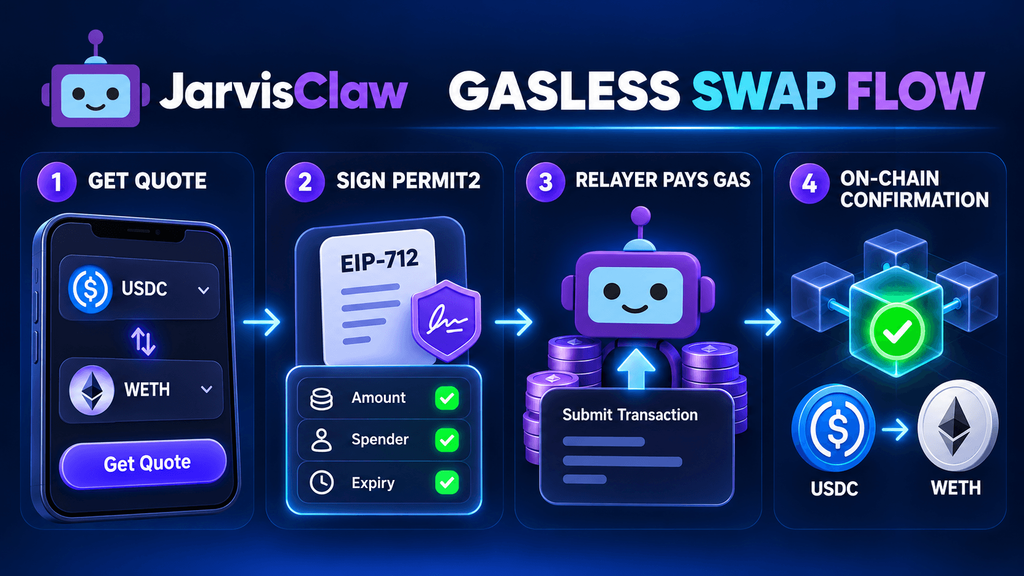
A conventional DEX integration usually asks the user’s wallet to sign and broadcast a transaction. A gasless workflow separates authorization from broadcasting.
The typical sequence is:
- The application requests an indicative price.
- The API calculates a route across available liquidity sources.
- The application requests an executable quote.
- The wallet signs structured trade authorization.
- The signed trade is submitted to the gasless endpoint.
- A relayer verifies the signature and broadcasts the transaction.
- The application checks the trade status until it is confirmed or failed.
With this design, the private key remains in the user’s or agent’s wallet. The relayer receives signed permission to execute the specified trade; it does not need custody of the wallet.
JarvisClaw’s documented gasless submission endpoint is:
POST /v1/marketplace/dex/gasless/submitThe request includes the complete trade object obtained from the quote response and an EIP-712 signature from the taker wallet.
A simplified request resembles:
{
  "trade": {
    "chainId": 8453,
    "sellToken": "0xSellTokenAddress",
    "buyToken": "0xBuyTokenAddress",
    "sellAmount": "1000000",
    "buyAmount": "384500",
    "to": "0xExchangeContract",
    "data": "0x...",
    "permit2": {
      "details": "..."
    }
  },
  "signature": "0xSignedTypedData"
}
If accepted, the response returns a tradeHash and submission status. The trade can then be monitored through:
GET /v1/marketplace/dex/gasless/status/:tradeHashDocumented status values include submitted, pending, confirmed, and failed. A confirmed response may also contain the blockchain transaction hash, block number and gas used.
Why Permit2 Is Part of the Workflow
Permit2 allows token-transfer permissions to be expressed through signed messages rather than requiring a new unlimited approval for every application.
In a gasless workflow, the wallet signs structured EIP-712 data describing what it authorizes. The signature can include restrictions such as the token, amount, spender and expiration.
This creates a better experience for automated applications because the agent can authorize a defined action without blindly handing over its private key or relying on an unrestricted approval.
However, Permit2 should not be treated as automatic safety.
Before signing, the application must verify:
- The expected chain ID
- The sell and buy token addresses
- The exact sell amount
- The minimum acceptable output
- The authorized spender
- The signature deadline
- The quote’s expiry time
- The destination wallet
- Any approval amount already granted
A signature is not “just a login.” It can authorize movement of assets. Displaying or validating these fields before signing is a necessary security control.
Price, Quote and Submission Are Different Steps
A reliable integration should not treat every response as an executable trade.
JarvisClaw documents separate DEX endpoints for indicative prices, firm quotes, Permit2 execution, gasless submission and status monitoring.
| Stage | Purpose | Production rule |
|---|---|---|
| Price | Estimate expected output | Use for comparison, not execution |
| Quote | Obtain current route and signing data | Validate amount, expiry and slippage |
| Signature | Authorize the defined trade | Sign only verified EIP-712 fields |
| Submit | Send the signed trade to the relayer | Store the returned trade hash |
| Status | Track execution result | Do not assume submission means success |
This separation prevents a common implementation mistake: showing one price to the user and executing a stale quote later.
Quotes can expire. Liquidity can move. Gasless eligibility can change between tokens and networks. An application should refresh the quote immediately before requesting the signature.
A Practical Integration Pattern
The DEX API base path is:
https://api.jarvisclaw.ai/v1/marketplace/dexA production workflow should follow this pattern:
- Request a price using the sell token, buy token, amount and chain.
- Compare the returned output with your minimum acceptable result.
- Request a firm gasless or Permit2 quote.
- Validate every token address and amount against the original order.
- Ask the wallet to sign the supplied typed data.
- Submit the complete quote object and signature without modifying them.
- Save the
tradeHashin your database. - Poll the status endpoint with a reasonable interval.
- Mark the order complete only after receiving
confirmed. - Reconcile the actual received amount from the confirmed transaction.
Do not automatically resubmit a trade simply because a status request times out. The first submission may already be pending. Blind retries can create duplicate execution attempts or inconsistent application records.
Use an idempotency layer in your own system by tying each intended trade to an internal order ID, wallet, quote identifier and trade hash.
Gasless Swaps for AI Agents
Gasless execution is especially relevant to autonomous agents.
A portfolio agent may need to rebalance small positions across different networks. Requiring it to maintain a native gas balance on every chain adds treasury management, price exposure and failure conditions unrelated to its actual goal.
A relayed workflow allows the agent to:
- Request quotes programmatically
- Compare available routes
- Reject trades above a price-impact limit
- Sign a tightly scoped authorization
- Submit the trade without sourcing a native gas token
- Monitor execution until final confirmation
The agent should still operate under hard controls.
For example:
Maximum trade value: $100
Maximum price impact: 0.75%
Maximum slippage: 0.50%
Approved chains: Base
Approved tokens: USDC, WETH
Signature expiry: 3 minutes
Human approval required above: $50
These rules should be implemented in code, not left only in a natural-language prompt.
JarvisClaw supports API-key authentication as well as x402-based payment flows. Its broader platform is designed for both conventional applications and agents that purchase API calls programmatically. The platform documentation describes x402 payments in USDC on Base and Solana, while the blockchain network used for the actual swap is determined separately by the swap request and upstream router.
Hidden Costs and Failure Cases to Check
The largest expense in a swap is not always gas.
For a large order or thin liquidity pair, price impact can exceed the network fee. For a small order, the API charge, relayer economics and minimum executable amount may matter more.
Before launching, test:
- Thin-liquidity token pairs
- Rapidly moving markets
- Expired quotes
- Invalid or reused signatures
- Insufficient token balance
- Missing Permit2 approval
- Unsupported gasless tokens
- Incorrect token decimals
- Relayer delays
- Submitted trades that later fail
- Status-endpoint interruptions
- Chain reorganizations and confirmation depth
Also separate three concepts in the interface: API price, estimated swap output and network execution status. Combining them into one “cost” value makes debugging and reconciliation difficult.
When to Use a Gasless Swap API
Gasless swaps are a strong fit for:
- Wallets onboarding users without native gas tokens
- AI agents performing rule-based rebalancing
- Consumer apps hiding blockchain complexity
- Payment apps converting stablecoins
- Trading dashboards adding executable swaps
- Automated treasury workflows
- Games and social applications with embedded wallets
They may be unnecessary when every user already maintains native gas, transaction volume is low, or the application needs full control over transaction broadcasting.
The goal is not to hide every blockchain detail. It is to remove a fragile prerequisite while keeping authorization transparent and non-custodial.
Build the Workflow Around Verification
A good gasless experience feels simple: choose a trade, sign once and wait for confirmation.
The infrastructure behind it should be stricter.
Validate the quote, limit slippage, inspect the Permit2 authorization, use short signature deadlines, record the trade hash, monitor the final transaction and reconcile the received amount.
JarvisClaw brings DEX routing, Permit2 and gasless submission into a common API environment. Developers can use it to build wallet applications and agent workflows without integrating liquidity venues and relayer infrastructure separately.
Explore the JarvisClaw API Marketplace and review the DEX Trading API documentation before using relayed trades in production.
FAQ
What is a gasless swap API?
A gasless swap API lets a user authorize a token trade with a cryptographic signature while a relayer broadcasts the transaction and pays the network gas.
Are gasless swaps completely free?
No. The user may avoid paying native network gas directly, but API fees, price impact, slippage, liquidity fees or relayer-related costs can still apply.
Does the relayer control the user’s wallet?
No. In a properly implemented non-custodial flow, the wallet signs authorization for defined trade parameters. The private key remains with the user or agent.
What is Permit2?
Permit2 is a token-approval and signature system that lets wallets authorize specified token transfers using structured signed data. Developers should verify the amount, spender, token and deadline before requesting a signature.
Does a submitted gasless swap mean the trade succeeded?
No. Submission only means the relayer accepted the signed trade. Applications should monitor the status until it becomes confirmed or failed.
Can AI agents execute gasless swaps?
Yes. An agent can request a quote, enforce price and risk limits, sign a scoped authorization, submit the trade and monitor confirmation. Spending and token restrictions should be enforced in code.
Which DEXs does JarvisClaw support?
JarvisClaw describes best-execution routing across more than 100 decentralized exchanges through the upstream 0x routing infrastructure. Actual liquidity and network availability should be checked at request time.
What should developers store after submission?
Store the internal order ID, wallet address, quote data, signature deadline, tradeHash, eventual transaction hash, execution status and actual token amounts.