
Prediction markets turn opinions about future events into measurable prices.
For developers, however, retrieving that information is more difficult than displaying a probability on a dashboard. Different venues use different market identifiers, schemas, pagination methods, price formats, order books, and settlement rules.
An application that compares Polymarket with Kalshi may need separate integrations before it can answer a basic question: are these two contracts actually pricing the same event?
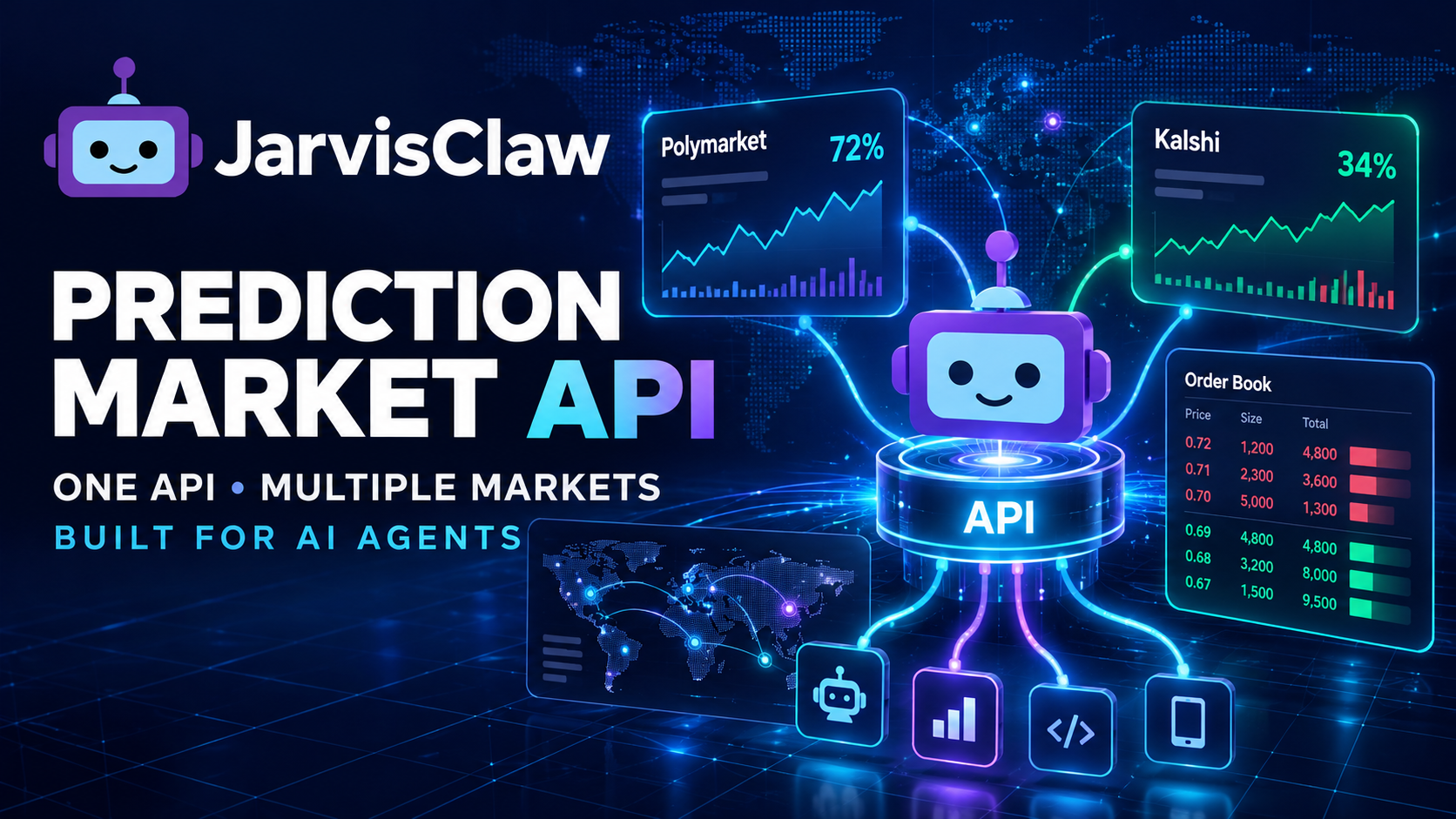
The JarvisClaw Prediction Market API brings market data from multiple prediction venues into one developer workflow. Apps and AI agents can search markets, inspect prices, retrieve trades and order books, analyze wallet activity, and compare similar contracts without building a new connector for every platform.
This makes the API useful for much more than a simple odds page. It can support market-monitoring systems, research agents, event dashboards, cross-venue comparison tools, trader analytics, and automated alert workflows.
What Data Can Developers Access?
JarvisClaw provides access to prediction-market data across venues including Polymarket, Kalshi, Limitless, Opinion, Predict.Fun, and supported sports feeds.
The available data includes:
- Open and historical markets
- Events and market categories
- Yes and no outcome prices
- Trading volume and open interest
- Current and historical order books
- Completed trades
- OHLC candlestick data
- Market price history
- Wallet activity and positions
- Trader leaderboards
- Smart-money screening
- Cross-venue market search
- Binance price data for market context
- UMA market-resolution information
Instead of maintaining separate authentication and data-normalization code for each source, developers can access these capabilities through the JarvisClaw prediction-market base URL:
https://api.jarvisclaw.ai/v1/marketplace/predictionThe platform also provides the equivalent /v1/prediction/ alias for supported routes.
Start With Cross-Venue Market Search
The most practical starting point is not downloading every market from every venue. It is searching by topic.
For example:
curl "https://api.jarvisclaw.ai/v1/marketplace/prediction/markets/search?q=bitcoin" \
  -H "Authorization: Bearer sk-your-api-key"
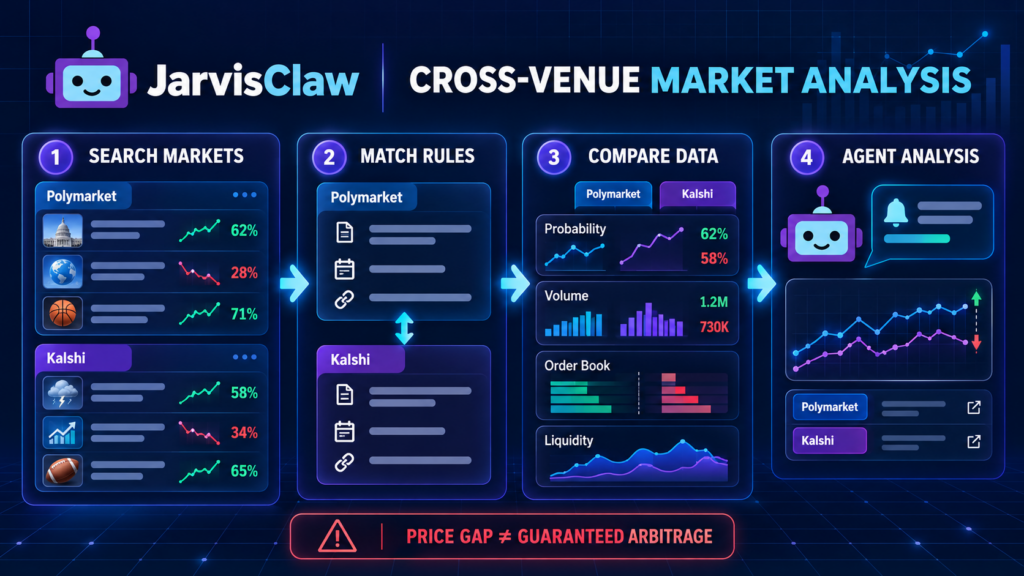
A search can return potentially related markets from different providers. Your application can then compare their titles, outcome prices, volume, close times, and identifiers.
This workflow is useful for:
- Finding all markets related to one event
- Building a unified prediction-market search engine
- Monitoring political, economic, crypto, or sports topics
- Giving an AI agent a smaller set of relevant contracts to analyze
- Identifying possible cross-venue pricing differences
Searching first also reduces unnecessary API calls. Instead of repeatedly listing thousands of unrelated contracts, the application narrows the market set before requesting deeper data.
Do Not Treat Similar Titles as Identical Markets
Cross-venue comparison is one of the most attractive prediction-market use cases—and one of the easiest to implement incorrectly.
Two contracts can look similar while having different:
- Expiration times
- Geographic scope
- Data sources
- Resolution authorities
- Price thresholds
- Definitions of “before,” “by,” or “during”
- Cancellation rules
- Treatment of delayed or disputed events
For example, “Will Bitcoin reach $150,000 in 2026?” is not necessarily equivalent to “Will Bitcoin close above $150,000 before January 1, 2027?”
One market may resolve based on an intraday price from a named exchange. Another may require an official daily closing value. A visible price gap between them is not automatically an arbitrage opportunity.
Before comparing prices, normalize:
- The underlying event
- The outcome definition
- The deadline and timezone
- The resolution source
- The settlement rules
- The available liquidity
- The trading and withdrawal costs
This semantic matching step is where AI agents can add value. A model can compare contract language and flag differences, but deterministic rules should still verify dates, thresholds, and resolution conditions.
Build a Market Monitoring Dashboard
A practical dashboard does not need every available endpoint.
Start with four data layers:
| Layer | Data Needed | Purpose |
|---|---|---|
| Discovery | Market search and listings | Find relevant markets |
| Snapshot | Current outcome prices and volume | Show current market state |
| Depth | Order books and trades | Measure liquidity and execution risk |
| History | Candlesticks and volume series | Display movement over time |
For a Polymarket dashboard, a developer might first retrieve active markets:
curl "https://api.jarvisclaw.ai/v1/marketplace/prediction/polymarket/markets?sort=volume&limit=50&status=open" \
  -H "Authorization: Bearer sk-your-api-key"
The application can then request price history, candlesticks, order books, or trades only when a user opens an individual market.
This staged approach reduces calls and improves page speed. It also prevents the frontend from loading large historical datasets that the visitor may never view.
Compare Prices Without Creating False Arbitrage Alerts
A price difference is only the beginning of an analysis.
Suppose one venue prices a “Yes” outcome at 0.41 and another prices a similar contract at 0.38. The three-point difference may appear actionable, but an alert system should also check:
- Whether the contracts have identical resolution criteria
- Whether enough liquidity exists at the displayed price
- Whether the displayed value is a midpoint or executable quote
- Whether fees remove the potential spread
- Whether funds can be deployed on both venues
- Whether settlement dates differ
- Whether one market is stale
The order book matters because a displayed probability does not guarantee that the required position size can be filled at that price.
A better alert might say:
Two semantically similar markets show a 3.0-point probability difference. Contract definitions appear aligned, but available depth supports only $250 near the quoted price.
That is more useful than claiming that the system has found guaranteed arbitrage.
Add Prediction Data to an AI Research Agent
Prediction-market prices can become one signal inside a wider research workflow.
An AI agent could:
- Search for markets related to a company, election, sporting event, or economic release.
- Retrieve current prices, historical movement, volume, and open interest.
- Compare similar contracts across venues.
- Retrieve relevant news or market-price data.
- Explain what changed and which evidence may have influenced the market.
- Produce a cited summary or send an alert.
A useful prompt might be:
Find prediction markets related to the next US interest-rate decision.

Compare similar contracts across available venues.

Show current prices, recent movement, volume, close time, and material differences in resolution rules.

Do not describe a price difference as arbitrage unless the contract definitions and executable liquidity have been checked.
This prompt sets important analytical boundaries. It tells the agent to compare evidence instead of merely repeating a headline probability.
Track Wallets and Smart-Money Activity Carefully
JarvisClaw exposes wallet-level analytics for supported Polymarket data, including activity, positions, identity resolution, clustering, leaderboards, and smart-money screening.
This can support:
- Following historically profitable accounts
- Monitoring position changes
- Finding traders active in a particular market
- Comparing realized profit, ROI, volume, and trade count
- Detecting clusters of related wallet behavior
However, “smart money” should not be treated as a buy or sell signal by itself.
A profitable wallet may hedge elsewhere, trade at a different entry price, use multiple addresses, or hold information that is no longer current. Wallet analysis is most useful as a research filter, not an instruction to copy a trade.
Developers should show the criteria used to classify a wallet. For example:
- Minimum realized profit
- Minimum total profit
- Minimum ROI
- Minimum trade count
- Minimum trading volume
This prevents the label from becoming an unexplained ranking.
Use Historical Data for More Than Charts
Candlesticks, trades, order books, and volume history can reveal how a market changed—not just where it is now.
Useful derived metrics include:
- Probability change over one hour, one day, or one week
- Volume spikes
- Spread changes
- Order-book imbalance
- Liquidity concentration
- Price movement before and after a news event
- Divergence between prediction prices and related asset prices
For crypto-related prediction markets, Binance candle and tick data can provide additional context. A developer might compare a Bitcoin prediction contract with spot-price movement around the same time window.
Historical endpoints commonly use Unix timestamps. Store all internal timestamps in UTC and convert them only in the presentation layer. This avoids subtle errors when contracts refer to different timezones.
Authentication and Pay-Per-Call Access
JarvisClaw supports two access methods for paid API calls.
API Key
Send a standard Bearer token:
Authorization: Bearer sk-your-api-keyThis is the simplest approach for web applications, backend services, and dashboards.
Direct x402 Payment
An autonomous agent can use its own compatible wallet to authorize a pay-per-call USDC payment. The SDK handles the HTTP 402 challenge, signature, and retry flow.
This approach is suitable for agents that need to purchase data without managing a separate subscription or provider account.
Prediction-market requests are priced per call. Check the live API catalogue before production deployment because pricing and endpoint availability can change. Current JarvisClaw pages describe prediction-market access as pay-per-call with x402 settlement.
Production Checklist
Before launching a prediction-market application, verify:
- Market identifiers are stored with the provider name.
- Timestamps are normalized to UTC.
- Prices are labeled as probabilities, not guaranteed forecasts.
- Similar contracts are compared by rules, not titles alone.
- Order-book depth is checked before showing executable opportunities.
- API responses are cached according to the required freshness.
- Failed requests use limited retries with backoff.
- Wallet or API spending limits are configured.
- API keys remain in server-side storage.
- Alerts include the market source and retrieval time.
- Delisted or resolved markets are handled correctly.
- Trading actions require separate authorization and compliance checks.
The last point is important: accessing market data is different from placing trades. A data API can inform a trading workflow, but execution introduces venue accounts, wallet permissions, jurisdictional restrictions, and additional risk controls.
Build With Prediction Data, Not Just Prediction Prices
The simplest prediction-market product displays a number.
The more useful products explain what the number represents, how it changed, how much liquidity supports it, and whether another venue is pricing the same event differently.
JarvisClaw gives developers and AI agents one workflow for searching markets, retrieving prices and history, analyzing order books, monitoring wallets, and comparing prediction venues.
Start with a narrow use case. Choose one topic, retrieve the relevant markets, normalize the contract terms, and add deeper data only when it improves the user’s decision.
Explore the JarvisClaw Prediction Market API and review the Prediction Markets API documentation before moving a production workload.
FAQ
What is a prediction market API?
A prediction market API gives applications structured access to markets about future events, including contract details, outcome prices, volume, trades, order books, and historical data.
Which prediction markets does JarvisClaw support?
Current JarvisClaw pages list Polymarket, Kalshi, Limitless, Opinion, Predict.Fun, and supported sports-market data, with additional Binance and UMA data for context and resolution analysis.
Can I search multiple prediction venues in one request?
Yes. The cross-venue market search endpoint allows developers to search supported providers by keyword or topic.
Can the API be used to find arbitrage opportunities?
It can identify price differences between potentially similar markets. Developers must still verify contract definitions, settlement rules, liquidity, fees, timing, and execution availability before treating a difference as actionable.
Does the API include historical data?
Yes. Supported endpoints include candlesticks, trades, volume history, price history, and historical order-book snapshots.
Can I track prediction-market wallets?
Supported Polymarket endpoints include wallet activity, positions, identity resolution, clustering, leaderboards, holder analytics, and smart-money screening.
Is prediction-market price the same as a real-world probability?
No. The price reflects the market’s current trading conditions. Liquidity, participant composition, fees, information availability, and contract rules can affect it.
How is the API authenticated?
Developers can use a JarvisClaw API key. Compatible autonomous agents can also pay directly through the x402 wallet-payment flow.
Does the Prediction Market API place trades?
The article focuses on market-data endpoints. Data access should not be confused with trade execution. Trading requires separate permissions, risk controls, and compliance review.
How much does the Prediction Market API cost?
Requests are billed per call. Check the live JarvisClaw product page and API catalogue for the current price rather than hard-coding a rate into your application.